Measuring coating thickness on PCBs is harder than most people expect
Eddy current thickness measurement often gives unreliable results on PCBs. Ground planes, copper density, component proximity and board construction can distort readings, even when the coating itself is consistent.
This insight highlights a common issue: teams trust the number on the gauge without questioning whether the measurement method is valid for that specific PCB.
Quick take. Eddy current measurement works well on flat, conductive substrates — but on complex PCBs it can be misleading. Measurement strategy matters more than the tool itself.
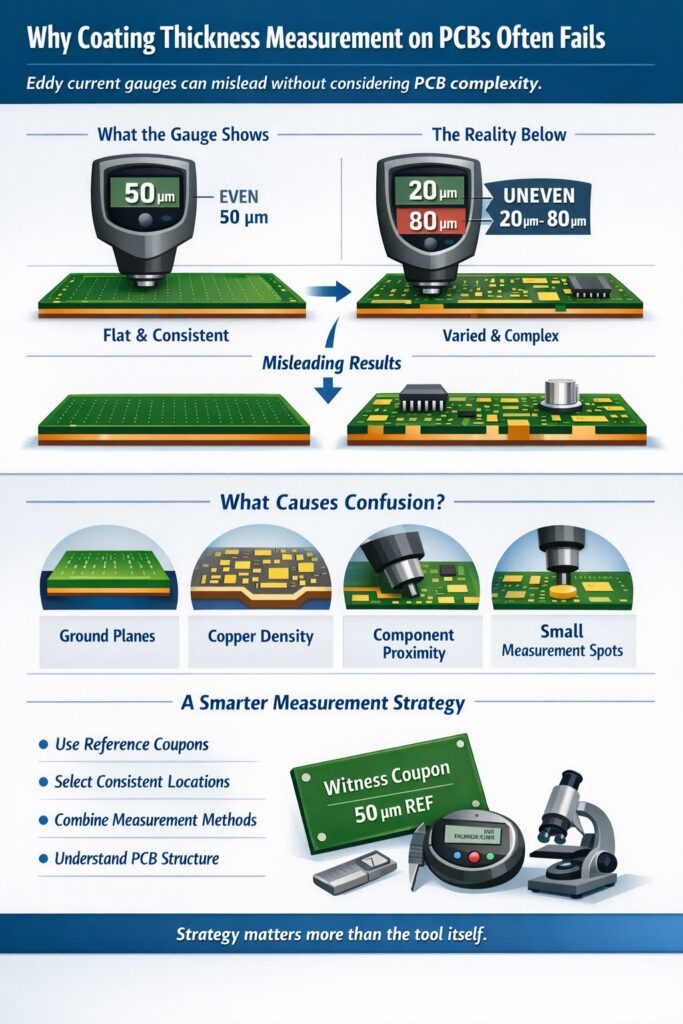
Eddy current coating thickness measurements on PCBs can be misleading due to ground planes, copper density, component proximity and measurement location — making strategy more important than the tool.
Why this matters
Thickness measurement is often treated as a simple validation step: apply coating, measure thickness, confirm compliance. In reality, this step is frequently one of the weakest points in the entire process.
On PCBs, the structure beneath the coating is highly variable. Ground planes, copper layers, tracks, pads and components all influence how measurement devices respond. As a result, two readings taken a few millimetres apart can differ significantly, even when the coating thickness is consistent.
This creates a dangerous situation where good coating processes appear inconsistent, and operators begin adjusting the process to match incorrect data.
The pattern we see again and again
In many production environments, an eddy current gauge is used across the PCB surface without considering where measurements are being taken. Readings are then averaged or compared directly to specification limits.
- Measurements taken over ground planes show different values to those over sparse copper areas.
- Readings near components are distorted by geometry and proximity.
- Operators see variation and assume the coating process is unstable.
- Process adjustments are made to correct what is actually a measurement problem.
This leads to unnecessary process changes, inconsistent results and reduced confidence in the coating line.
Why eddy current struggles on PCBs
Eddy current measurement relies on electromagnetic interaction with conductive substrates. On simple, uniform surfaces, this works well. On PCBs, the situation is far more complex.
- Internal copper planes affect signal response.
- Track density varies across the board.
- Component proximity alters probe behaviour.
- Small measurement areas amplify local variation.
The result is not necessarily incorrect measurement — but highly context-dependent measurement that must be interpreted carefully.
Practical warning sign. If thickness readings vary significantly across the same PCB but visual coating quality looks consistent, the issue is often measurement reliability rather than coating variation.
A more reliable way to approach measurement
Instead of relying on random PCB measurements, a more robust approach is to define a measurement strategy.
- Use consistent measurement locations where possible.
- Understand how PCB structure affects readings.
- Use witness coupons to provide repeatable reference values.
- Combine measurement methods rather than relying on one tool.
This approach separates true process variation from measurement artefacts.
What This Means in Practice
If your thickness readings do not make sense, the first step is not to adjust the coating process. It is to question whether the measurement method is appropriate for that PCB.
For related process control topics, see Conformal Coating Processes Hub, Inspection & Quality Hub, and De-wetting in Conformal Coating.
In many cases, a simple change in measurement strategy resolves what appears to be a coating problem.
Why Choose SCH Services?
SCH supports customers with practical coating process validation, measurement strategy and operator training. If your coating thickness data is inconsistent or difficult to interpret, we can help define a more reliable approach based on your specific assemblies and process.
This is often where better measurement removes unnecessary process changes.