Mon - Thur 7.30-15.30   Fri 7.30-14.00

Why Parylene Dimer Purity Defines Coating Performance


Clean chemistry, flawless coatings

Behind every reliable Parylene coating lies the dimer β€” a crystalline, purified precursor that drives the entire deposition process. Parylene dimer purity is the single most critical factor in achieving flawless polymerisation, electrical performance and long-term reliability.

When sublimed and cleaved under vacuum, the dimer becomes a reactive monomer that polymerises onto every exposed surface, forming a perfectly conformal, pinhole-free film.

But that level of precision depends on one factor above all others: purity.

How impurities affect coating quality

Even trace contamination in a Parylene dimer can have major consequences. Impurities such as moisture, oxygen, halogens, metal residues or unreacted intermediates can:

  • Reduce dielectric strength by interrupting polymer chain growth
  • Cause discolouration or haziness in the deposited film
  • Lead to pinholes, voids, and residues during sublimation and pyrolysis
  • Trigger uneven coating thickness or adhesion issues

Because the Parylene process amplifies any chemical irregularity during polymerisation, even parts-per-million contaminants can result in visible or electrical defects.

Why SCH focuses on ultra-pure feedstock

SCH Services Ltd sources and supplies high-purity Parylene dimers for advanced electronics, aerospace, and medical applications. Each batch undergoes controlled crystallisation, vacuum drying and contamination screening to ensure complete chemical consistency.

Our commitment to purity extends beyond production β€” it’s independently verified.

Independent SGS verification

Independent SGS testing throughout 2025 confirmed that all SCH Parylene materials β€” including Parylene N, C, D and fluorinated F (AF-4) β€” contain no detectable Substances of Very High Concern (SVHCs), polycyclic aromatic hydrocarbons (PAHs), or PFOS/PFOA compounds to ppm-level detection limits.

Fluorinated grades also meet full RoHS 2.0 (2015/863) compliance.

This independent verification demonstrates ultra-high-purity feedstock (>99.9 % equivalent), ensuring stable polymerisation, high dielectric performance, and pinhole-free coatings across the entire SCH Parylene range.

Performance benefits of high-purity Parylene

  • Improved dielectric strength and insulation resistance
  • Cleaner surface finish with no whitening or carbonised residue
  • Consistent film uniformity across complex geometries
  • Reduced risk of adhesion failures and outgassing
  • Enhanced long-term reliability under thermal or chemical stress

Certified materials for demanding industries

Whether you’re coating aerospace PCBs, medical implants, or automotive sensors, the purity of the dimer defines the quality of the final coating.

SCH’s independently tested materials ensure regulatory compliance, consistent film quality and traceable supply.

Frequently Asked Questions: Parylene Dimer Purity

Why does Parylene dimer purity matter?

Parylene dimer purity directly affects polymerisation, dielectric strength, film uniformity and long-term reliability. Even trace contaminants can disrupt chain growth, leading to pinholes, discolouration, adhesion loss or electrical instability.

What impurities cause problems in Parylene coatings?

Common problematic impurities include moisture, oxygen, halogens, metal residues and unreacted intermediates. These can cause voids during sublimation, hazy films, uneven thickness and reduced insulation resistance.

Can low-purity Parylene dimer still meet thickness targets?

Yes β€” but thickness alone does not guarantee performance. Low-purity dimers may reach nominal thickness while still producing coatings with reduced dielectric strength, pinholes or long-term reliability failures.

How does dimer purity affect dielectric performance?

High-purity Parylene dimers allow uninterrupted polymer chain formation, resulting in higher dielectric strength, stable insulation resistance and improved performance in high-voltage or high-humidity environments.

Are SCH Parylene dimers independently tested?

Yes. SCH Parylene materials have been independently tested by SGS and confirmed to contain no detectable SVHCs, PAHs or PFOS/PFOA to ppm-level detection limits. Fluorinated grades also meet full RoHS 2.0 compliance.

Does higher dimer purity reduce coating defects?

Yes. High-purity feedstock significantly reduces the risk of pinholes, hazing, carbonised residues, adhesion failures and outgassing β€” especially on complex geometries and sensitive electronics.

Learn more

Explore our full range of Parylene dimers or dive deeper into the chemistry behind coating performance in the Parylene Dimers Hub and find out how dimer purity affects coating quality.

All SCH Parylene materials have been independently tested by SGS to confirm no detectable SVHCs, PAHs or PFOS/PFOA, ensuring the highest levels of purity and performance.
5 Industries Benefiting from Parylene Coating Technology


Parylene coating applications are now recognised as one of the most advanced protective solutions for electronics, sensors, medical devices and precision components. Applied through chemical vapour deposition (CVD), Parylene forms a completely uniform, pinhole-free film that conforms to every surface β€” even into microscopic gaps and sharp edges.

Unlike traditional liquid coatings, Parylene contains no solvents, does not shrink or crack, and creates no surface tension during deposition. It is applied as a vapour, building molecule by molecule to produce an ultra-thin, transparent and highly durable coating. Because of this unique combination of properties, demand for high-reliability Parylene coating services and Parylene equipment continues to grow across multiple sectors.

Thanks to its chemical resistance, moisture barrier performance, electrical insulation and biocompatibility, Parylene coating applications now span a wide range of industries. Below are five of the most important Parylene coating applications seen across global markets today.

1. Aerospace and Defence

Aerospace and defence equipment must perform flawlessly in environments where failure is not an option. Electronics and sensors face extreme temperatures, pressure changes, vibration, salt fog, fuel vapours and moisture.

Why Parylene works so well in this industry:

  • Ultra-thin and lightweight protection without affecting component tolerances.
  • Exceptional barrier against corrosion, humidity and atmospheric contaminants.
  • Stable electrical insulation even at high altitude and low pressure.
  • Zero outgassing, ideal for space and satellite applications.

Typical aerospace/defence applications:

  • Avionics and flight control systems
  • Radar, communication and navigation modules
  • Fuel system sensors and connectors
  • Satellite electronics, optics and camera assemblies
  • Military night-vision equipment and guidance systems

Learn how Parylene protects avionics, satellite electronics and mission-critical defence systems in our Aerospace & Defence page.

2. Medical Devices and Life Sciences

Medical devices require coatings that are biocompatible, durable and able to withstand sterilisation methods such as autoclaving, ethylene oxide or gamma radiation. Parylene meets all these demands.

Key advantages for medical use:

  • Certified to ISO 10993 and USP Class VI biocompatibility standards.
  • Safe for implantable and skin-contact devices.
  • Creates a moisture and chemical barrier while preventing leaching of metals or chemicals from the device.
  • Flexible and non-cracking, even on thin-film circuits or small components.

Where it is used:

  • Pacemakers, neurostimulators and implantable sensors
  • Cochlear implants, hearing aids and diagnostic tools
  • Catheters, stents and surgical instruments
  • Lab-on-chip devices and microfluidic systems

See how Parylene is used to protect implants, surgical tools and diagnostic devices on our Medical Coatings section.

3. Automotive and Electric Vehicles (EVs)

Modern vehicles rely heavily on electronics that must survive vibration, temperature changes, oils, salt, water and dust. With electric vehicles, the demands on sensors and high-voltage systems are even higher.

Benefits in the automotive sector:

  • Protects PCBs, connectors and sensors from corrosion and moisture.
  • High dielectric strength ensures insulation in battery management and high-voltage systems.
  • Resistant to temperature extremes from engine heat to sub-zero climates.
  • Lightweight and thin, ideal for compact and sensitive components.

Typical components protected:

  • Battery management system (BMS) electronics
  • Advanced driver assistance systems (ADAS) including radar, LiDAR and cameras
  • ECU (Electronic Control Units) and PCB assemblies
  • LED lighting, sensors and underbody electronics

Learn more about Parylene protection for BMS, sensors and ADAS technologies on our Automotive & EV Parylene Coatings section.

4. Consumer Electronics and IoT Devices

Consumers expect their electronics to be smaller, lighter, waterproof and long-lasting. Parylene enables this without changing the appearance, size or performance of the device.

Why Parylene is chosen for consumer tech:

  • Transparent, ultra-thin coating that doesn’t affect touchscreens, buttons or LEDs.
  • Protects circuits from moisture, sweat, oils, dust and daily wear.
  • Ideal for miniaturised components such as MEMS sensors and microphones.
  • Improves lifespan and reliability without adding bulk.

Examples include:

  • Smartwatches, fitness trackers and wearable electronics
  • Smartphones components (microphones, speakers, cameras)
  • Hearing aids and earbuds
  • Smart home sensors and IoT devices

See how Parylene enhances durability in wearables, IoT devices and miniaturised electronics on our Consumer Electronics page.

5. Industrial, Energy and Harsh Environments

Industrial electronics face harsh settingsβ€”chemical vapours, humidity, salt, dirt, pressure and mechanical stress. Parylene helps ensure reliability, safety and longer operational life.

Why it’s valuable here:

  • High resistance to chemicals, solvents and gases
  • Prevents corrosion in offshore, marine and high-humidity environments
  • Strong electrical insulation for high-voltage systems
  • Works in high-pressure or submerged conditions without degrading

Applications in this sector:

  • Pressure and temperature sensors
  • Industrial control systems, PLCs and drive boards
  • Oil, gas and renewable energy electronics
  • Solar inverters, wind turbine sensors and power electronics
  • Leak detection and chemical instrumentation systems

Discover how Parylene protects sensors, control systems and energy infrastructure in harsh environments on our Industrial & Energy sector page.

Summary

Parylene is no longer a specialist coating used only in niche applicationsβ€”it is now a critical protection technology used across aerospace, medical, automotive, consumer and industrial sectors.

Its unrivalled combination of ultra-thin coverage, chemical resistance, electrical insulation, flexibility and biocompatibility makes it one of the most reliable and versatile coating technologies available.

Whether it’s safeguarding a pacemaker, a drone sensor or an EV battery system, Parylene enables engineers to design smaller, lighter and more durable products that meet the growing demand for reliability and performance.

Additional Resources and Links

To help readers explore specific aspects of Parylene technology in more depth, the following related articles can be linked within this blog:

Ready to Take Your Parylene Coating Further?

Choosing SCH Services means partnering with a specialist, not just a supplier. We provide complete Parylene Solutionsβ€”supported by coating service, equipment, materials, process development and training.

Why manufacturers choose SCH:

  • 25+ Years of Expertise – Trusted across aerospace, medical, defence, automotive and electronics industries.
  • End-to-End Support – From coating selection and Parylene grades to masking, application methods, inspection and ESD protection.
  • Scalable Capacity – Prototype trials, validation work or full high-volume production β€” we match your demand.
  • Global Coverage – Technical support and supply across the UK, Europe, North America and Asia.
  • Proven Quality & Reliability – Consistent results across services, equipment and materials.

Talk to our Parylene specialists:

Call: +44 (0)1226 249019
Email: sales@schservices.com
Contact form: Use our website contact page to send us a message.

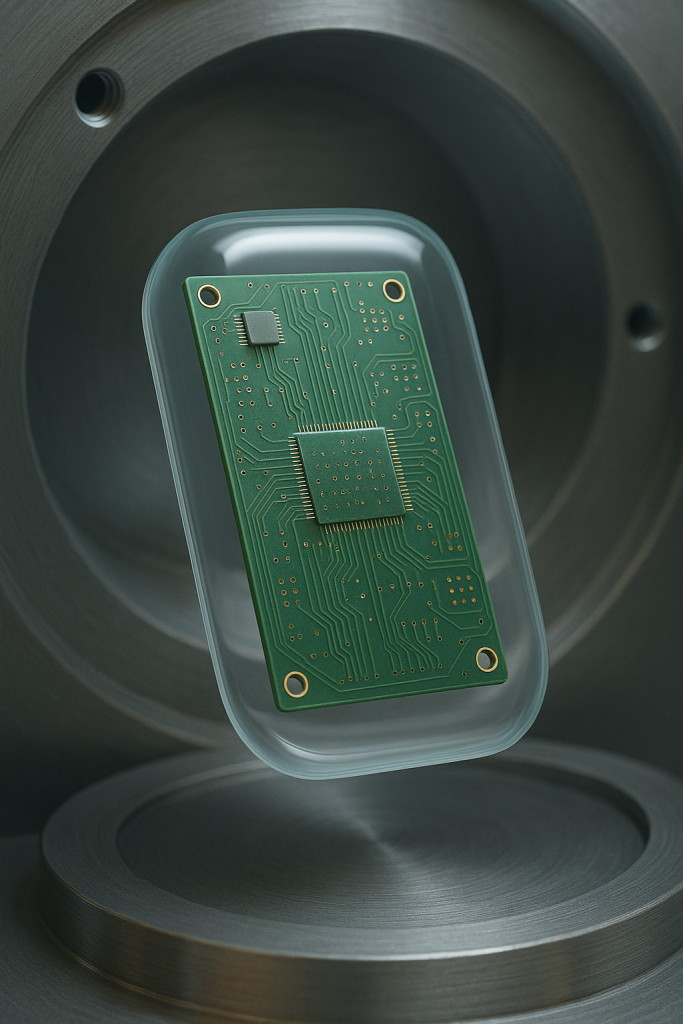
Parylene coating forming an ultra-thin, transparent protective layer on electronic components

Parylene Coating Explained – Invisible Protection with Visible Results


When it comes to protecting sensitive electronics and critical components, the best solutions are often the ones you can’t see. Parylene coating is exactly that β€” an ultra-thin, transparent film that provides superior protection without adding weight, altering dimensions, or affecting performance.

In this article, we break down what Parylene is, how the process works, and why it delivers results you can trust but barely see.


What is Parylene?

Parylene is a family of polymer coatings applied using a unique vapour deposition process. Unlike liquid coatings, it doesn’t rely on solvents or curing. Instead, it forms a pinhole-free, conformal layer that follows every contour of the surface β€” even sharp edges, crevices, and internal cavities.

Key Characteristics:

  • Completely transparent and ultra-thin (typically 5–50 Β΅m)
  • Solvent-free, vacuum-deposited protective film
  • Uniform coating with no pooling or bridging
  • Excellent barrier to moisture, chemicals, and gases
  • High dielectric strength and electrical insulation

For a deeper understanding of how different Parylene grades behave in real applications, see our guide to Parylene basics: dimer grades, properties and applications.


How is Parylene Applied? The Vapour Deposition Process

Parylene coating isn’t sprayed or dipped β€” it’s deposited molecule by molecule in a vacuum chamber. Here’s how:

  1. Vaporisation – Solid Parylene dimer is heated under vacuum, turning it into a vapour.
  2. Pyrolysis – The vapour is heated again to break the dimer into monomers.
  3. Deposition – These monomers enter a cool coating chamber where they polymerise and form a thin, uniform film over all exposed surfaces.
  4. No Cure Required – Unlike liquid coatings, Parylene is ready immediately β€” no oven curing, no drying time.

This unique process ensures 360Β° coverage, reaching areas where sprays, brushes, and dips simply can’t.


Why Use Parylene? Visible Results from an Invisible Layer

Although invisible to the eye, Parylene’s protective performance delivers very real benefits:

Benefit What It Means
Moisture & Chemical Barrier Protects against corrosion, solvents, humidity, body fluids and harsh environments
Electrical Insulation High dielectric strength and low leakage β€” ideal for PCBs, medical devices, sensors
Ultra-Thin & Lightweight Adds protection without affecting size, weight or functionality
Biocompatible & ISO 10993 Certified Safe for medical, implantable and life-science applications
Long-Term Reliability No cracking, peeling, or yellowing β€” even under stress or thermal cycling

Where Is Parylene Used?

Parylene’s versatility makes it suitable across many industries where reliability is critical:

  • Aerospace & Defence β€” avionics, satellites, fuel systems, sensors
  • Medical Devices β€” catheters, implants, hearing aids, surgical tools
  • Automotive & EV β€” PCBs, battery systems, ADAS components
  • Consumer Electronics β€” wearables, sensors, microcircuits
  • Industrial & Energy β€” sensors, control systems, harsh environment electronics

Parylene vs Traditional Liquid Conformal Coatings

Feature Parylene Conformal Coatings (Acrylic, Silicone, Urethane)
Application Vacuum deposition Brush, spray, dip
Coverage Complete 3D coverage, no shadows Limited by line-of-sight application
Thickness 5–50 Β΅m highly uniform Often uneven, 25–200 Β΅m
Solvents Solvent-free May contain VOCs
Cure Time No cure required Minutes to hours
Adhesion Requires pre-clean and adhesion promoter Generally good without promoter
Cost Higher per unit β€” but minimal rework and failures Lower upfront cost but more defects/rework

Find out more about the difference between Parylene and conformal coatings here.


Is Parylene Right for Your Product?

Parylene is ideal when:

  • You need high reliability in extreme environments
  • Conventional coatings don’t reach complex geometries
  • Devices are miniaturised or lightweight
  • Biocompatibility and cleanliness are required
  • Long-term product life and consistency are critical

Conclusions

Parylene may be invisible, but the results are not. With unmatched uniformity, protection and long-term performance, it delivers reliability where failure is simply not an option.

Whether you’re designing next-generation electronics, life-saving medical devices, or mission-critical aerospace systems β€” Parylene ensures invisible protection with visible results.

How Adhesion Promoters Work: Getting Reliable Bonds with the Right Promoter


Adhesion is one of the most critical factors in achieving reliable coating performance. Even the most advanced coatingβ€”such as Paryleneβ€”can fail if it doesn’t bond strongly to the underlying surface. That’s where Parylene adhesion promoters (often called primers) come in.

At SCH Services Ltd, we supply and use Parylene adhesion promoters as part of our day-to-day coating work. Selecting the right promoter (and applying it correctly) helps deliver strong, repeatable adhesion and long-term reliability.

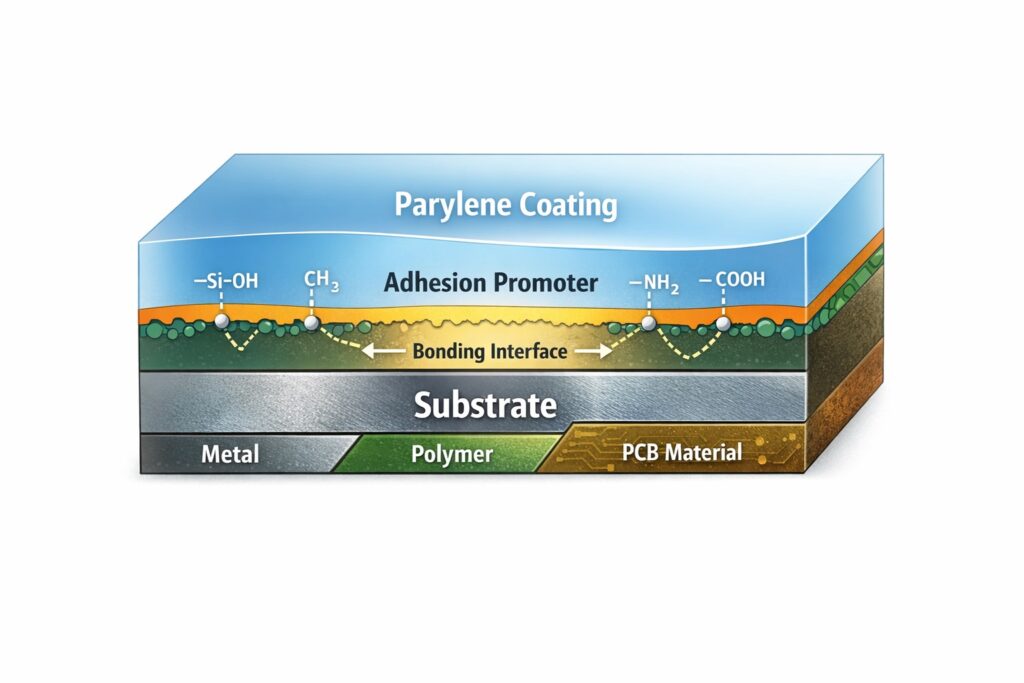
Diagram showing how a Parylene adhesion promoter improves bonding between the substrate and Parylene coating
Illustration showing how adhesion promoters enhance Parylene coating adhesion to challenging substrates.

Why Parylene Adhesion Promoters Are Needed

Parylene is deposited as a vapour and forms an ultra-uniform film, but adhesion is highly dependent on surface chemistry and cleanliness. Certain substratesβ€”such as smooth metals, ceramics, glass, and many plasticsβ€”can be naturally difficult for Parylene to bond to without additional surface preparation.

Without appropriate preparation and, where required, an adhesion promoter, coatings may:

  • Lift, peel, or delaminate over time
  • Fail adhesion testing (for example, cross-hatch testing such as ISO 2409 where applicable)
  • Compromise moisture, corrosion, or chemical protection

How Parylene Adhesion Promoters Work

Parylene adhesion promoters typically work by creating a chemical β€œbridge” between the substrate and the Parylene polymer. In practice, they:

  • Chemically bond to the substrate surface (after correct cleaning/activation)
  • Present a compatible functional layer that Parylene can anchor to during deposition
  • Reduce the risk of delamination, especially under thermal cycling, humidity, or chemical exposure

Different Substrates Need Different Approaches

There is no one-size-fits-all solution for Parylene adhesion. The correct approach depends on the substrate type, the contamination risk, and the service environment.

In Parylene processes, adhesion performance is typically driven by a combination of:

  • Cleaning (removal of oils, flux residues, silicones, and particulates)
  • Surface activation (often plasma treatment where appropriate)
  • Adhesion promoter selection matched to the substrate and reliability requirement

Common substrate categories where Parylene adhesion planning matters most include:

  • Metals (surface oxides, smooth finishes, and corrosion considerations)
  • Plastics (especially low surface energy polymers)
  • Ceramics & glass (non-porous surfaces)
  • PCB materials (solder masks, exposed copper, and mixed-material assemblies)

A quick note on liquid conformal coatings

For acrylic, urethane, and silicone conformal coatings, adhesion is often managed through process control and surface preparation, and in some cases the use of a primer where the substrate demands it. However, the term β€œadhesion promoter” is most commonly used in industry when discussing Parylene deposition.

SCH Services Ltd: Practical Parylene Adhesion Support

If you’re seeing adhesion concernsβ€”or you’re qualifying Parylene for a new substrateβ€”SCH can support with promoter selection guidance, surface preparation advice, and production-proven processes based on real coating experience.

Learn more: Discover our full range of Parylene coating solutions, or explore the Coating Defects Hub if you’re investigating adhesion or reliability issues.

If you’d like technical guidance on Parylene adhesion, surface preparation, or promoter selection, contact our team via the contact page.

Does Parylene Adhesion Decrease with Coating Thickness?


When it comes to Parylene coatings, adhesion is everything. A coating may offer exceptional barrier protection, but if it delaminates or peels from the substrate, performance and long-term reliability are immediately compromised. One of the most common technical questions in Parylene processing is whether adhesion decreases as coating thickness increases.

The short answer: thickness alone is not the root cause. Adhesion performance depends primarily on surface preparation, substrate chemistry, and process control.

Understanding Parylene Deposition

Parylene is applied using a vapour deposition process (CVD), where the coating polymerises directly onto the substrate at a molecular level. This produces a pinhole-free, highly uniform film that conforms perfectly to flat surfaces, sharp edges, and recessed geometries.

Unlike brush, spray, or dip-applied conformal coatings, Parylene does not rely on surface tension or solvent evaporation. However, like all coatings, its adhesion is still governed by surface energy, cleanliness, and interfacial bonding.

Parylene Thickness vs Adhesion Performance

In general, thinner Parylene coatings (typically 2–5Β Β΅m) exhibit excellent adhesion because internal stresses within the polymer layer remain low. As coating thickness increasesβ€”sometimes to 25–50Β Β΅m or moreβ€”internal mechanical stress within the film can increase.

If surface preparation is inadequate, this stress can contribute to adhesion loss. However, when substrates are properly prepared, even thick Parylene coatings can achieve outstanding adhesion and long-term durability.

Key influencing factors include:

  • Smooth or low-energy surfaces can limit adhesion at any thickness
  • Contamination (oils, flux residues, moisture) dramatically reduces bond strength
  • Surface activation significantly improves adhesion across all thickness ranges

Best Practices to Maintain Adhesion at Any Thickness

To ensure reliable Parylene adhesionβ€”whether applying thin or thick coatingsβ€”the following best practices are essential:

  • Use plasma cleaning or chemical surface activation to increase surface energy
  • Apply adhesion promoters where required for challenging substrates
  • Select coating thickness based on functional need, not assumption
  • Validate adhesion using recognised standards such as cross-hatch testing (ISOΒ 2409)

Parylene Adhesion Expertise at SCH Services Ltd

At SCH Services Ltd, we understand how coating thickness, substrate preparation, and process control interact to determine Parylene adhesion performance. Our Parylene processes combine controlled surface preparation with optimised deposition parameters to deliver reliable adhesion across both ultra-thin and high-build coatings.

Whether your application requires thin Parylene films for medical sensors or thicker layers for aerospace and defence electronics, we ensure adhesion performance is never compromised.

Learn more about our capabilities:
Parylene Coating Solutions

Surface Preparation for Parylene: Cleaning and Adhesion Promoters


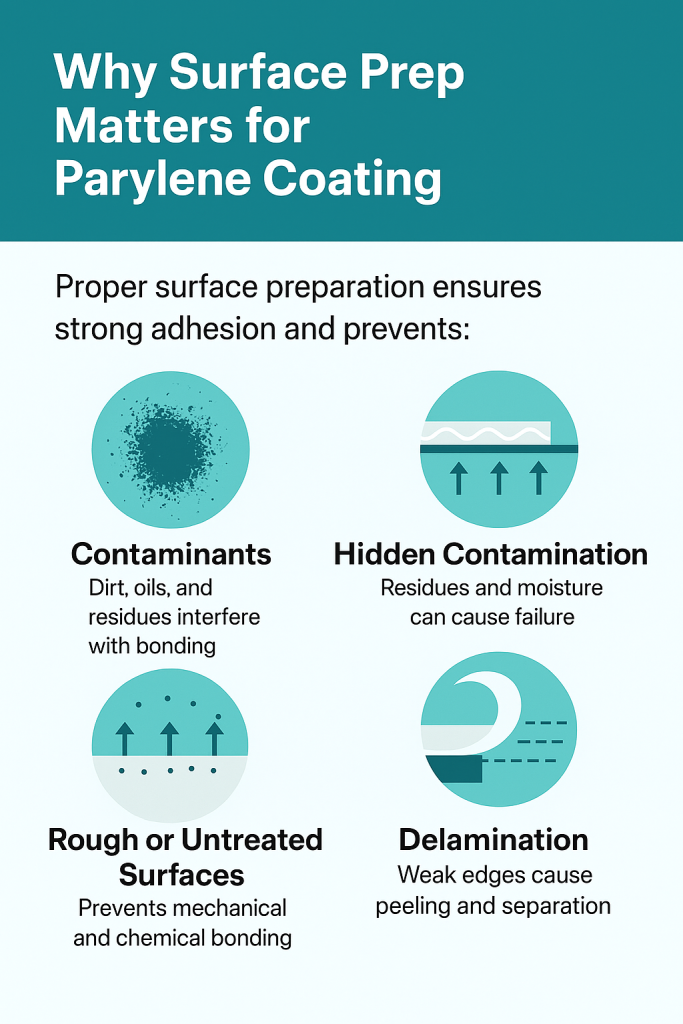
Even the best Parylene coating cannot perform reliably if the surface beneath it is not properly prepared. Adhesion failures, delamination, and reduced barrier performance often trace back to poor Parylene surface preparation. That’s why substrate preparation is one of the most critical steps before Parylene deposition.

Parylene is applied via vapour deposition, forming a thin, uniform layer that reaches every exposed surface. However, if the substrate has contamination, low surface energy, or residues, the Parylene may not bond properly β€” resulting in peeling, flaking, or reduced adhesion.

Correct preparation helps ensure:

  • Strong coating adhesion
  • Reliable moisture and chemical protection
  • Consistent long-term performance

For a deeper explanation of how vapour deposition works and why surface condition plays such a critical role, see our Parylene deposition process overview.


Cleaning: Removing contaminants

Before applying any adhesion promoter, thorough cleaning thinks about one thing: removing anything that blocks bonding. Residues such as flux, oils, fingerprints, silicone release agents, and dust can prevent Parylene from anchoring properly.

Common cleaning approaches include:

  • Solvent cleaning to remove organic residues (oils, greases, certain process residues)
  • Ultrasonic cleaning for intricate assemblies and precision components (where suitable)
  • Controlled drying to prevent water spots, residue redeposition, or recontamination

Cleaning effectiveness is also a common root cause in adhesion and coverage failures, which we break down further in our Conformal Coating Defects Hub.


Adhesion promoters: Creating reliable bonding sites

Adhesion promoters (often silane-based primers, depending on substrate and process) are used to improve Parylene bonding strength by modifying the surface chemistry. They help create functional bonding sites so the deposited film anchors more reliably.

They are particularly useful on low-surface-energy and difficult substrates such as some plastics, ceramics, and glass, and they can also support consistency across mixed-material assemblies.

By combining effective cleaning with the correct adhesion promoter strategy, manufacturers reduce delamination risk and achieve Parylene coatings that remain stable over the required service life.


SCH Services Ltd: Proven preparation and coating expertise

At SCH Services Ltd, we combine controlled cleaning and adhesion promoter treatments with expert Parylene deposition to deliver coatings that bond reliably across demanding substrates. Because these preparation steps are used in our own coating services, customers benefit from proven, production-ready processes designed for maximum performance.

Learn more: Explore our Parylene Coating Solutions or contact our team to discuss your substrate, environment, and coating thickness requirements.

If you’re assessing whether Parylene is suitable for your application or need support with substrate preparation and validation, our Parylene coating services provide end-to-end process control from preparation through inspection.

Parylene vs Traditional Coatings: Which is Right for You?


When it comes to protecting sensitive electronics, medical devices, and mission-critical components, the choice of coating can define long-term performance. Two common options are Parylene coating and traditional conformal coatings such as acrylics, silicones, and urethanes. Each offers unique benefits β€” but which is right for your application?

For an overview of vapour-deposited protection and where it fits within modern electronics manufacturing, see our Parylene coating solutions.


What Makes Parylene Different?

Parylene is applied using a vapour deposition process, producing a pinhole-free, highly uniform film that coats every exposed surface β€” including hidden spaces and complex geometries.

This process helps deliver:

  • Exceptional moisture barrier performance
  • Ultra-thin yet durable protection
  • Strong resistance to chemicals, solvents, and temperature extremes

Because it forms a truly conformal layer, Parylene is often selected where reliability cannot be compromised.

Our Parylene coating services are used where uniform coverage, low thickness, and high reliability are critical.


Where Traditional Conformal Coatings Excel

Traditional conformal coatings are typically applied by brushing, spraying, or dipping. They remain highly effective in many environments and offer practical advantages such as:

  • Faster application and curing (process dependent)
  • Lower cost compared to Parylene (in many cases)
  • Easier rework and repair during production

For applications where cost sensitivity or rapid turnaround is key, traditional coatings can be the most commercially sensible option.

For applications where cost, speed, or rework access are priorities, our liquid conformal coating solutions remain a highly effective option.


Making the Right Choice

The right choice depends on your environment and performance requirements. If your device must endure harsh conditions or complex 3D coverage requirements, Parylene coating can provide unmatched protection. For less demanding applications, traditional conformal coatings may strike the best balance between performance, reworkability, and budget.

The right choice depends on environment, geometry, and compliance requirements, which is why many manufacturers engage our coating services for application-specific guidance and discuss the options.


SCH Services Ltd: Your Coating Partner

At SCH Services Ltd, we provide both Parylene and liquid conformal coating solutions β€” helping you select the right option for your project. Whether you need high-performance protection or cost-effective coverage, our expertise ensures your product is protected for the long term.

Learn more: Parylene coating services

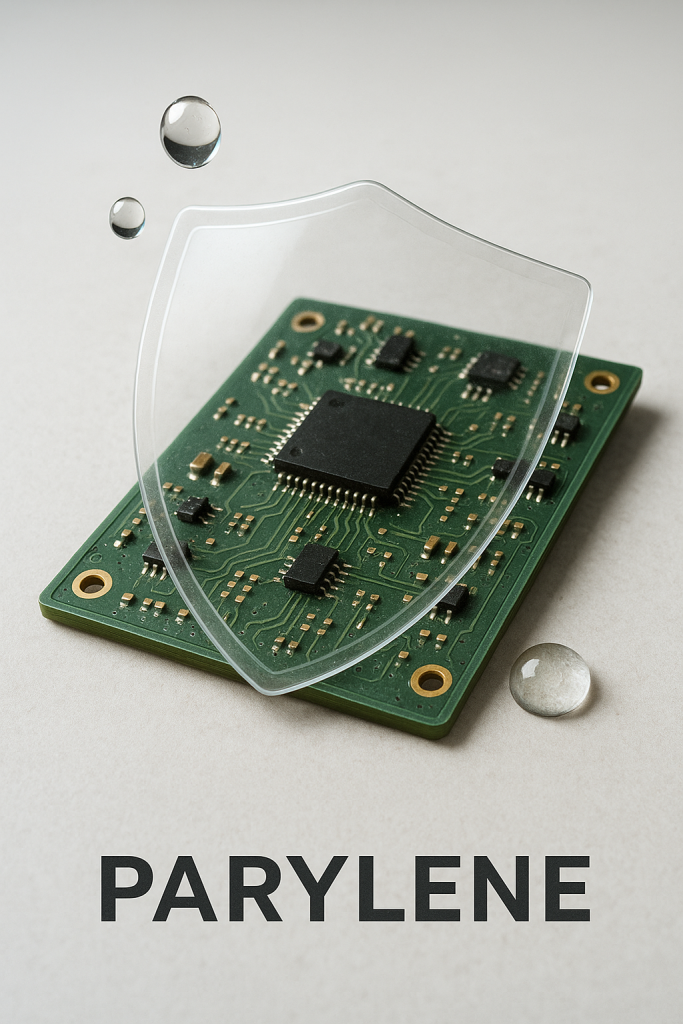
Parylene coating providing invisible protection for electronic components against moisture and environmental damage

The Hidden Protector: How Parylene Safeguards What You Don’t See


When it comes to protecting modern electronics and critical components, the greatest threats are often the ones you cannot see. Microscopic cracks, invisible moisture, and environmental contaminants all pose silent risks to performance and long-term reliability. This is where Parylene coating excels β€” acting as an ultra-thin, invisible shield that delivers durable, long-term protection.

Learn more about SCH Services’ specialist Parylene coating services here.

The Power of Parylene Coating

Unlike traditional conformal coating methods that are brushed, dipped, or sprayed, Parylene is applied using a specialised vapour deposition process. This process allows the coating to polymerise directly onto the surface, forming a uniform, pinhole-free layer that fully encapsulates components.

The result is a truly conformal barrier that coats not only visible surfaces but also sharp edges, internal geometries, and hidden crevices that liquid-applied coatings often struggle to reach.

Invisible Moisture Protection

Moisture remains one of the leading causes of electronic failure. Even minimal condensation can lead to corrosion, leakage currents, or short circuits. Parylene provides exceptional moisture resistance by forming a continuous microscopic film that significantly reduces water vapour ingress.

This makes Parylene particularly effective in harsh, humid, or environmentally demanding applications where traditional coatings may degrade or fail over time.

Why Industries Rely on Parylene

Industries such as aerospace, automotive, medical devices, and consumer electronics rely on Parylene because of its proven performance and reliability. It is lightweight, chemically resistant, biocompatible, and stable across a wide temperature range β€” making it suitable for applications where failure is not acceptable.

SCH Services Ltd – Your Partner in Invisible Protection

At SCH Services Ltd, we specialise in both liquid and Parylene conformal coating services, providing tailored solutions to meet specific environmental and performance requirements. Whether protection is needed against moisture, chemicals, or long-term environmental exposure, Parylene offers reliable defence against unseen threats.

Because in many applications, the best protection is the protection you never notice.

For detailed information on Parylene coating capabilities, applications, and process control, visit our Parylene coating services page.

Parylene conformal coating protecting electronic assemblies from moisture, chemicals and environmental damage

5 Reasons Why Parylene is the Gold Standard for High-Reliability Applications


Introduction: Why Parylene Stands Out

When it comes to protecting electronic assemblies, manufacturers have several conformal coating options available, including acrylics, silicones, urethanes, and epoxies. However, when performance, reliability, and long-term protection cannot be compromised, Parylene consistently stands apart as the industry benchmark.

At SCH Services Ltd, we provide a complete, end-to-end Parylene solution. Unlike providers that focus on a single element of the process, SCH supports the full lifecycle β€” from coating services and deposition systems to high-purity dimers, consumables, spares, consultancy, and training.

Whether you are outsourcing coating services, developing in-house capability, or strengthening your supply chain resilience, SCH delivers the expertise and infrastructure required to support electronics, aerospace, automotive, and medical applications.

Our focus is simple: dependable, scalable, and cost-effective Parylene solutions, backed by deep technical knowledge and proven industrial experience.

Learn more about SCH Services’ complete Parylene coating solutions here.

Below are five reasons why Parylene is widely regarded as the gold standard in conformal coating.

1. Superior Barrier Protection

Parylene forms an ultra-thin, pinhole-free polymer film that provides complete environmental protection against:

  • Moisture and humidity
  • Corrosive chemicals and solvents
  • Salt spray and aggressive environments

Because Parylene is applied in vapour form, it coats all exposed surfaces evenly, including sharp edges, crevices, and areas beneath components. This level of coverage significantly improves long-term PCB reliability compared with liquid-applied coatings.

2. Uniform, Truly Conformal Coverage

Parylene is deposited molecule by molecule within a controlled vacuum chamber, resulting in a coating that is:

  • Uniform across complex three-dimensional geometries
  • Ultra-thin, typically between 10 and 50 microns
  • Stress-free, with no pooling, bridging, or edge effects

This makes Parylene particularly well suited to miniaturised electronics and densely populated assemblies where conventional coatings struggle to perform.

3. Outstanding Chemical and Moisture Resistance

Parylene demonstrates excellent resistance to a wide range of environmental and chemical exposures, including:

  • Water vapour transmission
  • Fuels, oils, and industrial solvents
  • Acidic and alkaline solutions

In automotive, industrial, and outdoor electronics applications, this resistance translates into stable, predictable protection throughout the product lifecycle.

4. Biocompatibility for Medical Applications

Parylene’s biocompatibility is a key differentiator in medical and healthcare applications. Certified to ISO 10993 standards, Parylene coatings are:

  • Suitable for direct contact with human tissue and fluids
  • Widely used in implantable devices such as pacemakers and stents
  • Common in diagnostic equipment, sensors, and wearable technology

For medical device manufacturers, Parylene is not just a coating choice β€” it is a pathway to regulatory compliance and long-term device reliability.

5. Long-Term Reliability in Harsh Environments

Parylene remains stable across a wide temperature range, offers excellent dielectric strength, and resists UV and environmental degradation.

This makes it the coating of choice in demanding sectors such as:

  • Aerospace and defence – avionics, satellites, and radar systems
  • Automotive – electric vehicle systems and ADAS sensors
  • Telecommunications and IoT – outdoor and remote installations

Where downtime or failure is unacceptable, Parylene delivers consistent long-term protection.

When to Choose Parylene Versus Other Coatings

While Parylene offers unmatched performance in high-reliability applications, it may not always be the most economical solution for low-cost or easily repairable products. Alternative coatings may be suitable where:

  • Chemical exposure is minimal
  • Miniaturisation is not critical
  • Ease of repair is a priority

However, when reliability is critical and environmental exposure is unavoidable, Parylene remains the safest and most robust option.

Conclusion: The Benchmark for Reliability

From medical implants to aerospace electronics, Parylene has earned its reputation as the gold standard in conformal coating. Its unique vapour deposition process delivers uniform, durable, and biocompatible protection that liquid coatings cannot replicate.

For further information on Parylene coating services, equipment, and technical support, visit our Parylene services page.

SCH Services Ltd provides comprehensive Parylene solutions, supporting customers with coating services, equipment, materials, consultancy, and training from our UK base.

The SCH Advantage: Services, Equipment, Dimers, and Training Under One Roof


Within the Parylene industry, many providers focus on a single element of the process β€” offering coating services, supplying equipment, or distributing dimers. At SCH Services Ltd, we take a different approach. We deliver a complete, integrated Parylene total solution, combining coating services, turnkey systems, dimer supply, and training to give customers confidence, flexibility, and long-term reliability.

Learn more about SCH Services’ complete Parylene coating solutions here.

Why a Total Solution Matters

Organisations exploring Parylene typically share two core concerns:

  1. Reliability – Will the coating process consistently meet performance, quality, and compliance requirements?
  2. Scalability – Can the process start small and expand without disruption or rework?

When services, equipment, materials, and training are sourced from multiple providers, this often leads to mismatched processes, unclear accountability, and hidden costs. Working with a single, experienced partner removes these risks and creates a more controlled and predictable outcome.

Our Four Pillars of Support

1. Coating Services

SCH operates ISO-certified Parylene coating facilities supporting medical, aerospace, automotive, and electronics sectors. From rapid prototyping through to volume production, our services deliver consistent quality, full traceability, and controlled process execution.

2. Turnkey Equipment

SCH supplies complete Parylene deposition systems, ranging from R&D platforms to full-scale production equipment. Each system is delivered with:

  • Installation and commissioning support
  • Comprehensive operator training
  • Process validation assistance
  • Ongoing technical and application support

This ensures customers are not simply purchasing hardware, but implementing a validated, working coating process.

3. Dimer Supply

As the official European distributor of KaryNano Parylene dimers, SCH provides customers with a reliable supply of high-purity materials. This guarantees consistency, compliance, and traceability in every deposited Parylene film.

4. Training and Knowledge Transfer

This is where SCH’s approach is fundamentally different. Many equipment suppliers avoid transferring full process knowledge in order to protect their own coating service offerings. SCH takes the opposite view.

We believe in partnership rather than protectionism. Beyond system installation, we transfer practical knowledge so customer teams can operate confidently, troubleshoot effectively, and validate processes to recognised international standards.

Our training programmes cover:

  • System operation and routine maintenance
  • Masking and demasking best practice
  • Process troubleshooting and optimisation
  • Validation and compliance (including IPC-CC-830 and ISO 9001)
  • Surface preparation and adhesion promotion techniques
  • New Product Introduction (NPI) support for smooth integration

The outcome is a capable, self-sufficient team that avoids common pitfalls and achieves consistent, repeatable Parylene coating performance.

For detailed information on a Parylene total solution, coating services, equipment, dimers, and training, visit our Parylene solutions page.

0
  • Your current order total is £0.00 β€” you must have an order with a minimum of £75.00 to place your order.
0
Your Cart
Your cart is empty
  • Your current order total is £0.00 β€” you must have an order with a minimum of £75.00 to place your order.
Calculate Shipping
  • Your current order total is £0.00 β€” you must have an order with a minimum of £75.00 to place your order.

Conformal Coating UK

Conformal Coating UK
Privacy Overview

This website uses cookies so that we can provide you with the best user experience possible. Cookie information is stored in your browser and performs functions such as recognising you when you return to our website and helping our team to understand which sections of the website you find most interesting and useful.