
Why incomplete cleaning can lead to adhesion loss, corrosion and long-term coating reliability problems
Cleaning the residues left behind by a no-clean flux process is one of the most difficult and misunderstood stages of PCB preparation. These residues are specifically designed to remain on the board, so they are not formulated to be removed easily.
That becomes important when conformal coating is planned. Surface contamination, partially removed residues and poorly matched cleaning chemistry can all affect wetting, adhesion and long-term reliability. The goal is not simply to make the board look cleaner. The goal is to avoid creating a worse failure mechanism than the original residue itself.
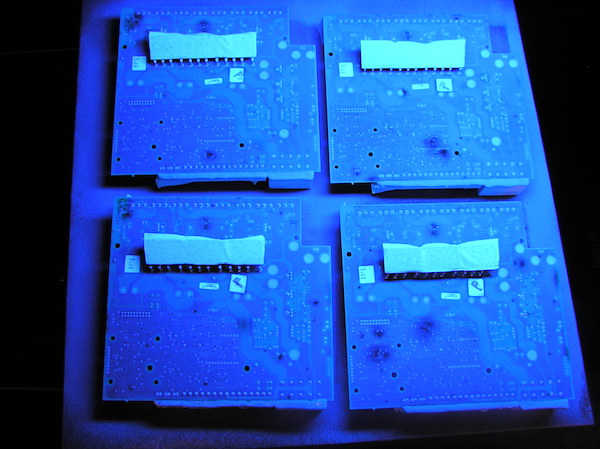
How do you clean no-clean flux residues if you need to?
Whether a no-clean flux residue can be cleaned effectively depends on the cleaning chemistry’s saponification factor and its compatibility with the residue chemistry present on the assembly.
Saponification is the ability of the cleaning chemistry to soften and break down the residue so it can be dissolved and removed. In simple terms, the more effectively the chemistry attacks the residue, the easier it becomes to clean the surface properly.
The key requirement is complete removal. If the cleaning chemistry does not fully dissolve and remove the residue, the process may create more risk rather than less.
Reality check: A partially cleaned no-clean residue may be more dangerous than a residue left untouched, because the protective resin matrix can be disturbed without fully removing the active chemistry beneath it.
What happens if the residues are only partially dissolved?
A no-clean residue that is only partly cleaned away may be far worse for a printed circuit board assembly than a no-clean residue left untouched. One reason is that lead-free flux activators are generally more active than those used in earlier leaded formulations.
When the residue is left in place, the activators are held within the carrier resin matrix. At normal operating temperatures, that matrix helps keep the residue stable and reduces the risk of corrosion-related problems.
However, if the protective matrix is only partly removed by an inadequate cleaning process, the active chemistry may become exposed. This can initiate corrosion on the circuit board and may be accelerated by heat, electrical bias in service or high relative humidity.
Why this matters for conformal coating
Conformal coating is often applied to improve environmental protection and long-term reliability. But coating over contamination or marginally cleaned residues can lock defects into the assembly rather than eliminate them.
If cleaning is incomplete, the result may include poor coating wetting, reduced adhesion, localised dewetting, corrosion risk and reliability problems that only appear later in service.
This is why cleaning should be treated as a controlled process step, not as a cosmetic operation. If you are reviewing coating failures, it is also worth understanding how poor preparation interacts with broader process issues covered in our article on why conformal coating fails in complex PCB assemblies.
So how should no-clean residues be assessed?
When considering whether to clean no-clean residues before coating, three questions matter:
- Can the residue actually be cleaned effectively on this assembly?
- Have you matched the cleaning chemistry to the degree of difficulty and the available cleaning process?
- Have you validated the overall process by testing, rather than assumption?
These questions matter because no-clean fluxes vary, assemblies vary and cleaning processes vary. A workable answer on one product may fail on another. Validation is essential.
Related process guidance
This article supports the wider process control guidance in the Conformal Coating Processes Hub.
Why Choose SCH Services?
SCH Services supports conformal coating users with practical process knowledge, coating services, training and engineering support. If you are reviewing cleaning, coating adhesion or broader process reliability, we can help assess the issue in the context of the full coating process rather than as an isolated symptom.
To discuss cleaning, coating preparation or process troubleshooting, contact us or call (+44) 1226 249019.
This article is provided as general technical guidance only. Cleaning chemistry, residue behaviour and conformal coating performance vary by assembly, flux system and process conditions. Final process decisions should be validated through suitable trials, inspection and reliability testing.
