Parylene as a Manufacturing System: From Deposition to Controlled Production
Why repeatable Parylene yield depends on controlling the whole system, not just the recipe
Parylene is often described as a coating process, but in real production it behaves more like a tightly coupled manufacturing system. Material inputs, substrate condition, loading geometry, chamber behaviour, and verification methods all influence whether the final coating is stable, repeatable, and scalable.
This matters because many teams treat Parylene deposition as a black box. They assume that once a recipe has been set, the output should remain consistent. In practice, the same nominal cycle can produce different results when upstream variables drift, moisture changes, surfaces are poorly prepared, or loading conditions vary between runs.
The key shift is simple: Parylene does not fail randomly. Systems do. If yield is unstable, the answer is rarely just to adjust thickness or alter the deposition recipe. The answer is to stabilise the entire manufacturing system around the process.
A stable recipe without stable inputs is not a stable process.
The diagram below summarises how Parylene coating performance is controlled as a complete system, linking inputs, process conditions, and verification into a repeatable manufacturing outcome.
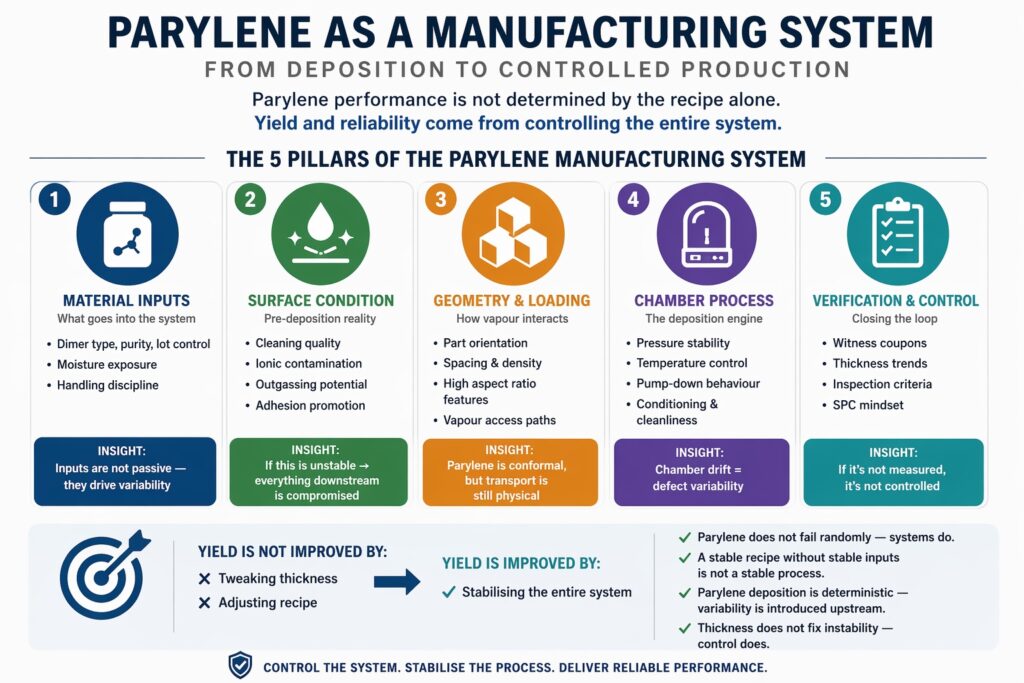
Parylene manufacturing system showing the five control pillars required for stable, repeatable coating performance.
Why the “recipe equals result” mindset breaks down
Parylene deposition is deterministic, but variability is introduced before and around the chamber. If dimer condition changes, surfaces hold contamination, parts are loaded differently, or the chamber state drifts over time, the result can look inconsistent even when the programmed cycle appears unchanged.
This is why some defects are wrongly described as random. Pinholes, haze, weak adhesion, thickness drift, shadowing, or unstable coverage often reflect uncontrolled inputs rather than mysterious process behaviour. The chamber reveals instability that already exists in the system.
For symptom-led diagnosis, see Parylene Troubleshooting Workflow. For a broader defect view, see Parylene Process Stability & Yield Optimisation.
The five pillars of the Parylene manufacturing system
Reliable Parylene production can be understood through five linked control pillars. Each one influences the others. Weak control in one area often appears later as yield loss, poor repeatability, or difficult troubleshooting.
- Material inputs
- Surface condition
- Geometry and loading
- Chamber process
- Verification and control
The purpose of this framework is not to make the process more complex. It is to make the sources of variation visible so they can be controlled systematically.
1) Material inputs: what goes into the system matters
Dimer is not just a consumable. It is a process input that affects deposition stability, coating quality, and repeatability. Grade selection, purity, storage, lot discipline, and exposure to moisture all influence what enters the deposition cycle.
Typical control points
- Dimer type matched to the application and performance requirement
- Lot traceability and controlled stock rotation
- Protection from moisture exposure during storage and handling
- Clear handling discipline before loading the system
When material inputs vary, output variability follows. This is one reason why apparent chamber inconsistency may actually begin with input discipline rather than equipment settings.
For background on grades and material choices, see Parylene Basics: Dimer Grades, Properties & Uses.
Temperature is also a process input: if the coated product will face elevated operating temperatures, sustained heat exposure, or thermal cycling, the manufacturing system must control grade choice, thickness, surface preparation and validation around that requirement. See our high-temperature protective coatings for electronics guide for applications where thermal exposure drives coating selection.
Inputs are not passive. They are active drivers of variability.
2) Surface condition: the process starts before deposition
Parylene can only perform as well as the surface it is applied to. Cleaning quality, ionic contamination, non-volatile residues, moisture retention, outgassing risk, and adhesion preparation all influence the final result. If the substrate condition is unstable, downstream consistency is compromised before deposition even begins.
What surface instability commonly affects
- Adhesion reliability
- Visual appearance and haze risk
- Barrier performance over time
- Rework and investigation burden after coating
Surface preparation is one of the clearest examples of why Parylene should be managed as a system. A well-controlled chamber cannot compensate for poor cleaning discipline or inconsistent dry-out behaviour.
For deeper guidance, see Parylene Cleaning, Surface Preparation & Adhesion Control.
3) Geometry and loading: conformal does not mean unlimited access
Parylene is conformal, but vapour transport is still physical. Coverage depends on how vapour reaches the target surfaces, how parts are spaced, how densely they are loaded, and whether high aspect ratio features restrict access. Loading geometry can therefore change results even when the chamber recipe remains constant.
Common geometry and loading variables
- Part orientation relative to vapour flow and shielding surfaces
- Spacing between parts, fixtures, and carriers
- Feature depth, recesses, cavities, and blind areas
- Batch density and repeatability of rack loading
This is where scaling often becomes unstable. A process that works on a light engineering batch can become inconsistent when the same recipe is applied to different densities or product geometries without revalidation.
Thickness expectations should also be judged against access reality, not just nominal setpoint. See Parylene Thickness Strategy for a practical view of this relationship.
For specialist applications involving stent frames, fine metallic structures and complex micro-geometries, see our Insight on Parylene coating for stent frames and micro metal structures.
Parylene is conformal, but vapour transport is still governed by physical access, geometry, spacing, and loading conditions within the chamber.
4) Chamber process: the deposition engine must stay stable
The chamber is where the process becomes visible, but it is not independent of the system around it. Pressure stability, temperature control, pump-down behaviour, chamber cleanliness, conditioning state, and maintenance discipline all influence repeatability from run to run.
What chamber drift can lead to
- Variable deposition behaviour between nominally identical runs
- Unexpected coating appearance changes
- Thickness trend movement over time
- Inconsistent production confidence during scale-up
Stable deposition depends on more than a saved programme. The system must start each cycle from a controlled and repeatable condition. That means process settings, machine state, loading condition, and pre-run discipline need to work together.
For parameter-level background, see Parylene Deposition Process Parameters. For production control thinking, see Parylene Process Stability & Yield Optimisation.
For a detailed breakdown of how chamber behaviour, pressure stability and process parameters influence deposition consistency, see Parylene Chamber Stability & Deposition Control.
5) Verification and control: if it is not measured, it is not controlled
The final pillar closes the loop. Witness coupons, thickness checks, inspection criteria, traceability, and trend review convert deposition from a hopeful activity into a controlled manufacturing process. Without verification, drift can continue unnoticed until yield or field performance suffers.
What effective verification usually includes
- Representative witness coupons on defined runs
- Consistent thickness measurement practice
- Visual inspection criteria and defect recognition discipline
- Trend review mindset rather than one-off pass/fail thinking
- Documented control points linked to standard work
Verification is not just about finding faults. It is how a process proves that it remained under control. This is the difference between coating parts and running a repeatable Parylene manufacturing operation.
For more on specification logic, see Parylene Basics Hub and Parylene Thickness Strategy.
For a production-focused view of how these controls translate into repeatable output and improved yield, see Parylene Process Stability & Yield Optimisation.
What this means for yield, scale-up, and troubleshooting
When yield is unstable, it is tempting to focus on the most visible number in the process, usually thickness or recipe settings. That can help in some cases, but it often treats the symptom rather than the mechanism. Stable output comes from controlled inputs, controlled surfaces, repeatable loading, stable chamber behaviour, and verified results.
This is especially important during transfer from development to production. A process that appears acceptable in low-volume work can break down during scaling if the system architecture has not been defined properly. For new assemblies, a Parylene engineering run can be used to prove the proposed preparation, masking, deposition, thickness verification and inspection process on representative parts before release into repeat production. The problem is not that Parylene is unpredictable. The problem is that the control framework was incomplete.
Parylene deposition is deterministic. Variability is introduced upstream, around the chamber, or through weak verification discipline. That is why structured troubleshooting works best when it looks at the whole system rather than only the deposited film.
A practical operating mindset for controlled production
The most effective Parylene operations usually share the same mindset. They do not assume that a recipe guarantees control. They define critical inputs, standardise preparation, stabilise loading patterns, maintain chamber discipline, and verify the result with evidence.
- Define what must stay fixed from run to run
- Separate true control variables from incidental noise
- Use witness data and trend review to detect drift early
- Treat scale-up as a system revalidation exercise, not a volume increase alone
- Write process discipline into standard work, not just operator memory
That is how Parylene moves from specialist deposition knowledge to controlled manufacturing capability.
This is also why operator and engineer training should start with the whole process, not just the chamber cycle. See our Insight on why Parylene training should start before the chamber.
System Stability vs Recipe Adjustment
Parylene yield is often treated as a function of recipe tuning or thickness adjustment. In practice, these changes rarely address the root cause of variability.
Yield is not improved by adjusting recipes or increasing thickness.
Yield improves when the full Parylene manufacturing system is stabilised.
If results are already inconsistent, use the Parylene Troubleshooting Workflow to diagnose root causes before attempting to optimise the process.
Related Parylene articles
- Engineering Runs for Parylene Coating: Proving the Process Before Production
- Parylene Process Stability & Yield Optimisation
- Parylene Troubleshooting Workflow: Diagnose Defects Fast
- Parylene Cleaning, Surface Preparation & Adhesion Control
- Parylene Thickness Strategy: Dielectric Performance, Coverage & Cost Control
- Parylene Deposition Process Parameters
- Parylene Basics: Dimer Grades, Properties & Uses
Why Choose SCH Services?
Managing Parylene as a controlled manufacturing system requires more than deposition capacity alone. It depends on understanding materials, preparation, loading strategy, validation, and the discipline needed to turn chamber cycles into repeatable production.
- Parylene Coating Services for prototype, development, and production support
- Parylene Training & Support for teams building internal capability
- Parylene Equipment and process-led guidance for controlled implementation
SCH supports customers who need practical engineering guidance, structured process development, and production-focused thinking rather than black-box assumptions.
This article is provided as general technical guidance only. Final material selection, process settings, validation methods, and acceptance criteria must be confirmed against the actual product geometry, operating environment, regulatory requirements, and qualification testing relevant to your application.