
Why operator-only ESD control does not address infrastructure and handling risk
Wrist straps are not a complete ESD solution in data centre environments. They control charge on a person, but they do not control the wider infrastructure, surfaces, packaging or handling routes that electronics move through.
This creates a common gap: teams assume ESD is covered because operators are grounded, while static risk continues to exist across the environment.
Quick take. Wrist straps control people. Data centres require control of surfaces, materials and infrastructure. Without that, ESD protection remains incomplete.
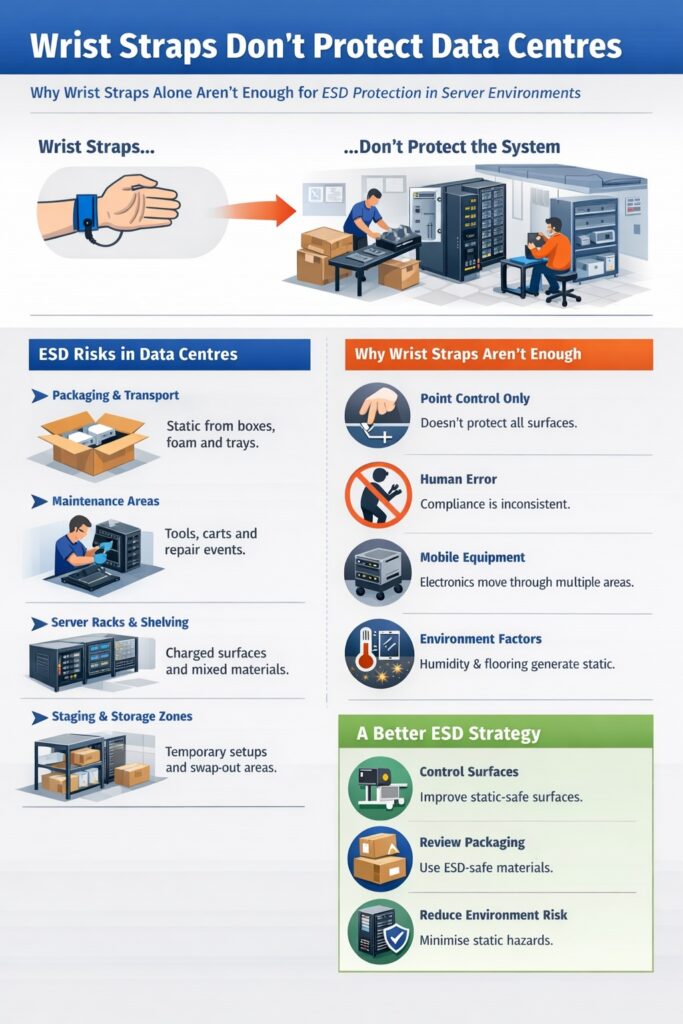
Wrist straps control operator charge, but ESD risk in data centres exists across packaging, infrastructure, maintenance areas and handling environments.
Why this matters
ESD control is often approached as a compliance task: ensure operators are grounded, provide mats, and follow procedures. In controlled bench environments, this can be effective. In data centres, it is often insufficient.
Electronics in data centres move through multiple stages — unpacking, staging, storage, installation, maintenance and replacement. At each stage, different surfaces and materials are involved, many of which can generate or hold static charge.
If those surfaces are not considered, ESD risk is not removed — it is simply moved to a different part of the process.
This is one example of a wider issue. In many cases, ESD protection fails due to multiple gaps across the environment, as explored in why ESD protection fails in data centres.
The pattern we see again and again
In many environments, ESD protection is focused heavily on the operator, with less attention given to the wider handling environment.
- Wrist straps are used during installation or repair work.
- Packaging materials such as foam and cardboard are not controlled.
- Racks, trays and storage systems include mixed materials.
- Maintenance zones introduce tools, carts and temporary setups.
- Teams assume compliance equals protection.
The result is a fragmented system where some areas are controlled and others are not, even though electronics pass through all of them.
In addition, risk is often introduced before operator control even begins, particularly through packaging and staging environments, as outlined in packaging-related ESD risk.
Why wrist straps alone fall short
Wrist straps are designed as a point-control measure. They do not provide continuous protection across an environment.
- They only control charge on the person wearing them.
- They do not influence packaging, trays or infrastructure surfaces.
- They rely on consistent human use and correct connection.
- They do not address static generated before or after operator contact.
In data centre environments, where electronics move between multiple surfaces and locations, this creates unavoidable gaps.
Practical warning sign. If your ESD control relies mainly on operator grounding but does not consider packaging, storage and infrastructure surfaces, your protection is likely incomplete.
A more realistic approach
A stronger ESD strategy for data centres combines operator controls with a wider review of the environment.
- Identify where electronics are stored, moved and handled.
- Review materials such as packaging, foams, trays and shelving.
- Assess maintenance and staging areas for repeated contact risks.
- Introduce more consistent surface behaviour where appropriate.
This shifts ESD control from isolated compliance to system-level reliability.
What this means in practice
Wrist straps should still be used where appropriate. The issue is not removing them — it is recognising their limits.
For a broader view of how ESD risk appears across infrastructure and handling environments, see our ESD Protection for Data Centres page. To understand how these issues combine at system level, see Why ESD Protection Fails in Data Centres and The Most Overlooked ESD Risk in Data Centres: Packaging.
In many cases, improving surface consistency and reducing environmental variation has a greater impact than adding more point controls.
Why Choose SCH Services?
SCH supports customers with practical ESD strategy development across infrastructure, packaging, handling and surface behaviour. We focus on how ESD risk appears in real environments, not just how it is defined in procedures.
This is often where moving beyond operator-only thinking improves real-world reliability.
