
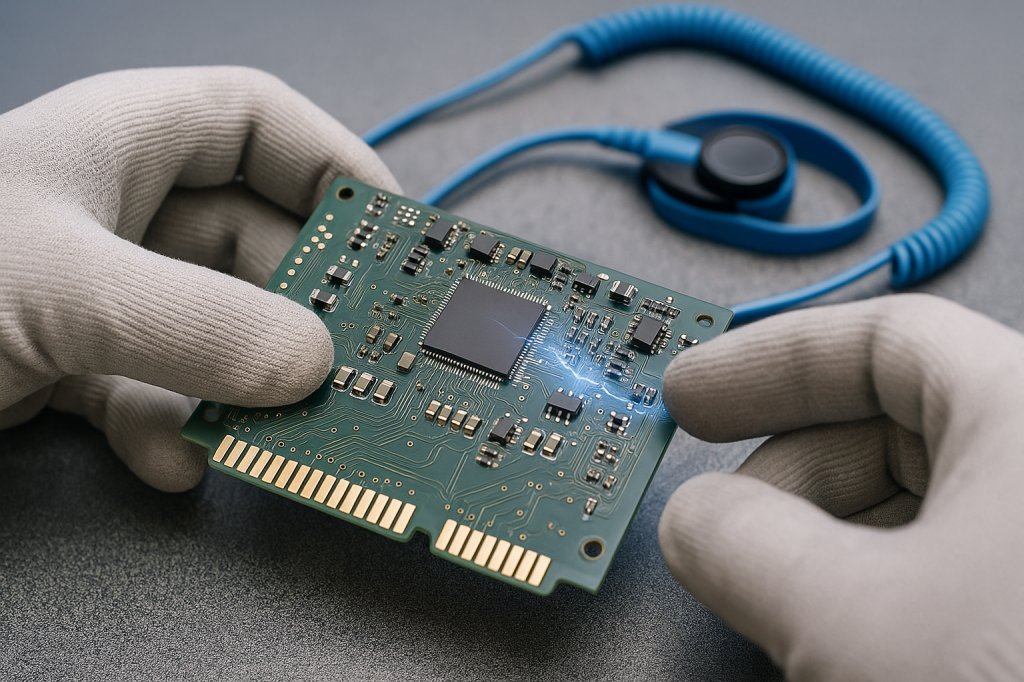
In today’s high-tech manufacturing and logistics environments, static electricity is far more than an occasional nuisance — it represents a significant commercial, quality, and safety risk. Across electronics manufacturing, medical devices, automotive systems, aerospace, and logistics, uncontrolled electrostatic discharge (ESD) can damage sensitive components, disrupt production, and compromise long-term reliability.
The Hidden Risk of Electrostatic Discharge (ESD)
Electrostatic discharge occurs when two objects with different electrical charges come into contact or close proximity, allowing charge to transfer rapidly. While a human may only feel a static shock at around 3,000 volts, modern electronic components can be permanently damaged by discharges as low as 30 volts. As electronics continue to shrink and performance densities increase, tolerance to ESD continues to decline.
This means effective static control is no longer optional — it is a fundamental requirement for modern manufacturing and handling environments.
Industry Impact: Where ESD Causes the Most Damage
- Electronics Manufacturing – ESD can cause latent damage to semiconductors, leading to early-life failures, reduced yield, and costly field returns.
- Automotive & Aerospace – Modern vehicles and aircraft rely heavily on complex electronics; ESD-related failures can impact safety-critical systems.
- Medical Devices – Reliability is essential. ESD damage in medical electronics can compromise performance and patient safety.
- Logistics & Packaging – Poor static control increases the risk of component damage during storage and transport and can introduce ignition hazards in sensitive environments.
Why Static Control Is Becoming More Critical
- Component Miniaturisation – Smaller geometries and thinner insulating layers increase ESD sensitivity.
- Extended Global Supply Chains – ESD damage can occur at any stage, from manufacture through shipping and final assembly.
- Compliance and Quality Expectations – Standards and customer requirements increasingly demand robust ESD controls.
- Waste Reduction and Sustainability – Preventing scrap and rework lowers environmental impact and total cost.
Modern Approaches to Static Control
Traditional static control methods — such as temporary sprays or heavily filled conductive paints — often degrade over time, require frequent reapplication, or introduce contamination risks. Modern ESD strategies focus on permanent, homogeneous dissipation methods that provide stable performance throughout the product lifecycle.
Innovative conductive polymer technologies, such as those used in ProShieldESD, enable uniform static dissipation across a wide range of substrates including plastics, foams, paper, cardboard, packaging, and flooring. These solutions provide long-term protection without the drawbacks associated with carbon or metal-filled systems.
Static Control as a Long-Term Strategy
Effective static control is not a one-off fix — it is a strategic decision that supports quality, safety, and operational efficiency. Organisations that invest in robust ESD protection reduce downtime, minimise losses, and protect their reputation for reliability.
For businesses operating in high-reliability industries, controlling static electricity is not simply good practice — it is mission-critical.
Learn more about advanced static control solutions: ProShieldESD
