
Why even low-cost electronics can require high-performance coating solutions
Low-cost electronics are often deployed in high-risk environments. That creates a contradiction: the product may be inexpensive, but the conditions it operates in demand high-performance protection.
This is where coating decisions become less about unit cost and more about reliability, failure risk and system performance over time.
Quick take. A £4 sensor in soil, moisture, chemicals or outdoor environments can still require advanced coating protection. The cost of failure often outweighs the cost of coating.
Visual summary. The diagram below shows why low-cost electronics often require high-performance coating in real-world environments.
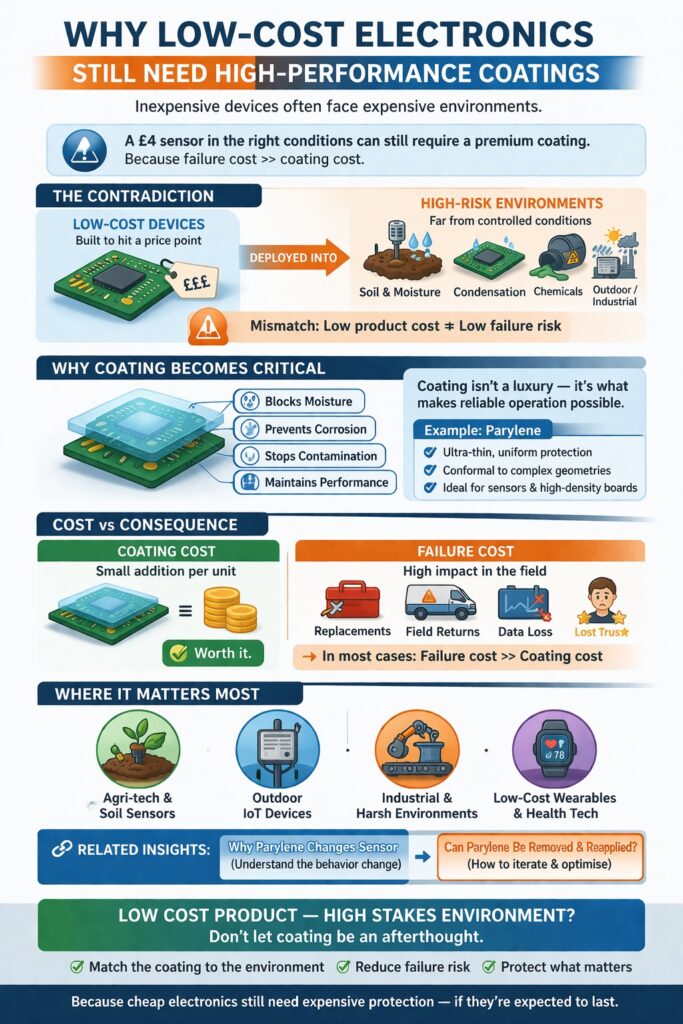
Low-cost electronics are often deployed in harsh environments where failure risk is high, making high-performance coatings essential for reliability despite low unit cost.
The contradiction
Many electronic devices are designed to be low-cost, high-volume products. Sensors, control boards and embedded systems are often built to tight cost targets, sometimes just a few pounds per unit.
At the same time, those same devices may be expected to operate in environments that are far from controlled:
- soil and moisture exposure
- condensation and humidity cycling
- chemicals or fertilisers
- temperature variation
- outdoor or industrial environments
This creates a mismatch between product cost and environmental demand.
Why coating becomes critical
Without protection, even a simple electronic assembly can fail quickly in these conditions. Corrosion, leakage paths, contamination and electrical drift can all affect performance.
In these cases, coating is not a premium feature. It is often what allows the product to function reliably at all.
This is where materials such as Parylene can become relevant, even in cost-sensitive applications, because they provide consistent, uniform protection across complex geometries.
Cost vs consequence
The key question is not always “how much does the coating cost?” but “what does failure cost?”
Failure cost can include:
- product replacement
- field service visits
- loss of data or function
- customer dissatisfaction
- brand or reliability impact
In many cases, those costs outweigh the incremental cost of applying a higher-performance coating.
Where it becomes more complex
In some applications, coating does more than protect. It can also influence how the device behaves. This is particularly relevant in sensor systems, where dielectric materials can affect electrical response.
For example, in capacitive sensing applications, coating can change the dielectric environment and shift performance. For more detail, see Why Parylene Coating Changes Capacitive Sensor Performance.
This reinforces the need to treat coating as part of the engineering system, not just a protective layer.
What This Means in Practice
If you are designing or manufacturing low-cost electronics for use in challenging environments, coating should be considered early rather than added as an afterthought.
The goal is not to over-specify protection, but to match the coating approach to the real operating conditions and the cost of failure.
In many cases, this leads to a more balanced decision where coating is treated as part of the product design rather than an optional extra.
Need support selecting the right coating approach?
SCH supports companies in selecting and implementing coating solutions that balance performance, cost and reliability for real-world environments.
This can include material selection, process guidance, coating trials and support for development-stage decisions.
