
Why Conformal Coating Problems Often Appear Random — And Why They Aren’t
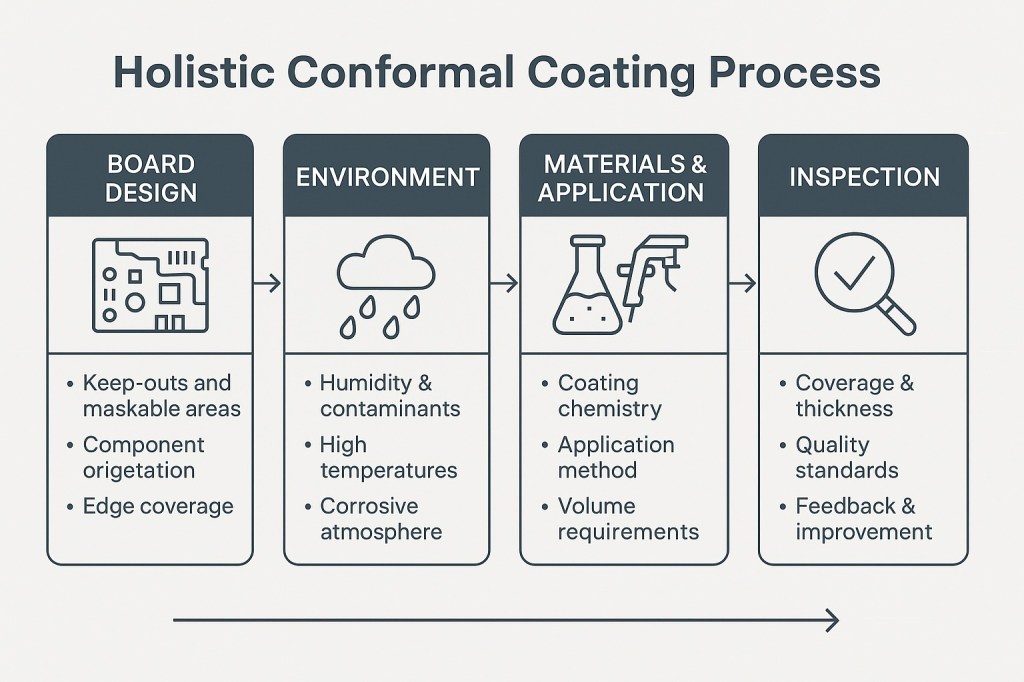
In most cases, they aren’t random at all — they are symptoms of a process that was never aligned from the start. Conformal coating only works reliably when PCB design, environmental demands, coating chemistry, application method and inspection strategy all work together as a unified system.
To help manufacturers establish stable, scalable and predictable coating processes, we’ve published a fully updated guide:
 Holistic Conformal Coating Process – End-to-End Framework
Below is a high-level summary. For the full technical model, diagrams and linked resources, explore the article above.

1. It all begins with PCB design
Most coating challenges originate at the design stage — long before production starts. Poor keep-outs, difficult orientations, insufficient drain paths or incompatible materials lead to:
- excessive masking
- rework and inspection delays
- pooling, edge thinning and trapped solvent
- long-term reliability risks
A design that supports coating reduces cost and improves first-pass yield.
Explore the Design for Conformal Coating Hub:
2. Chemistry must be matched to the real environment
No coating is universally suitable. Chemistry selection should be driven by environmental stress, including:
- humidity and condensation
- SO₂ / H₂S corrosion
- fuels, oils, chemicals and solvents
- UV exposure
- thermal cycling and vibration
- high-voltage creepage and clearance
Using the wrong chemistry often results in de-wetting, cracking, poor adhesion or long-term corrosion.
Explore:
ProShieldESD Conductive Polymer Platform
3. The application method must suit material, volume & geometry
Selective coating, manual spray, dip coating and Parylene each solve different process challenges. Selecting the wrong method leads to inconsistent thickness, material waste and increased labour.
Your method should reflect:
- production volume
- assembly density
- design geometry
- material selection
- drainage capability
- masking burden
See the Coating Process Hub Overview:
4. Material & process control prevent drift
Even well-designed processes degrade over time if material conditions are not tightly managed.
Small variations in:
- viscosity
- solvent balance
- 2K mix ratio
- temperature & humidity
- flash-off or cure profile
…can create large deviations in coverage, edge definition, adhesion and repeatability.
Good material management is one of the strongest predictors of coating stability over time.
5. Inspection closes the loop
Inspection validates the process and ensures defects are caught before assemblies reach customers.
A robust inspection strategy should include:
- UV contrast and coverage checks
- thickness measurement (preferably with coupons)
- adhesion and environmental tests
- periodic functional/hi-pot checks
Explore the Inspection & Quality Hub:
SCH-manufactured UV Inspection Booths:
6. Continuous improvement keeps the process stable
Production changes, new PCB variants and supplier shifts all introduce risk. Without structured review, even a previously stable line can begin to drift.
SCH’s consultancy team provides:
- NPI validation & materials benchmarking
- full process audits
- defect pattern analysis
- SPC review & control planning
- design alignment and masking strategy optimisation
Explore:
7. When Parylene is the smarter choice
For certain assemblies, liquid coatings will never deliver the required performance. Parylene excels when:
- geometries are complex
- components are closely packed
- surfaces are hidden, recessed or sharp-edged
- moisture protection must be absolute
- very high electrical resistance or stability is required
- field reliability is mission-critical
Explore:
8. Why the holistic model matters
Failures rarely originate in the coating booth. They arise from misalignment of design, chemistry, application method or environment.
Symptoms include:
- dewetting
- fisheyes and pinholes
- inconsistent thickness
- chronic masking leakage
- pooling and edge thinning
- delamination and poor adhesion
These issues often appear random — yet almost always stem from upstream decisions.
Explore the full Coating Defects Hub:
9. SCH’s Total Solutions Approach
Whether you coat in-house or outsource, SCH provides full lifecycle support across both liquid coatings and Parylene.
 In-house coating support
- PCB design reviews
- Full coating line development
- Application coating systems
- Parylene deposition systems
- Masking strategy optimisation
- SPC & process control planning
- Operator training
- NPI validation
- Troubleshooting, benchmarking & failure analysis
Outsourced coating services
- Liquid conformal coating
- Parylene deposition
- Specification development
- Structured consultancy & engineering support
Explore:
Total Conformal Coating Solutions
 Read the full technical framework
This blog provides a high-level summary only. For the complete methodology, diagrams, commercial considerations and cross-linked technical resources, view the full article:
