Mon - Thur 7.30-15.30   Fri 7.30-14.00

Surface Preparation for Parylene: Cleaning and Adhesion Promoters


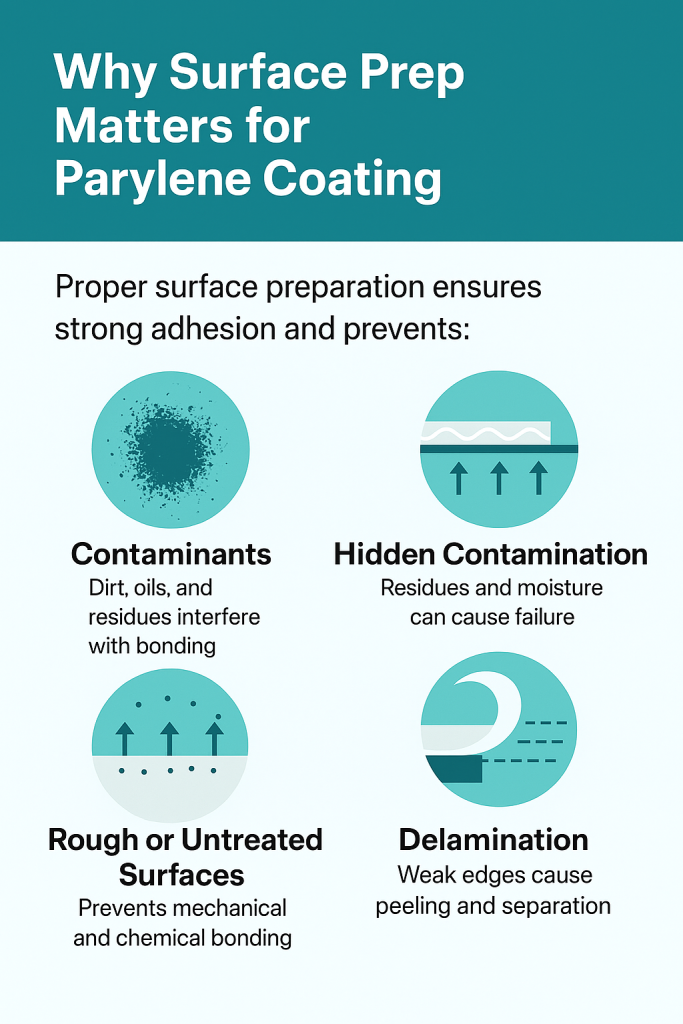
Even the best Parylene coating cannot perform reliably if the surface beneath it is not properly prepared. Adhesion failures, delamination, and reduced barrier performance often trace back to poor Parylene surface preparation. That’s why substrate preparation is one of the most critical steps before Parylene deposition.

Parylene is applied via vapour deposition, forming a thin, uniform layer that reaches every exposed surface. However, if the substrate has contamination, low surface energy, or residues, the Parylene may not bond properly β€” resulting in peeling, flaking, or reduced adhesion.

Correct preparation helps ensure:

  • Strong coating adhesion
  • Reliable moisture and chemical protection
  • Consistent long-term performance

For a deeper explanation of how vapour deposition works and why surface condition plays such a critical role, see our Parylene deposition process overview.


Cleaning: Removing contaminants

Before applying any adhesion promoter, thorough cleaning thinks about one thing: removing anything that blocks bonding. Residues such as flux, oils, fingerprints, silicone release agents, and dust can prevent Parylene from anchoring properly.

Common cleaning approaches include:

  • Solvent cleaning to remove organic residues (oils, greases, certain process residues)
  • Ultrasonic cleaning for intricate assemblies and precision components (where suitable)
  • Controlled drying to prevent water spots, residue redeposition, or recontamination

Cleaning effectiveness is also a common root cause in adhesion and coverage failures, which we break down further in our Conformal Coating Defects Hub.


Adhesion promoters: Creating reliable bonding sites

Adhesion promoters (often silane-based primers, depending on substrate and process) are used to improve Parylene bonding strength by modifying the surface chemistry. They help create functional bonding sites so the deposited film anchors more reliably.

They are particularly useful on low-surface-energy and difficult substrates such as some plastics, ceramics, and glass, and they can also support consistency across mixed-material assemblies.

By combining effective cleaning with the correct adhesion promoter strategy, manufacturers reduce delamination risk and achieve Parylene coatings that remain stable over the required service life.


SCH Services Ltd: Proven preparation and coating expertise

At SCH Services Ltd, we combine controlled cleaning and adhesion promoter treatments with expert Parylene deposition to deliver coatings that bond reliably across demanding substrates. Because these preparation steps are used in our own coating services, customers benefit from proven, production-ready processes designed for maximum performance.

Learn more: Explore our Parylene Coating Solutions or contact our team to discuss your substrate, environment, and coating thickness requirements.

If you’re assessing whether Parylene is suitable for your application or need support with substrate preparation and validation, our Parylene coating services provide end-to-end process control from preparation through inspection.
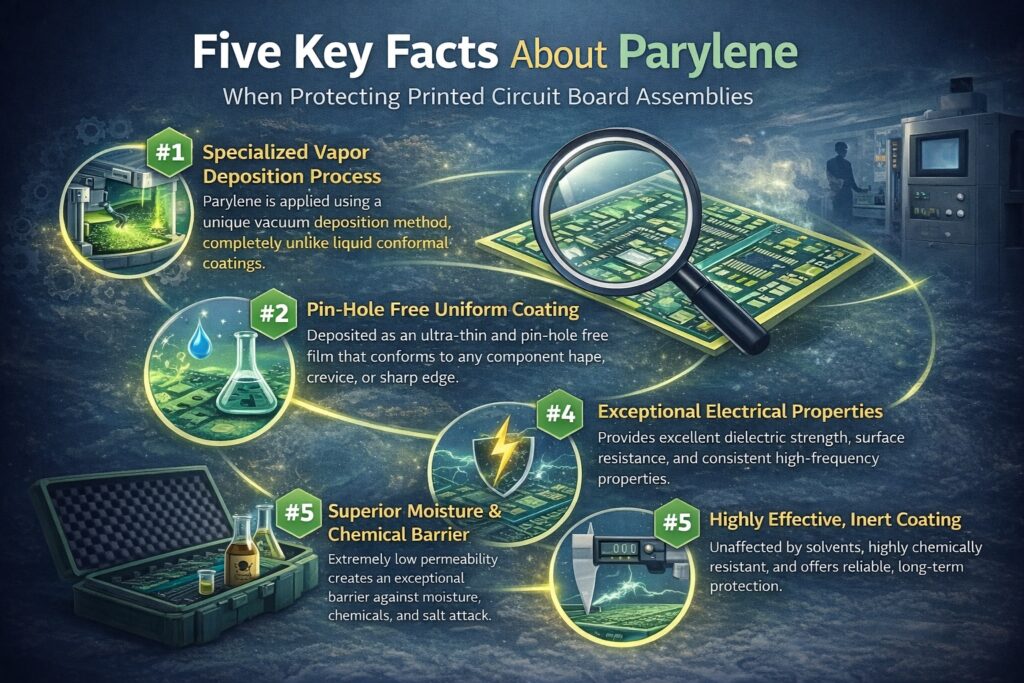
Five key facts about Parylene when protecting printed circuit board assemblies


Large industrial Parylene coating equipment featuring KR1200HS and KR1500HSU systems for high-volume medical, aerospace and electronics manufacturing

Here are five key facts about Parylene that are critical in understanding this process:

  1. The Parylene conformal coating process is a very specialised vapour deposition application method using specialist vacuum chamber systems. This differs significantly to all of the other liquid conformal coatings available on the market that are applied by spraying, brushing and dipping.
  2. Parylene coating is completely conformal and uniform to the surface of the Printed Circuit Board (PCB) or product. It is also pinhole free. Therefore, components with sharp edges, points, flat surfaces, crevices or exposed internal surfaces are coated uniformly without voids.
  3. Parylene coating provides an excellent moisture and gas barrier due its very low permeability. This means that electronics circuit boards coated in Parylene generally are more β€œwaterproof” than the same electronics coated in a liquid conformal coating.
  4. Parylene is unaffected by solvents (it has very high chemical resistance) and is very effective against salt attack.
  5. Parylene has excellent electrical properties. This includes having low dielectric constant and loss with good high-frequency properties, good dielectric strength, and high bulk and surface resistance.

Find more in-depth details about Parylene materials, deposition principles, masking methods, thickness measurement and core application concepts at our Parylene Basics HubΒ now.

Or, if you’re interested in moving towards a Parylene process click through to our Parylene Solutions, Β Parylene equipment and Parylene subcontract services pages.


Want to find out more about Parylene?

Contact us now to discuss your needs and let us explain how we can help you.

How to Remove Parylene From a Printed Circuit Board


conformal coating rework collage 640_SCH UK

Removing conformal coatings from a printed circuit board (PCB) is a hard process to do well. Removing Parylene coating is even more difficult.

The problems are many but a key reason is that the Parylene coating itself is chemically inert. It has a very high chemical resistance so the solvents don’t work well. This means any chemical attack tried with solvents or other liquid chemicals on the Parylene is as much likely to damage the circuit board than remove the actual coating.

This leaves the basic option of mechanical abrasion.

Mechanical Abrasion

Mechanical abrasion is a well known method for Parylene Removal. It can be done crudely by scraping off the Parylene with a knife or tool. Or, removal can be done with a media blast system like a Vaniman Problast system that gradually erodes the Parylene coating away.

However, mechanical abrasion is a time consuming process and is highly skilled. Also, it tends to be a localised repair and removal technique.

The concept of completely removing all of the Parylene off a circuit by mechanical abrasion is considered almost impossible unless a ridiculous amount of time and effort is injected into the process.


Find out now how much money you can save by using our Parylene removal service

We are happy to provide a quotation for removing Parylene through our coating services so you can see for yourself how much you can save.

Contact us now to request your quotation for complete removal of Parylene from a circuit board. Or, give us a call at (+44) 1226 249019 or email your inquiries at sales@schservices.com

Β 

What are the alternative materials to liquid conformal coatings?


There are several alternative coatings available to the traditional conformal coating materials.

These alternative coatings include:

  • Parylene and other Chemical Vapour Deposition (CVD) films
  • Fluorinated ultra-thin and thin film coatings
  • Molecular Vapour Deposition (MVD) coatings
  • Atomic Layer Deposition (ALD) coatings

They can provide extremely high protection to circuit boards if used correctly for the right product.

There are several new and old alternative coatings available to the traditional conformal coating materials. They include Parylene, fluorinated Nano-coatings, Molecular Vapour Deposition (MVD) and Atomic Layer Deposition (ALD) thin films.

Parylene (XY) Coatings

Parylene is the trade name for a variety of chemical vapor deposited poly(p-xylylene) polymers used as moisture and dielectric barriers.

Parylene is a conformal coating that is deposited as a gas in a vacuum chamber. It is a dry process compared to the standard β€œwet” liquid conformal coatings.

Find out more about our Parylene Coating Solutions or compare Parylene vs liquid conformal coatings in our knowledge hub.

Fluoropolymer (FC) Nano Coatings

Surface Modifiers are ultra thin nano coatings that are applied at less than a few microns in thickness. Liquid conformal coatings are applied in the range of 25-75um so they are considerably thicker in nature.

There are several variations in ultra thin conformal coatings out in the market now but two of the most popular types are liquid materials and partial vacuum deposition.

Read more about our full range of Fluoropolymer Nano Coatings.

Atomic Layer Deposition (ALD)

ALD belongs to the family of chemical vapor deposition methods (CVD).

  • It is a deposition process at a Nano-scale level within a vacuum chamber.
  • The deposition process forms ultra-thin films (atomic layers) with extremely reliable film thickness control.
  • This provides for highly conformal and dense films at extremely thin layers (1-100nm).

Molecular vapour deposition (MVD)

MVD belongs to both the families of chemical vapor deposition (CVD) and atomic layer deposition (ALD) methods.

  • Unlike traditional CVD and ALD flow systems the MVD reaction takes place in a chamber under static pressure resulting in extremely low chemical use.
  • The MVD process produces highly conformal thin film coatings, typically less than 100nm in thickness.
  • The coating provides excellent barrier properties and surface energy control.

Need to know more about alternative materials to the traditional liquid conformal coatings?

Contact us now and we can discuss how we can help you. Or, give us a call at (+44) 1226 249019 or email your inquiries at sales@schservices.com

0
  • Your current order total is £0.00 β€” you must have an order with a minimum of £75.00 to place your order.
0
Your Cart
Your cart is empty
  • Your current order total is £0.00 β€” you must have an order with a minimum of £75.00 to place your order.
Calculate Shipping
  • Your current order total is £0.00 β€” you must have an order with a minimum of £75.00 to place your order.

Conformal Coating UK

Conformal Coating UK
Privacy Overview

This website uses cookies so that we can provide you with the best user experience possible. Cookie information is stored in your browser and performs functions such as recognising you when you return to our website and helping our team to understand which sections of the website you find most interesting and useful.