A manufacturing customer operating an electronics assembly line identified that their PVC conveyor belt surface had drifted out of ESD compliance over time.
Measured surface resistivity had increased to:
>109 Ω/sq
At this level, the belt was behaving as an insulator rather than a static dissipative surface — introducing electrostatic risk in a controlled production environment.
Full belt replacement was possible, but would have involved production downtime, mechanical removal, and significant cost. SCH proposed an alternative: on-site restoration using a flexible ProShieldESD coating platform.
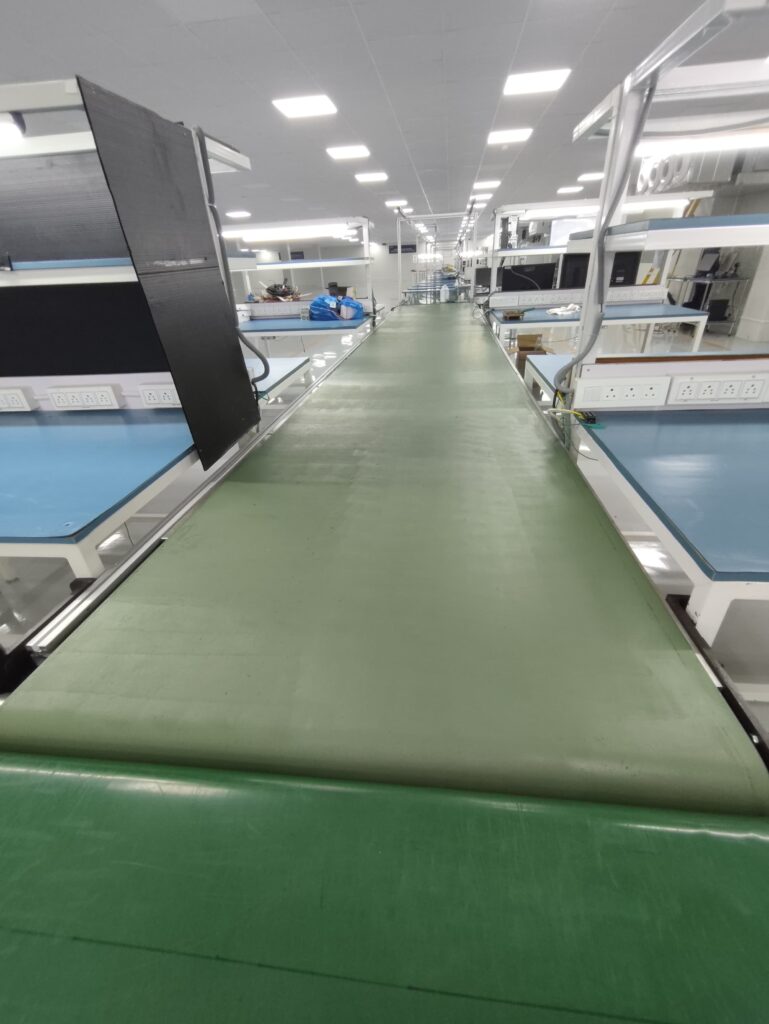
Original PVC conveyor belt (left foreground) compared with newly applied flexible conductive coating (right), restoring surface resistivity from >109 Ω/sq to 106–107 Ω/sq without belt removal.
Substrate & Conditions
- Substrate: Flexible PVC conveyor belt
- Environment: Active assembly line
- Requirement: Maintain flexibility and mechanical durability
- Application constraint: No belt removal
Technical Solution
A new two-part flexible conductive coating variant (within the ProShieldESD platform) was applied directly to the belt surface. Application was carried out via our ProShieldESD subcontract coating services, enabling in-situ refurbishment without mechanical disruption.
Application Method
- Surface cleaned with mild solvent
- No primer required
- Roller-applied in situ
- Belt remained installed
- Functional resistivity confirmed within 2–3 hours
Performance Outcome
Post-application surface resistivity:
106 – 107 Ω/sq
This returned the surface into the static dissipative range, suitable for electronics assembly environments. For more detail on conductive polymer behaviour and how ProShieldESD differs from conventional ESD paints, see the ProShieldESD FAQs.
Additional Technical Advantages
- Fully flexible after cure
- Mechanically durable
- Localised repair possible (scratch-visible indicator)
- No complex tooling required
Engineering Value
This approach demonstrates a practical refurbishment model for flexible plastic ESD surfaces where:
- Conductive fillers in the original belt degrade over time
- Cleaning cycles reduce surface performance
- Capital replacement costs are disproportionate
Instead of replacing mechanical infrastructure, the ESD performance layer can be reinstated as a coating system.
Conclusion
This field beta installation confirms that flexible PVC conveyor systems can be restored to static dissipative performance without removal or downtime-heavy replacement.
For facilities managing ageing ESD flooring, mats or conveyor systems, this represents a significant process and cost advantage.