Static Control Coatings for Industrial Equipment
Upgrade Machinery, Enclosures and Production Systems with Static-Dissipative Surfaces
Industrial equipment often combines metal structures with insulating polymer covers, panels, housings and guarding. While these materials offer clear mechanical and design advantages, they can also allow static charge to accumulate during normal operation, airflow, movement or handling.
ProShieldESD offers a practical route to static control without redesigning the equipment in specialist conductive materials. By applying a conductive polymer coating to selected surfaces, machinery and production equipment can be upgraded with controlled static-dissipative performance while retaining the original component design and function. In many ESD control applications the objective is a stable static-dissipative surface rather than a highly conductive finish.
Learn more about the ProShieldESD coating platform, the underlying filler-free ESD coating technology, our comparison page on conductive coatings vs conductive plastics, the broader page on anti-static coating for plastic and our overview of ESD coating.
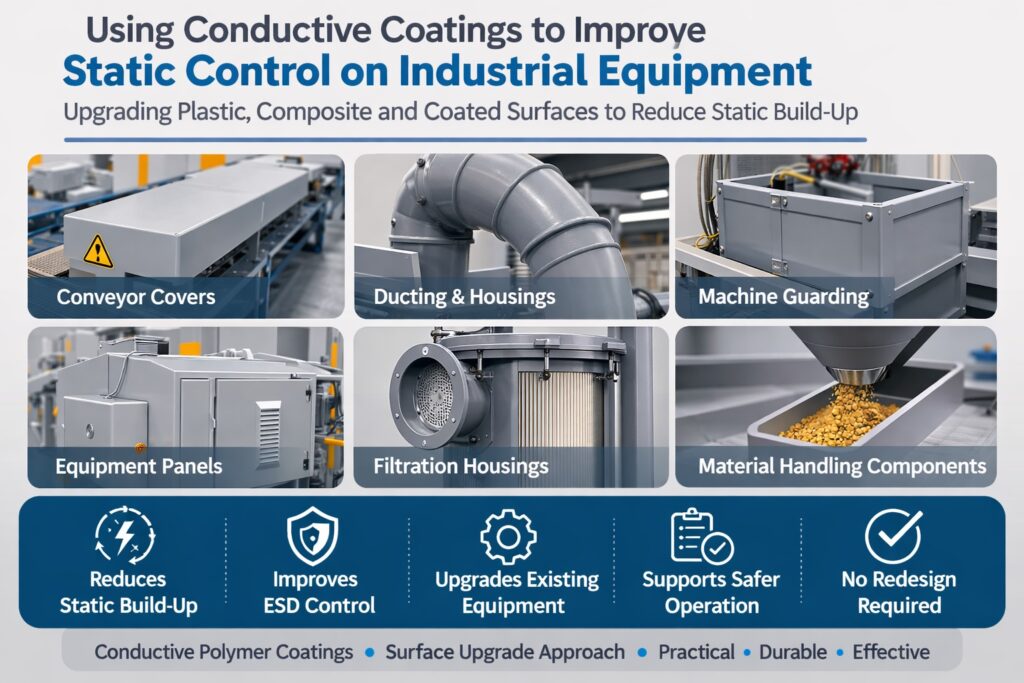
Infographic showing how conductive polymer coatings provide static control on industrial equipment surfaces such as machine covers, ducting, equipment housings and material handling systems.
Where Static Problems Occur on Industrial Equipment
Static electricity can affect a wide range of industrial systems, particularly where polymer surfaces, airflow, moving parts or dry environments are present. Even where the main machine frame is metallic, localised insulating components may still allow electrostatic charge to build up.
- ✅ Machinery housings and external covers
- ✅ Automation equipment enclosures and robotics panels
- ✅ Machine guarding panels and access doors
- ✅ Conveyor system parts and handling equipment covers
- ✅ Test equipment casings and fixture assemblies
- ✅ Packaging machinery panels and process enclosures
- ✅ Production line equipment with insulating surface materials
In these environments, static charge can contribute to dust attraction, contamination, nuisance discharge events and inconsistent process behaviour.
Why Conventional Static Control Solutions Can Be Difficult
Managing static electricity on industrial equipment is not always straightforward. While grounding is essential at system level, it does not automatically solve static build-up on insulating covers, panels and polymer assemblies.
- ✅ Conductive plastics can increase material and manufacturing costs.
- ✅ Carbon-filled materials may affect appearance, weight and mechanical properties.
- ✅ Replacing existing machine parts can trigger redesign and qualification work.
- ✅ Retrofitting static control into installed equipment is often challenging.
- ✅ Isolated or removable parts may not benefit fully from conventional grounding alone.
As a result, many machine builders and end users need an alternative method to introduce static-dissipative behaviour to critical surfaces without rebuilding the equipment.
Using Conductive Polymer Coatings for Static Control
Static control coatings for industrial equipment provide a practical way to upgrade selected surfaces without replacing the underlying material. A thin conductive polymer coating can be applied to appropriate covers, housings, panels or guarding to create a controlled dissipative pathway across the surface. This approach allows the original mechanical design to be retained while improving electrostatic behaviour in service.
ProShieldESD uses conductive polymer technology to deliver stable surface conductivity without relying on traditional filler-loaded paints. This helps reduce static build-up on insulating surfaces used throughout industrial machinery and automation systems. In many industrial ESD applications, the practical target is a controlled static-dissipative surface rather than a highly conductive coating.
To understand the underlying science, see the ProShield conductive polymer technology platform. You can also learn more about filler-free ESD coating technology, compare design routes in our guide to conductive coatings vs conductive plastics, explore the broader surface-upgrade route in our page on anti-static coating for plastic and read the main overview of ESD coating.
Typical Surface Resistivity Range
Industrial static control coatings are typically designed to create a static-dissipative surface rather than a highly conductive one. Typical target surface resistivity values are in the range of 106 – 109 Ω/sq. This allows electrostatic charge to dissipate in a controlled and predictable manner, helping reduce the risk of charge accumulation while avoiding the rapid discharge associated with highly conductive materials.
Example Applications for Industrial Equipment
Static-dissipative coatings can support a wide range of machinery and production environments where insulating surfaces create electrostatic concerns.
- ✅ Robotics and automation equipment covers
- ✅ Conveyor systems and material handling equipment
- ✅ Electronics manufacturing equipment and test stations
- ✅ Packaging machinery and production line enclosures
- ✅ Inspection windows, guarding and access panels
- ✅ Fixtures, jigs and process tooling with polymer surfaces
This makes conductive polymer coatings particularly useful where existing equipment needs to be upgraded for improved static control without replacing complete assemblies. Related applications can also be explored in our pages on ESD coating, anti-static coating for plastic, static control for plastic components and static control in hazardous environments.
Engineering Considerations Before Coating Industrial Equipment
The suitability of any static control coating depends on the substrate, operating environment and how the coated component functions within the wider machine system.
- ✅ Surface preparation and adhesion must be appropriate for the substrate.
- ✅ Final resistivity should align with the intended static control strategy.
- ✅ Grounding arrangements should be considered where coated surfaces form part of a larger system.
- ✅ Mechanical wear, cleaning processes and chemical exposure should be reviewed.
- ✅ Coating chemistry should be matched to durability and environmental requirements.
These factors help ensure that static control performance is stable in real production conditions rather than only under laboratory measurement.
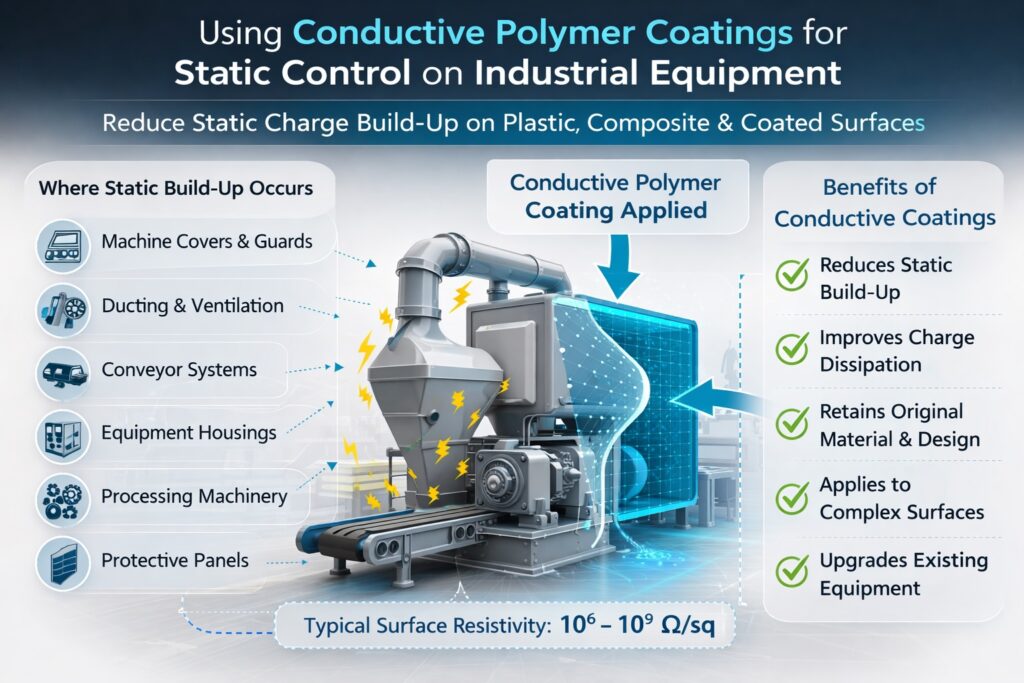
Diagram illustrating how conductive polymer coatings can convert insulating equipment surfaces into controlled static-dissipative materials to improve electrostatic control.
Need Static Control on Industrial Equipment?
If static build-up on machinery covers, enclosures, guarding or process equipment is affecting performance, cleanliness or reliability, ProShieldESD may provide a practical retrofit solution.
We can review the substrate, component function and operating environment to assess whether conductive polymer coatings are suitable for your industrial equipment.
Keep the equipment. Upgrade the surface. Let’s evaluate whether static-dissipative coatings can support your process.
Useful Links
- ProShieldESD Overview
- What Is an ESD Coating?
- Introduction to ProShieldESD
- Anti-Static Coating for Plastic
- Conductive Coatings vs Conductive Plastics
- Static Control for Plastic Components
- Static Control in Hazardous Environments
- Where ProShieldESD Can Be Used
- Chemistries & Available Formats
- Outsourced Coating Services
- FAQs – Learn More About ProShieldESD
Related Static Control Applications
Why Use ProShieldESD on Industrial Equipment?
- ✅ Retain existing equipment – Upgrade selected surfaces without redesigning complete machines in conductive materials.
- ✅ Stable surface conductivity – Conductivity is delivered through conductive polymer technology rather than conventional filler loading.
- ✅ Flexible application scope – Suitable for covers, housings, guarding, panels and other insulating machine surfaces.
- ✅ Cost-effective retrofit path – Improve static control without replacing complete equipment or assemblies.
- ✅ Chemistry options available – Coating formats can be selected to suit substrate and service conditions.
- ✅ Engineering-led assessment – Evaluate the part, the process and the environment before choosing the correct route.
Static control coatings for industrial equipment can help reduce contamination risk, improve process consistency and support more reliable operation across machinery and production systems. In many cases, that improvement is delivered as a stable static-dissipative surface created using conductive polymer technology rather than as a highly conductive finish.