Anti-Static Coating for Plastic
Convert Standard Plastic Surfaces into Static-Dissipative Engineering Materials
Plastic is widely used across industrial equipment, packaging, housings, covers and handling systems, but most standard plastics are electrical insulators. This means static charge can accumulate on the surface during handling, airflow, friction or normal operation, creating risks such as dust attraction, contamination, nuisance discharge and poor process control.
Anti-static coating for plastic provides a practical alternative to redesigning parts in specialist conductive materials. By applying conductive polymer technology to the surface, standard plastic components can be converted into stable static-dissipative surfaces while retaining the original material, shape and mechanical performance. In most ESD applications, the aim is controlled static dissipation rather than a highly conductive finish.
Learn more about the ProShieldESD coating platform, the underlying filler-free ESD coating technology, our guide to conductive coatings vs conductive plastics and the broader overview page on ESD coating.
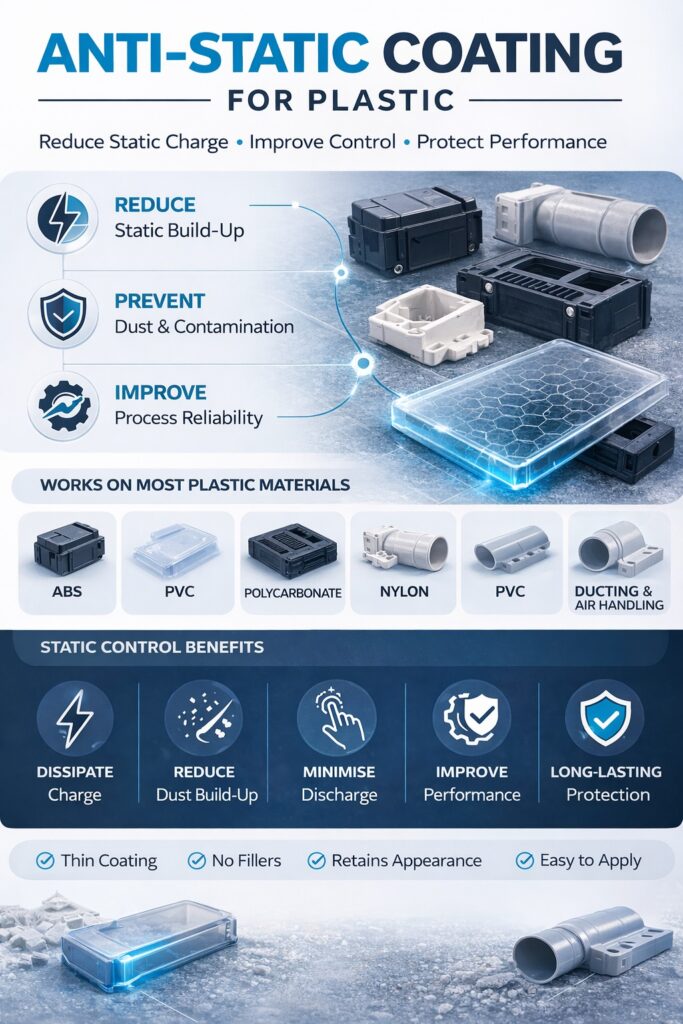
Infographic explaining how anti-static coating for plastic converts insulating polymer surfaces into controlled static-dissipative materials using conductive polymer technology.
Why Plastic Surfaces Generate Static
Most plastics commonly used in engineering and manufacturing are highly insulating. Because they do not naturally dissipate charge, electrostatic energy can build up on the surface through everyday movement and process conditions.
- Handling and contact between parts
- Airflow across covers, ducts and housings
- Friction during transport or assembly
- Movement through conveyors and packaging lines
- Dry operating conditions that reduce natural dissipation
This is why anti-static coating for plastic is often needed on parts that are otherwise mechanically suitable but electrically insulating.
Where Anti-Static Coating for Plastic Is Used
Plastic surfaces appear in many different industrial and technical environments. Anti-static coatings can be applied where electrostatic charge control is required but the base material needs to remain plastic for cost, weight, transparency or design reasons.
- Plastic housings and instrument enclosures
- Machine covers and protective guarding
- Ventilation ducts and fan assemblies
- Conveyor parts and handling equipment
- Packaging inserts, trays and protective structures
- Automation panels, robotics covers and fixtures
Many of these applications are explored further in our pages on ESD coating, static control for plastic components, static control for industrial equipment and static control in hazardous environments.
Why Not Just Use Conductive Plastics?
Conductive plastics can solve some static control problems, but they are not always the most practical or economical route. Many projects only need a controlled static-dissipative surface rather than a fully conductive bulk material.
- Conductive plastics are often more expensive than standard grades.
- Specialist materials may affect appearance, weight or mechanical behaviour.
- Changing the material may trigger redesign, tooling or validation work.
- Installed equipment cannot usually be upgraded by changing bulk plastic.
- Surface performance is often the real requirement, not full part conductivity.
For a deeper engineering comparison, see conductive coatings vs conductive plastics.
How Anti-Static Coating for Plastic Works
Instead of replacing the substrate, anti-static coating for plastic modifies the surface behaviour. A conductive polymer coating is applied to the plastic surface to create a controlled pathway for charge dissipation. This allows the original plastic component to retain its mechanical and dimensional properties while gaining improved electrostatic performance.
ProShieldESD uses conductive polymer technology to create stable, homogeneous conductivity without relying on conventional filler-loaded coatings. In practical ESD use, this usually means producing a static-dissipative surface rather than a highly conductive one.
For a broader explanation of the concept, see our page on ESD coating.
Typical Surface Resistivity Range
Anti-static coating for plastic is typically designed to produce a static-dissipative surface rather than a highly conductive one. Typical target surface resistivity values are in the range of 106 – 109 Ω/sq. This range allows electrostatic charge to dissipate in a controlled way while avoiding the rapid discharge associated with highly conductive materials. Stable resistivity within this window is important for predictable performance in ESD-sensitive environments.
Benefits of Anti-Static Coating for Plastic
- ✅ Retain standard plastics – Keep the original material where it already meets the design need.
- ✅ Avoid unnecessary redesign – Upgrade surface behaviour without changing the entire part.
- ✅ Reduce dust attraction – Lower contamination risk on exposed plastic surfaces.
- ✅ Support controlled charge dissipation – Improve ESD management using static-dissipative surface behaviour.
- ✅ Upgrade installed assets – Apply static control to existing parts, covers and structures.
- ✅ Use one platform across many substrates – Apply the same technology across multiple plastic applications.
These advantages make anti-static coating for plastic particularly attractive where conductivity is needed at the surface but a full material change would be excessive.
Engineering Considerations
As with any functional coating system, suitability depends on both the substrate and the operating environment. Before selecting an anti-static coating for plastic, engineers should consider the following:
- Surface preparation and adhesion compatibility with the plastic type
- Required resistivity range for the intended ESD control strategy
- Mechanical wear, cleaning and chemical exposure during service
- Whether grounding paths are needed at equipment level
- Coating chemistry selection for substrate and durability requirements
These factors help ensure the resulting anti-static plastic surface performs reliably in real production and service conditions.
Need Anti-Static Coating for Plastic?
If plastic housings, covers, ducts, panels or packaging parts are generating unwanted static, a coating-based route may provide a practical upgrade without redesigning the whole part.
We can assess your plastic substrate, application environment and electrostatic requirements to determine whether a static-dissipative coating is appropriate.
Keep the plastic. Upgrade the surface.
Useful Links
- ProShieldESD Overview
- What Is an ESD Coating?
- Introduction to ProShieldESD
- Conductive Coatings vs Conductive Plastics
- Static Control for Plastic Components
- Static Control for Industrial Equipment
- Static Control in Hazardous Environments
- Chemistries & Available Formats
- FAQs – Learn More About ProShieldESD
Why ProShieldESD Is Well Suited to Plastic Surfaces
ProShieldESD is designed around conductive polymer science rather than conventional filler loading. That means plastic parts can be upgraded using a more stable and flexible surface-engineering route.
- ✅ Filler-free conductive polymer technology – Supports stable surface performance without conventional carbon-loaded paints.
- ✅ Static-dissipative outcomes for ESD control – Typically targets the resistivity range most useful for controlled charge dissipation.
- ✅ Compatibility with broader engineering use – Supports housings, covers, ducts, panels and other polymer parts.
- ✅ Retrofittable approach – Particularly useful where the existing part is already mechanically suitable.
Anti-static coating for plastic is not only about reducing nuisance charge. It is an engineering route for improving reliability, cleanliness and static control performance without changing the entire product architecture.