A second layer of Parylene can work — but it is not the same as getting it right first time
Parylene is often treated as a one-pass, final coating process, but in practice assemblies are sometimes modified after coating and require further protection. In these cases, a second Parylene layer may be applied over an already coated and locally changed surface.
Our experience shows that this can work in some cases, with the second layer depositing well and restoring useful coverage. However, it should be treated as an engineered recovery option, not a direct equivalent to a single controlled original coating process.
Quick take. Parylene can sometimes be successfully overcoated after rework or modification, but performance depends on the condition of the original coating, the nature of the change and the final application requirements.
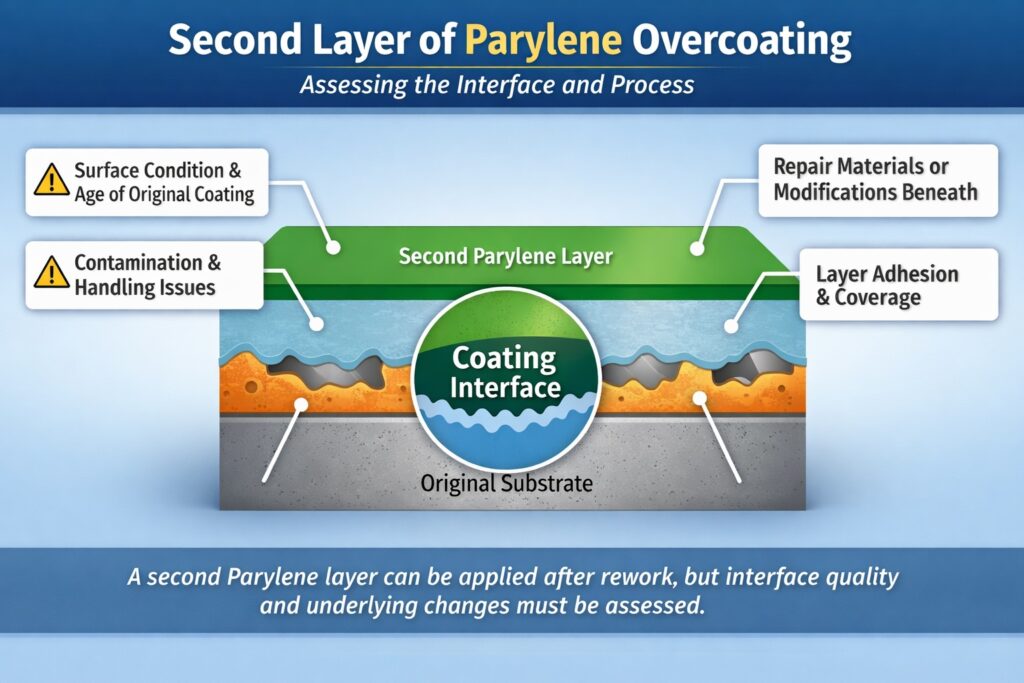
Second-layer Parylene can be applied after rework, but coating interface quality, surface condition and underlying modifications must be carefully assessed.
Why this matters
A common assumption is that once Parylene has been applied, the coating architecture is fixed and cannot be meaningfully altered. In reality, many assemblies go through change after coating, including component replacement, local repair or design updates.
When that happens, the engineering decision is no longer about ideal process flow. It becomes a practical question: can protection be restored without stripping and restarting completely?
That is where second-layer overcoating becomes a useful option to consider.
What we have seen in practice
In recent work, assemblies that had already been coated and then locally modified were overcoated with a second Parylene layer.
The key observation was that the second layer deposited well over the existing surface, providing renewed coverage over the changed areas without obvious visual defects.
This demonstrates that previously coated parts are not automatically excluded from further vapour deposition work when engineering changes are required.
Where the limitation sits
The important point is not whether overcoating is possible. It is how it compares to a first-pass coating on a correctly prepared surface.
A second-layer system introduces additional variables:
- surface condition and ageing of the original coating
- handling or contamination prior to recoating
- local repair materials or modified substrates beneath the new layer
- interface behaviour between coating layers
Because of this, overcoating should not automatically be treated as equivalent to a single, well-controlled original deposition.
Why overcoating can still work
Parylene is deposited through a vapour-phase process, allowing it to conform to existing surfaces rather than relying on liquid wetting behaviour.
Where the underlying surface is suitable, this allows a second layer to follow the existing geometry and build additional barrier coverage over modified regions.
That is why overcoating can be a credible engineering option, even though it is not identical to a first-pass coating scenario.
Where this is most useful
Second-layer overcoating is most relevant where assemblies have already been coated and then changed, and where a full strip and restart may be disproportionate in cost, time or risk.
- post-coating engineering changes
- repair or modification of coated assemblies
- situations where local protection is no longer sufficient
- evaluation of recovery options on high-value assemblies
In these cases, overcoating provides a middle ground between local repair and full coating removal.
What This Means in Practice
If a coated assembly has been modified, the next step is not always to strip everything and start again. A second Parylene overcoat may provide a practical way to restore protection.
However, this should be approached as an engineering decision rather than a default process. The condition of the existing coating, the nature of the change and the required performance all need to be considered.
For engineering teams, this creates an additional option — not a replacement for getting the original coating process right.
Need support with Parylene rework or overcoating?
SCH supports assessment of rework routes including local repair, strip and recoat, and second-layer overcoating where assemblies have already been modified after coating.
This includes practical evaluation of feasibility, risk and performance based on the specific application rather than assumptions.
Parylene Coating Services | Removal & Rework Systems | Engineering Consultancy