
Introduction
Fine-feature metal structures such as stent frames and other micro-machined components present unique challenges in conformal coating. While Parylene deposition is inherently conformal, the real engineering work is usually in preparation discipline, repeatable presentation and fixturing, thickness control and inspection strategy.
This technical insight outlines practical considerations when coating small metal lattice or tubular structures, without assuming a regulated end-use and without relying on application-specific claims.
Infographic: Key Engineering Considerations
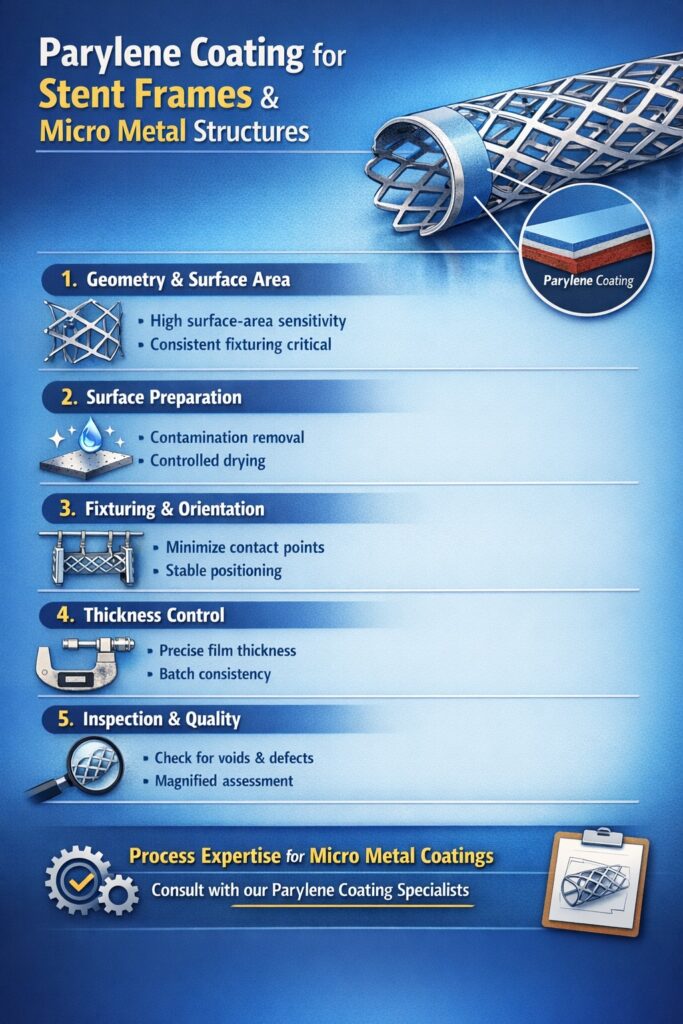
Engineering considerations when applying ultra-thin Parylene coatings to fine-feature metal components.
This infographic summarises the key engineering controls required when applying Parylene to micro-structured metal components, including geometry sensitivity, surface preparation discipline and inspection methodology.
1) Geometry and Surface-Area Effects
Micro-structured components typically have a very high surface-area-to-mass ratio. This influences deposition consistency and the sensitivity of results to small variations in handling and contamination. Key considerations include:
- Stability of deposition rate across very small loads
- Local thickness variation across tight lattice features
- Handling sensitivity during loading and unloading
- Batch repeatability driven by spacing and presentation
Although Parylene polymerises conformally, orientation and spacing still influence consistency across a batch. Repeatable fixturing is therefore critical.
2) Surface Preparation of Metal Substrates
For metals commonly used in precision components, such as stainless steel, aluminium alloys, cobalt chrome or shape-memory alloys including nitinol, coating reliability is strongly linked to surface condition. Typical process controls include:
- Removal of machining oils, polishing compounds and handling residues
- Controlled drying to reduce moisture carryover
- Particulate control following any abrasive or finishing step
- Consistent adhesion promotion where required
Because ultra-thin polymer films are unforgiving, minor surface contamination or moisture carryover can significantly affect adhesion and long-term performance. The most reliable results come from disciplined handling, documented preparation steps and prevention of re-contamination between stages.
3) Fixturing and Orientation
How a component is supported inside the deposition chamber directly impacts contact marks, shadowing risk and run-to-run reproducibility. Effective fixturing aims to:
- Minimise contact points and avoid critical functional areas
- Maintain consistent spacing between parts
- Prevent movement during pump-down and deposition
- Enable repeatable loading practices for process control
For small tubular or lattice components, suspended or end-supported configurations are often preferred to reduce contact artefacts and ensure uniform exposure of complex geometry.
4) Thickness Selection and Control
Film thickness should be selected based on the required function, such as barrier performance, flexibility and dimensional tolerance. Achieving consistent thickness on micro parts relies on disciplined control of:
- Material loading calculations
- Chamber stability and repeatable batch configuration
- Verification using witness coupons and documented inspection checks
For more detailed guidance on thickness considerations, see our article: Parylene Thickness & Environmental Protection: How Much Is Enough?
5) Inspection and Quality Checks
Inspection of fine metal components typically involves magnified visual assessment for:
- Coverage continuity
- Pinhole or void indications
- Foreign inclusions or particulates
- Handling damage or contact marking
Where coating removal or selective rework is required on precision components, a controlled approach is essential. For broader rework considerations, see our Removal & Rework Hub.
Practical Next Step
If you are evaluating Parylene for fine-feature metal parts and would like a process-focused discussion around geometry, fixturing and thickness targets, our engineering team can assist.
Related Resources
FAQs
Is Parylene suitable for very small metal lattice structures?
Yes. Parylene deposition is conformal and capable of coating fine features uniformly. However, surface preparation, contamination control and repeatable fixturing play a critical role in achieving consistent results.
Does part orientation matter during Parylene deposition?
Yes. While Parylene is not line-of-sight limited, orientation and spacing influence repeatability and reduce the risk of contact artefacts or localised non-uniformity across a batch.
What metals can be coated with Parylene?
Parylene is commonly applied to a range of metals used in precision engineering, including stainless steels, aluminium alloys, nickel-containing alloys and shape-memory alloys such as nitinol. Final performance depends on preparation discipline and intended service environment.
