Why static risk often begins before equipment reaches the rack
Packaging is often treated as a logistics detail, not an ESD control point. In reality, cardboard, foams, trays, inserts and temporary handling materials can all influence static risk before equipment is even installed.
This creates a blind spot in many data centre environments: the electronics may enter a controlled space, but only after moving through uncontrolled packaging and staging conditions.
Quick take. If packaging, storage and staging materials are ignored, ESD protection starts too late. In many cases, the risk begins before the rack is ever opened.
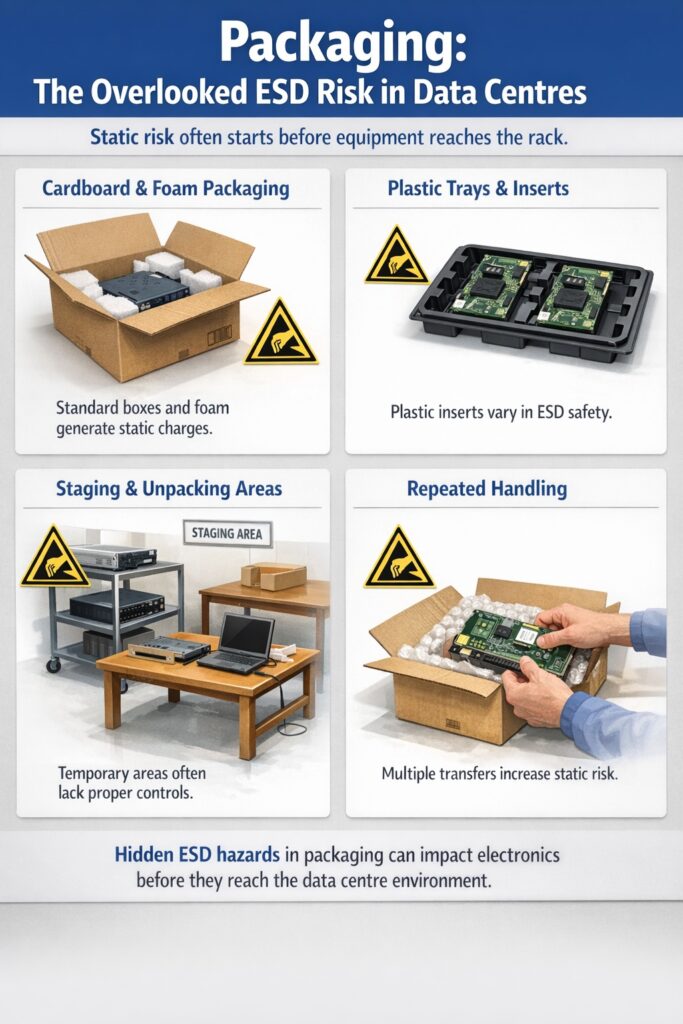
Packaging materials such as cardboard, foams, trays and staging environments can introduce hidden ESD risk before electronics reach controlled data centre areas.
Why this matters
Many ESD programmes focus heavily on workstations, operators and final handling areas. That makes sense on paper, but it can miss a critical part of the journey: how electronics are stored, shipped, unpacked and staged before use.
Servers, boards, modules and replacement parts frequently arrive in mixed packaging systems that include cardboard cartons, foam inserts, plastic trays, temporary protective films and transport aids. These materials may be practical for logistics, but they are not always neutral from an electrostatic point of view.
If packaging is not considered as part of the wider ESD strategy, static risk may already have been introduced before the equipment reaches the controlled area.
This forms part of a wider pattern where ESD protection is fragmented across environments, as explained in why ESD protection fails in data centres.
The pattern we see again and again
In many environments, packaging is seen as temporary, so it is treated as less important than permanent infrastructure. In practice, temporary materials can be involved in repeated handling and repeated risk.
- Equipment is received in standard packaging and moved into staging areas.
- Foams, inserts and trays remain in use during unpacking and temporary storage.
- Components are transferred between boxes, benches, carts and racks.
- Packaging is reused or repurposed without reviewing its ESD suitability.
- Attention stays on the operator while the surrounding materials are ignored.
The result is a chain of small exposures that may never appear in formal process maps, but still affect real-world reliability.
Even where operator controls are in place, they do not address packaging-related risk, which is why wrist straps alone are not sufficient.
Why packaging creates hidden ESD exposure
Packaging sits at the boundary between logistics and electronics handling. That is exactly why it gets missed.
- Cardboard and foams can contribute to charge generation during movement and contact.
- Plastic trays and inserts vary widely in their ESD behaviour.
- Temporary staging areas may not have the same controls as formal workstations.
- Repeated unpacking, repacking and movement adds more handling events.
Because packaging is often short-lived, teams assume it does not matter. But short-lived materials can still create risk during the exact moments when electronics are most exposed.
Practical warning sign. If your ESD controls begin only when the equipment reaches the bench, rack or maintenance station, your real control boundary may be too late.
A better way to think about packaging
A stronger approach is to treat packaging as part of the handling environment, not just as a shipping material.
- Review what materials sensitive electronics arrive in.
- Assess how long those materials remain in contact with the product.
- Look at where unpacking and staging actually happen.
- Consider whether higher-risk materials can be reduced, replaced or better controlled.
This does not mean every box becomes an engineering project. It means recognising that packaging is often the first real ESD environment the product experiences.
What this means in practice
If packaging is outside your ESD review, there is a good chance your control strategy starts too late. This is especially relevant in data centres where replacement hardware, spares and service parts move repeatedly through temporary holding and handling areas.
For a broader view of infrastructure, staging and handling risk, see our ESD Protection for Data Centres page. To understand how these issues combine at system level, see Why ESD Protection Fails in Data Centres and Wrist Straps Don’t Protect Data Centres.
In many cases, improving packaging awareness is one of the simplest ways to close practical ESD gaps without overcomplicating the wider programme.
Why Choose SCH Services?
SCH supports customers with practical ESD strategy thinking across packaging, handling environments, infrastructure and surface behaviour. We help teams look beyond formal control points and identify where risk is actually introduced in day-to-day operations.
This is often where seemingly minor packaging decisions have a bigger reliability impact than expected.