Solvent-Based Conformal Coating Removal (UK & Europe)
When solvents work, when they don’t — and how to control risk on high-value PCB assemblies
Solvent-based conformal coating removal can be a safe and efficient option for certain coatings (especially many acrylics) — but it can also create serious risks if applied by “trial-and-error” or with aggressive immersion. This guide explains when solvents are appropriate, the key compatibility and residue risks, and the escalation rules for when to switch to micro-abrasive methods.
If the coating chemistry is unknown, start here first: Identify Unknown Conformal Coatings (IPC-7711 Method).
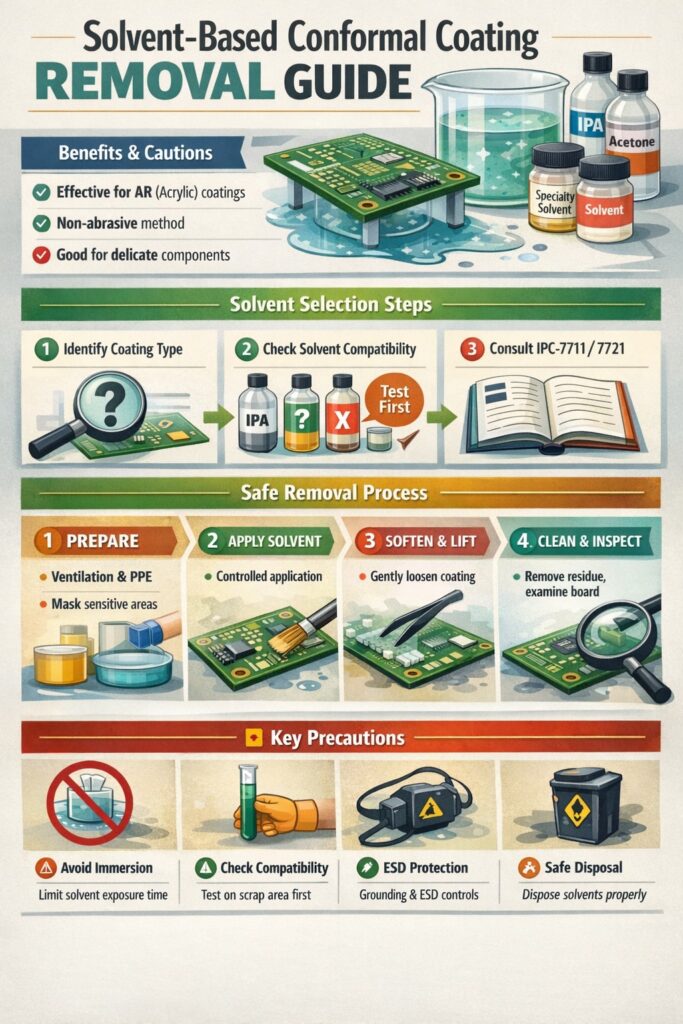
Solvent-based conformal coating removal workflow for PCB rework — showing when solvents are effective, how to apply locally using low-lint swabs, compatibility risks, residue control and when to escalate to micro-abrasive methods in UK & European production environments.
Quick Navigation
- When solvent removal works (and when it does not)
- The “local-only” rule (avoid immersion)
- Localised solvent delivery with swabs (controlled rework)
- Compatibility risks (plastics, labels, inks, masks)
- Process controls: how to reduce damage risk
- Residue, cleaning & recoat readiness
- When to stop and escalate to micro-abrasion
- FAQs
- Support: trials, services & training
1) When solvent removal works (and when it does not)
Solvent-based removal relies on softening, swelling, or partially dissolving the coating so it can be removed in a controlled way. The key is that solvent response varies massively across coating families and even between products in the same family (due to cure state, age, thickness, and rework history).
| Coating family | Typical solvent response | Practical implication |
|---|---|---|
| Acrylic (AR) | Often the most responsive (many systems soften/solubilise) | Solvent-based local removal can be viable with strict control and protection of plastics/markings. |
| Urethane (UR) | Variable; often tough/elastic; may soften but smear | Solvents can help, but edge control and contamination control become critical; trials recommended. |
| Silicone (SR) | Often limited; may swell or become gummy | Solvent routes can create smearing/dragging; assess behaviour carefully before committing. |
| Epoxy (ER) | Typically resistant once cross-linked | Solvent-based removal is often unreliable; micro-abrasion is usually the controlled option. |
| Parylene (XY) | Highly resistant to solvents in practice | Solvent removal is generally not the route; use controlled micro-abrasion for access windows. |
For a method-by-method comparison (wet routes vs micro-abrasion), use: Conformal Coating Removal Methods (Wet & Micro-abrasion).
2) The “local-only” rule (avoid immersion)
In most electronics rework environments, solvent use should be treated as a local, controlled action — not a “dip and wait” approach. Immersion increases the probability of damaging plastics, adhesives, inks, and component seals, and it can drive contamination under low-standoff components.
- Work locally: target only the area that must be exposed (pads, joints, test points, connector zones).
- Control time-on-board: define maximum exposure time and escalation rules.
- Protect the surroundings: masking and shielding reduces collateral attack on plastics and markings.
- Plan the boundary: define where removal stops and where coating must remain intact.
3) Localised solvent softening & removal using low-lint swabs (controlled acrylic rework)
In practical PCB rework, solvents are commonly applied using swabs soaked in solvent to locally soften acrylic conformal coatings so the coating can be lifted, wiped away or mechanically assisted from wrongly coated areas, keep-out zones, connector lands, pads and test points.
This approach gives far better control than flooding or immersion and is especially effective for correcting masking errors, overspray and local coating breaches without disturbing surrounding protected areas.
Why specialist low-lint swabs are critical (and cotton buds are a risk)
- Near lint-free construction: proper electronics swabs shed virtually no fibres. Cotton buds shed lint which can lodge under components, into vias and around fine-pitch pads.
- Contamination control: loose fibres trap softened acrylic residues and redeposit contamination back into the rework area.
- Recoat reliability: trapped fibres can compromise coating adhesion and create defects after reapplication.
- Edge quality: firm, shaped swab tips allow controlled wiping and lifting of softened coating without tearing solder mask.
- Process repeatability: consistent swab geometry and solvent load improves operator consistency and reduces variability.
- Localised delivery: solvent stays where it is needed — reducing migration under components and collateral attack on plastics and markings.
Typical production uses
- Removing acrylic coating from keep-out zones after masking leakage or overspray.
- Cleaning coating from connector contacts, pads and test points prior to electrical test or rework.
- Localised softening of coating before controlled mechanical assist.
- Edge clean-up prior to selective recoating.
Commercial note: SCH supplies specialist low-lint solvent-compatible polyester swabs for electronics rework and uses the same swabs daily within our own conformal coating and rework services. Swab selection (tip shape, firmness and solvent compatibility) is treated as part of the process control, not a generic consumable — supporting consistent local acrylic removal, clean edge control and reduced contamination risk in production environments.
4) Compatibility risks (plastics, labels, inks, masks)
Solvents don’t only interact with the conformal coating. They can attack connector bodies, component housings, labels, inks, adhesives, potting residues and even alter solder mask behaviour. A solvent that “works” on the coating can still create unacceptable collateral damage.
High-risk items to assume are vulnerable unless proven otherwise:
- Connector bodies, cable jackets, seals and elastomers
- Component markings (legend ink), date codes, barcodes and labels
- Adhesives (staking / bonding), tapes, foams and plastics used for strain relief
- Solder mask near fine pitch features (thin mask and sharp edges are vulnerable)
5) Process controls: how to reduce damage risk
Treat solvent removal as a controlled rework process with defined inputs, limits and verification — especially for high-reliability work.
- Start small: test in a non-critical area first; observe softening vs smearing vs no-response.
- Minimise spread: apply locally, prevent wicking under components, and avoid flooding.
- Protect boundaries: masking strategy matters for clean access windows and to prevent collateral attack.
- Control technique: prefer repeatable, gentle removal actions over force (force creates pad/mask damage).
- Stop conditions: define “no-go” behaviours (gumming, smearing, marking loss risk) and escalate.
- Record what worked: once validated, document as an SOP with limits and inspection points.
For the downstream sequence after removal, follow: Rework Workflow: Clean, Repair, Recoat.
6) Residue, cleaning & recoat readiness
Solvent removal can leave behind softened residues that become a contamination trap and reduce recoat adhesion if not managed. “Looks clean” is not always “recoat-ready”.
- Residue control: define how residues are removed and how cleanliness is verified (visual/UV/inspection).
- Edge quality: confirm clean boundaries without feathering into keep-out zones.
- Substrate integrity: solder mask preserved, copper geometry unchanged, component bodies/markings intact.
- Recoat planning: decide early whether you need local recoat or a broader re-application strategy.
7) When to stop and escalate to micro-abrasion
Solvent routes should not become an open-ended experiment. Escalate to micro-abrasion when any of the following are true:
- Little/no solvent response after controlled local testing (common with epoxies and Parylene).
- Coating becomes gummy or smears, making clean boundaries impossible.
- Collateral risk is high: plastics, labels, inks, seals or fine-pitch regions nearby.
- Board is high-value / safety critical and you need repeatability + documented controls.
- You need consistent edge definition for local recoat or acceptance requirements.
For solvent-free, controlled access windows, see: Vaniman Problast Micro-Abrasive Systems and the Micro-Abrasive Media Selection Guide.
FAQs
Do solvents remove every conformal coating type?
Is immersion (dipping) a good idea for PCB assemblies?
How do I proceed if the coating chemistry is unknown?
What’s the biggest hidden risk with solvent removal?
When should I switch to micro-abrasive removal?
Need help validating a safe removal route?
If you’re dealing with unknown coatings, high-value boards, or you need repeatable rework outcomes, SCH can support method selection, feasibility trials, process documentation and operator training across the UK and Europe.
Prefer a fast technical triage? Contact us via our contact form and include the coating type (if known), the area requiring access, board criticality, and whether recoat will be required after rework.
Related Removal & Rework Resources
cleaning/inspection criteria, and compliance requirements against your specific assembly materials, customer requirements, and applicable standards before rework.