Why ESD Protection Fails in Data Centres
Hidden gaps in packaging, infrastructure, handling and environment often undermine static control
ESD protection in data centres often fails because the strategy is too narrow. Controls may exist at workstations or during maintenance, but static risk is still present across packaging, storage, staging areas, infrastructure and mixed-material handling environments.
This article explains why apparently good ESD programmes can still leave practical gaps, and why data centre reliability depends on viewing the whole environment rather than isolated control points.
Quick take. Data centre ESD protection fails when the programme focuses on benches, operators and formal control points while ignoring packaging, staging, infrastructure and temporary handling environments.
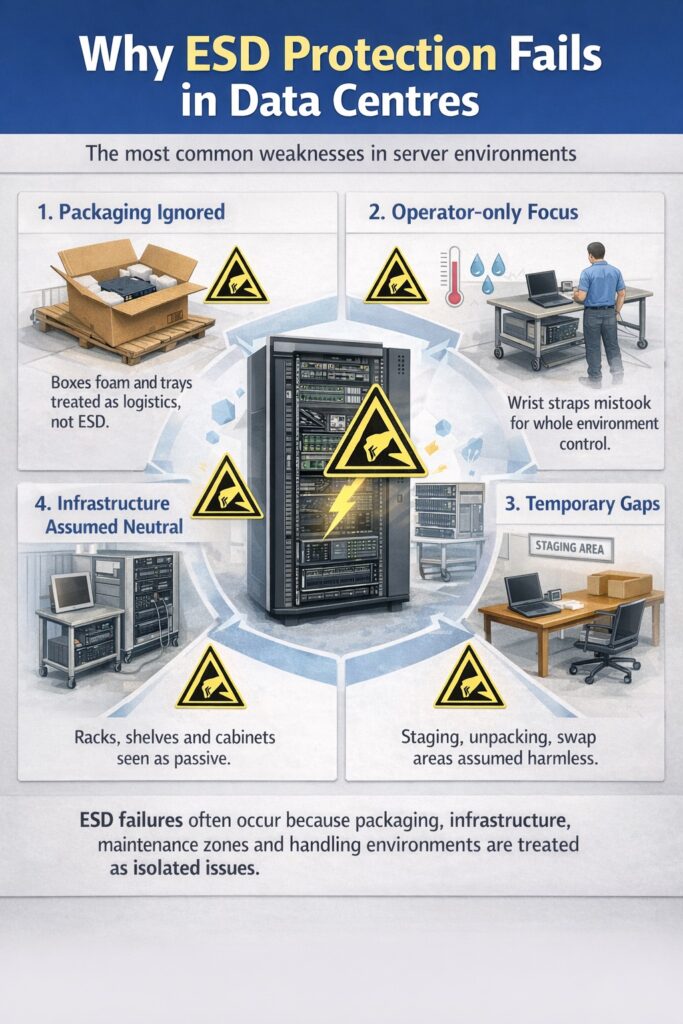
ESD protection in data centres often fails when packaging, infrastructure, maintenance zones and handling environments are treated as separate issues instead of one connected system.
Why this matters
Data centres depend on reliable movement, installation, storage and replacement of sensitive electronics. Servers, boards, modules and replacement parts pass through multiple environments before and after live operation. Every one of those environments can influence electrostatic risk.
The problem is that ESD protection is still often framed around obvious control points such as wrist straps, mats or workstations. Those controls may be useful, but they only address part of the problem. Static can still be introduced through packaging, mixed materials, temporary holding areas, maintenance activity and infrastructure surfaces.
This means ESD protection can fail without any single dramatic mistake. It fails quietly, through fragmented assumptions and incomplete boundaries.
The pattern we see again and again
Most failures in data centre ESD strategy do not come from having no controls at all. They come from having controls that are too localised.
- Operators are grounded, but packaging materials are not reviewed.
- Workstations are controlled, but staging areas use mixed materials.
- Maintenance procedures exist, but tools, carts and support surfaces vary.
- Infrastructure is assumed neutral, even where plastics, coatings and inserts behave differently.
- Teams focus on compliance checks rather than the real movement of electronics through the site.
The outcome is a system with pockets of protection separated by practical gaps. A clear example is the assumption that grounding the operator protects the wider environment, when in reality wrist straps do not protect data centres on their own.
1. Packaging is treated as outside the ESD boundary
One of the biggest reasons ESD protection fails in data centres is that packaging is treated as a logistics issue rather than a handling issue. Yet cardboard, foam inserts, trays, cartons and temporary storage materials are often the first environment the electronics encounters.
If those materials are ignored, static risk may already have been introduced before the equipment reaches the controlled area.
For a focused look at this issue, see The Most Overlooked ESD Risk in Data Centres: Packaging.
2. Operator controls are mistaken for system protection
Wrist straps, heel straps and grounded benches all have value. The failure happens when these are treated as proof that the whole environment is safe.
In reality, operator controls manage charge on a person. They do not automatically control racks, cabinets, packaging, trays, carts, tools or support surfaces. In a data centre, electronics often move through all of these.
For more on this point, see Wrist Straps Don’t Protect Data Centres.
3. Temporary areas become permanent blind spots
Data centres often include temporary environments that are not treated with the same discipline as formal maintenance benches or production-style workstations. These may include staging rooms, unpacking areas, swap-out zones, short-term shelving or transit holding points.
Because these areas are seen as temporary, they can escape detailed review. But in practice, they are often used repeatedly and play a major role in how hardware is handled.
A control strategy that ignores these spaces leaves part of the real workflow outside the protection boundary.
4. Infrastructure surfaces are assumed to be neutral
Another common weakness is the assumption that racks, shelving, support surfaces and cabinets are simply part of the room rather than active parts of the ESD environment. In reality, materials, finishes, inserts and attachments all influence how a space behaves.
This does not mean every surface is a problem. It means infrastructure should be reviewed as part of the full handling chain rather than treated as background.
That is why ESD protection in data centres increasingly needs a wider surface and environment perspective.
Practical warning sign. If your ESD programme is strong at the bench but weak in packaging, staging, storage and infrastructure review, the system is probably more fragmented than it appears.
5. Environmental variation is underestimated
Humidity, flooring, mixed materials, repeated movement and maintenance activity all affect how static risk appears in practice. Even where a formal programme exists, local variation can still create weak points.
This is one reason why static control that looks sufficient in theory may not behave consistently in real use. The environment itself changes how risk is expressed across the site.
A robust strategy needs to account for how the environment behaves, not just how the procedure is written.
A more reliable way to think about data centre ESD protection
A better approach is to view the data centre as one connected handling environment rather than a collection of isolated control points.
- Map where electronics arrive, pause, move, get unpacked and are serviced.
- Review packaging and temporary materials, not just permanent infrastructure.
- Assess staging areas, maintenance zones and short-term storage spaces.
- Look at how surfaces behave across the wider environment.
- Combine operator controls with broader infrastructure and handling review.
This shifts ESD protection from narrow compliance to practical reliability. For a broader commercial overview of this approach, see our ESD Protection for Data Centres page.
What This Means in Practice
If your ESD protection has been built mainly around people, benches and formal workstations, the first step is not necessarily to add more rules. It is to look again at the actual journey the electronics takes through your site.
For related content, see Wrist Straps Don’t Protect Data Centres for the limits of operator-only control, The Most Overlooked ESD Risk in Data Centres: Packaging for hidden logistics exposure, and our ESD Protection for Data Centres page for the broader implementation view.
In many cases, the biggest gains come from identifying where protection ends too early rather than from tightening the controls that already exist.
Why Choose SCH Services?
SCH supports customers with practical ESD strategy thinking across infrastructure, packaging, handling environments and surface behaviour. We help identify where static risk is actually introduced in day-to-day operation, then support a more realistic implementation approach.
This is often where a wider environmental review reveals why apparently good ESD programmes still leave practical gaps.