Why Measuring Conformal Coating Thickness is Difficult
Understanding why common measurement methods fail on real PCBs
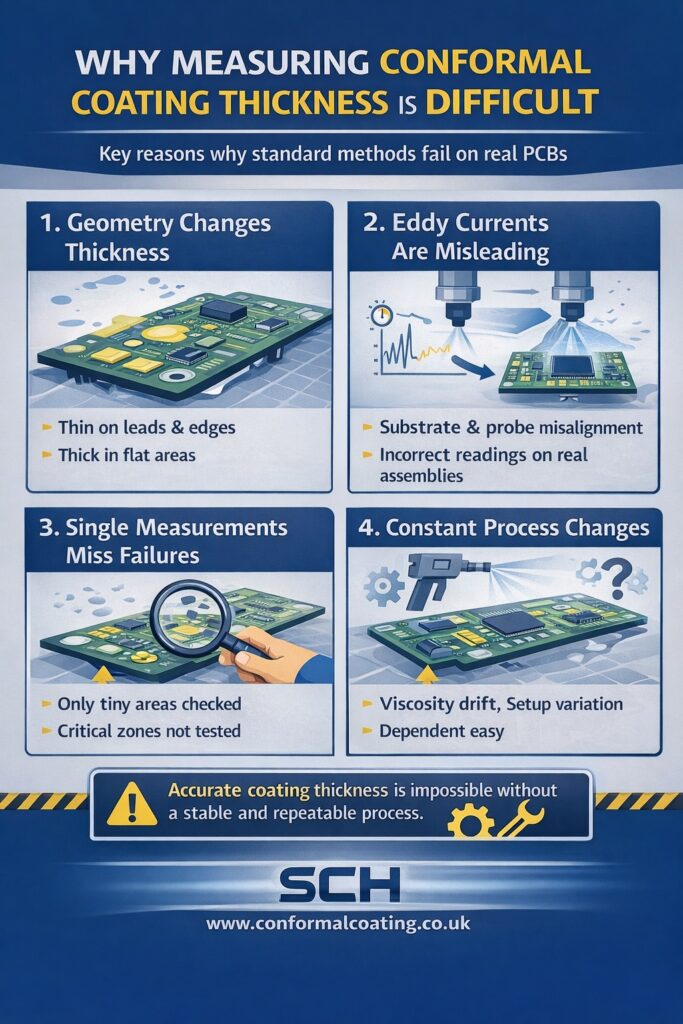
Measuring conformal coating thickness is widely treated as a simple validation step—but in practice, it is one of the most misunderstood parts of the entire coating process.
Most manufacturers rely on spot measurements using eddy current gauges or calculated film builds. These approaches appear precise, but often fail to represent what is actually happening across a real PCB assembly.
The issue is not just measurement accuracy—it is the assumption that a single number can represent a highly variable, geometry-driven coating layer.
1) The illusion of a single thickness value
Specifications often define coating thickness as a range, giving the impression of uniform coverage.
In reality, thickness varies significantly across a PCB due to:
- Component geometry and height
- Surface energy differences
- Application method (spray, dip, selective)
- Drainage and pooling behaviour
There is no single “true” thickness—only a distribution.
Reality: A single measurement point cannot represent coating performance across an assembly.
2) Why eddy current measurements are often misleading
Eddy current gauges are widely used because they are fast and non-destructive. However, they depend on ideal conditions rarely present on real PCBs.
- Substrate variation: Copper thickness and stack-up affect readings
- Surface irregularity: Probes struggle on uneven areas
- Edge effects: Nearby features distort results
- Calibration mismatch: Flat standards do not reflect assemblies
This creates measurements that appear consistent but are not representative.
3) Geometry: the hidden variable
Geometry has a greater impact on coating thickness than most measurement methods account for.
- Edges and leads → thinner coatings
- Flat surfaces → thicker coatings
- Cavities → pooling
This creates a mismatch between measured areas and critical failure zones.
Key insight: The areas most likely to fail are often the hardest to measure accurately.
4) Why measurement without process control fails
Many coating operations rely on measurement as validation rather than control.
- Viscosity drift over time
- Environmental variation
- Operator inconsistency
- Equipment variability
These factors drive variation before measurement even occurs. See Inconsistent Coating Thickness for a deeper analysis.
5) The problem with trusting measurement data
When readings fall within specification, it is often assumed the coating is acceptable.
- Measurement location bias
- Non-representative sampling
- Poor repeatability
This creates false confidence and hidden defects. See Incorrect Trust in Measurement Data.
6) Linking measurement to established methods
Measurement methods are not inherently wrong—they are often misapplied.
For a structured overview of measurement techniques, see Conformal Coating Thickness Measurement.
7) Summary
Thickness measurement does not fail because tools are inaccurate—it fails because the problem is misunderstood.
- Coating thickness is inherently variable
- Measurement methods have limitations
- Process variation drives inconsistency
Effective control comes from understanding the process—not relying on a number.
Related content:
Why Choose SCH Services?
SCH Services helps manufacturers build stable, repeatable conformal coating processes based on real-world behaviour—not assumptions or isolated measurements.
- 🛠️ Process-led coating strategy
- 📈 Scalable from trials to production
- 🌍 Global technical support
- ✅ Focus on real-world reliability
📞 +44 (0)1226 249019 | ✉ sales@schservices.com | 💬 Contact Us
Note: This article provides general technical guidance only. Coating performance and measurement validity must be verified against specific applications, materials and process conditions.