How to Select a Conformal Coating Material
Choose the right chemistry for environment, process, rework and compliance
Knowing how to select a conformal coating material is critical to protecting PCB assemblies against moisture, chemicals, electrical leakage, and long-term reliability risks. This guide compares core chemistries—acrylic, urethane, silicone, epoxy, Parylene—and when to add ProShieldESD for static control.
At a glance: Match the coating to environment, electrical requirements, application process, reworkability, and compliance.
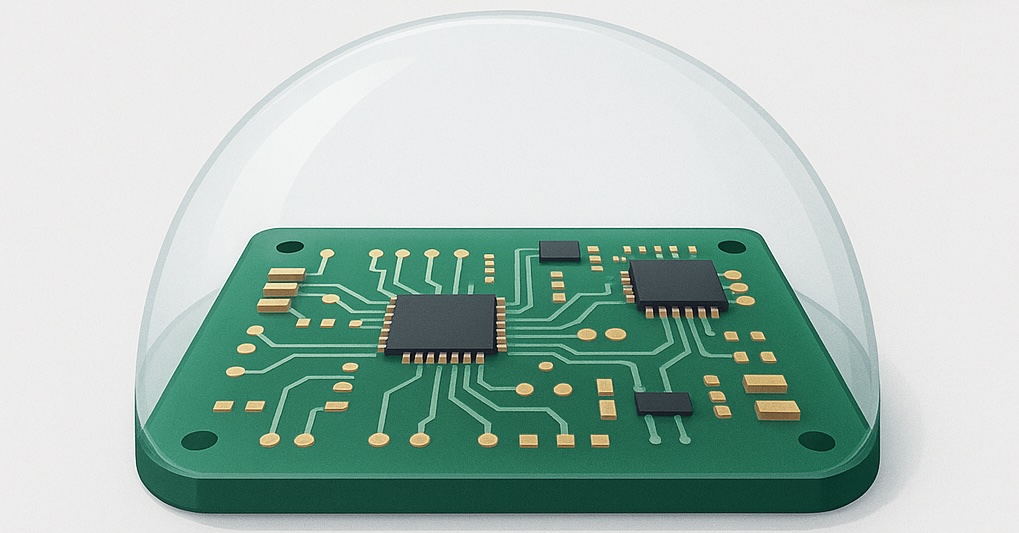
At a glance: Match the coating to environment, electrical requirements, application process, reworkability, and compliance.
If you want the shortest route: define the environment first, then confirm your process window, then confirm inspection/thickness verification.
Article Quicklinks
| Topic | Jump |
|---|---|
| Key selection factors | 🔗 |
| Comparison table | 🔗 |
| Selection steps (checklist) | 🔗 |
| Conclusion | 🔗 |
Key Factors in How to Select a Conformal Coating Material
1) Application Environment
- Moisture / humidity: Acrylics and silicones often perform well.
- Chemicals / fuels / oils: Urethanes (UR) and epoxies (ER) typically offer higher resistance.
- High temperature & thermal cycling: Silicones (SR) excel; Parylene supports wide ranges at thin films.
- Ultra-high barrier needs: Parylene (XY) provides exceptional gas and moisture barrier with uniform, pinhole-free films.
2) Electrical Requirements
- Dielectric strength & leakage control: select chemistry and thickness to support creepage/clearance design goals.
- SIR / insulation stability: confirm IPC-CC-830 qualification and your process SIR performance.
- ESD mitigation: add ProShieldESD for housings, packaging, fixtures, or surfaces where static control is needed.
3) Application Process
- Spray / dip / selective: acrylics and urethanes are common choices for manual or automated lines.
- UV-curable: high throughput with rapid cure; mind shadowing and lamp access.
- Parylene deposition: vacuum CVD gives true conformality and uniform coverage on complex geometry.
4) Rework & Repair
- Easiest: acrylics (AR) with common strippers.
- Moderate: urethanes and silicones—often need specialist solvents and/or mechanical methods.
- Challenging: Parylene—typically laser ablation, plasma etch, or micro-abrasion.
5) Standards & Compliance
Comparison Table: How to Select a Conformal Coating Material
| Coating Type | Strengths | Limitations | Typical Uses |
|---|---|---|---|
| Acrylic (AR) | Easy to apply & remove; good moisture protection; clear | Lower chemical resistance; moderate temperature range | General electronics, rapid prototyping, rework-heavy builds |
| Urethane (UR) | Excellent chemical/solvent resistance; tough | Harder to rework; longer cure; potential yellowing | Automotive, industrial, chemical exposure |
| Silicone (SR) | Wide temperature range; flexible; strong humidity performance | Lower abrasion resistance; more difficult removal | Aerospace, power electronics, thermal cycling |
| Epoxy (ER) | High chemical & abrasion resistance; durable | Brittle; difficult to rework; potential stress on parts | Harsh industrial, chemical environments |
| Parylene (XY) | Superior barrier; ultra-thin, uniform, pinhole-free; highly conformal | Vacuum process; higher cost; challenging rework | Medical, aerospace, fine-pitch/high-reliability electronics |
| ProShieldESD | Conductive polymer for static control; coats surfaces, cases, packaging | Not a moisture barrier; complements moisture coatings | ESD-sensitive assemblies, workspaces, packaging and handling surfaces |
Making the Right Choice: How to Select a Conformal Coating Material
- Define the environment: humidity, splash/immersion, chemicals, temperature profile, contamination risks.
- Set electrical targets: insulation (SIR), dielectric strength, creepage/clearance context, ESD strategy.
- Choose the process: spray/dip/selective vs Parylene CVD; throughput and masking complexity. See our masking section.
- Plan rework/repair: align chemistry to your service/repair model and acceptable rework methods.
- Verify compliance: IPC-CC-830 / UL 746E expectations and customer sector requirements.
Tip: Use test coupons coated alongside assemblies to verify thickness and properties rather than measuring directly on populated boards.
Conclusion
When considering how to select a conformal coating material, no single chemistry fits all. Acrylics are versatile and reworkable; urethanes and epoxies offer chemical robustness; silicones tolerate heat and cycling; Parylene delivers exceptional barrier performance.
For ESD risks, apply ProShieldESD to surfaces, housings, packaging, or handling fixtures alongside your chosen barrier coating.
Need Help Selecting a Coating?
We can specify materials, masking, and process settings for your application—plus ProShieldESD integration for static control.
Why Choose SCH Services?
Partnering with SCH Services means more than just outsourcing — you gain a complete, integrated platform for
Conformal Coating, Parylene & ProShieldESD Solutions, alongside equipment, materials, and training, all backed by decades of hands-on expertise.
- ✈️ 25+ Years of Expertise – Specialists in coating technologies trusted by aerospace, medical, defence, automotive, and electronics industries worldwide.
- 🛠️ End-to-End Support – Guidance on coating selection, Parylene grades, masking strategies, application methods, inspection, and ProShieldESD integration.
- 📈 Scalable Solutions – From small prototype batches to full-scale, high-volume production, SCH delivers flexible capacity that grows with your needs.
- 🌍 Global Reach – Responsive technical support and supply coverage across Europe, North America, and Asia.
- ✅ Proven Reliability – A strong reputation built on quality, consistency, and customer satisfaction across services, equipment, and materials.
📞 Call: +44 (0)1226 249019
✉ Email: sales@schservices.com
💬 Contact Us ›