How Conformal Coating and Parylene Interfere with Press-Fit Electrical Contacts
Understanding how coating behaviour affects electrical performance in press-fit connector interfaces
Conformal coatings and Parylene are designed to protect PCBs — but at press-fit connector interfaces, they can directly interfere with electrical performance.
Even very thin films can disrupt contact resistance, introduce instability or create long-term reliability issues if they reach the wrong areas.
This is why connector-related failures are rarely caused by material selection alone. They are typically a process control and interface definition problem, where coating behaviour interacts with electrical contact design.
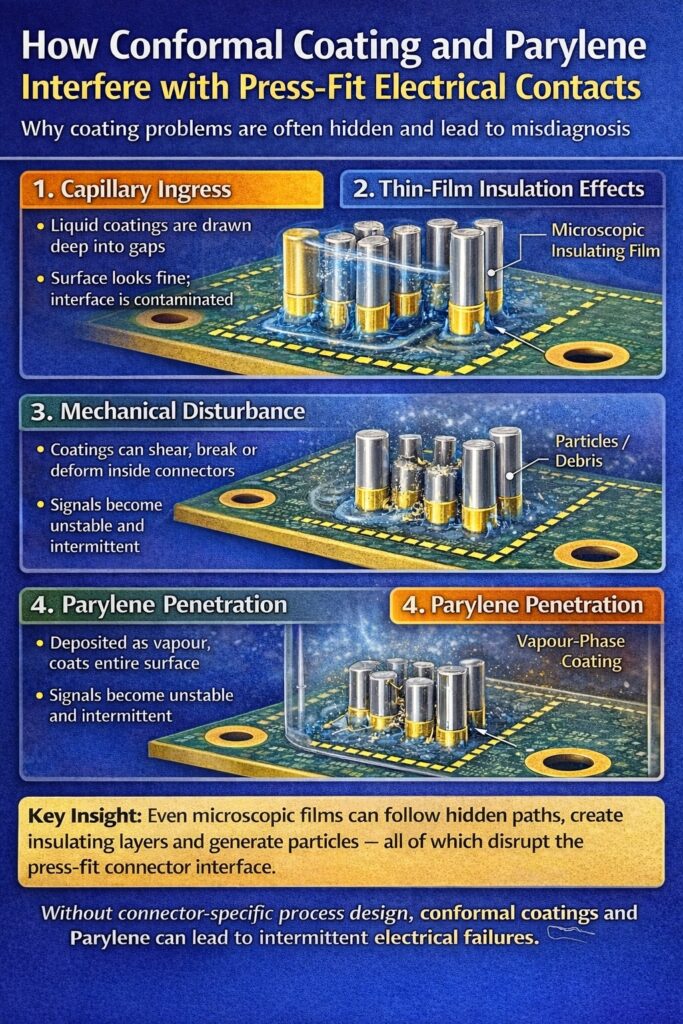
1) Electrical contacts require clean metal interfaces
Press-fit connectors rely on controlled mechanical interference to create reliable electrical contact.
- Metal surfaces must remain clean and oxide-free
- Contact resistance must remain stable over time
- Mechanical pressure ensures electrical continuity
Any insulating layer introduced into this interface can disrupt the intended electrical behaviour.
Electrical contact risk is one reason why the wider choice between conformal coating, nano coating and Parylene must be made at strategy level, not just at application stage.
2) Even thin films can affect contact resistance
Conformal coatings and Parylene are insulating materials by design.
- Thin films can sit between mating surfaces
- Electrical resistance may increase or become unstable
- Contact behaviour can change under load, temperature or vibration
The issue is not always immediate failure — it is often long-term reliability drift.
3) Capillary action drives coating into interfaces
Liquid conformal coatings are particularly prone to capillary-driven movement.
- Coating is drawn into small gaps between pin and plated hole
- Ingress can occur beyond visible boundaries
- Interfaces may be contaminated without obvious surface evidence
This makes connector issues difficult to detect until functional testing or field failure. For the wider connector-driven coating problem, see Press-Fit Connector Coating Problems: Why They Cause Failures.
4) Parylene penetrates where liquids cannot
Parylene deposition behaves differently to liquid conformal coating.
- Deposited from vapour phase
- Highly conformal — coats all exposed surfaces
- Penetrates extremely small gaps and internal features
If connector interfaces are not masked, they will be coated — often more completely than with liquid systems.
Important: Neither conformal coating nor Parylene should be allowed to enter functional electrical contact areas unless the design explicitly allows for it.
5) Mechanical effects can make the problem worse
In some cases, coatings do not simply sit passively within the interface.
- Films may shear or deform under insertion forces
- Particles or residues can be generated
- Contact surfaces may become inconsistent across pins
This leads to variability — one of the most difficult failure modes to diagnose.
6) Why this is often misdiagnosed
When connector issues appear, they are often attributed to:
- Connector design
- Assembly force or alignment
- Material incompatibility
However, coating-related causes are frequently overlooked.
Because coating ingress is often invisible, it can be misidentified as a purely mechanical or electrical issue.
7) What works in practice
Avoiding interference requires a process-led approach rather than relying on material behaviour alone.
- Define connector keep-out zones early in the design
- Use masking where full exclusion is required
- Accept realistic limits of coating boundary control
- Separate coating functions where necessary
This is where structured coating strategies — including hybrid approaches — become critical. See Hybrid Coating Strategy: Combining Conformal and Nano Coatings for Complex PCBAs.
8) Summary
Conformal coating and Parylene interfere with press-fit electrical contacts when they enter functional interface areas.
- Thin films can disrupt electrical contact
- Capillary action drives coating into hidden interfaces
- Parylene deposits into even the smallest gaps
This is not just a coating issue — it is a process design and interface control problem.
Why Choose SCH Services?
SCH Services supports customers in developing coating processes that protect assemblies without compromising electrical performance. We focus on practical interface control, coating behaviour and real manufacturing conditions.
- 🛠️ Process-Led Engineering – We solve coating problems through process design, not assumptions.
- 📈 Scalable Solutions – From trials through to production.
- 🌍 Global Support – UK, Europe, Asia and North America.
- ✅ Reliability Focus – Built around real-world performance.
📞 Call: +44 (0)1226 249019 |
✉ Email: sales@schservices.com |
💬 Contact Us ›
Note: This article provides general technical guidance only. Final coating design, connector compatibility and validation must be confirmed against product-specific requirements and applicable standards.