Conformal Coating Curing & Drying
How to choose and control cure methods for quality and throughput
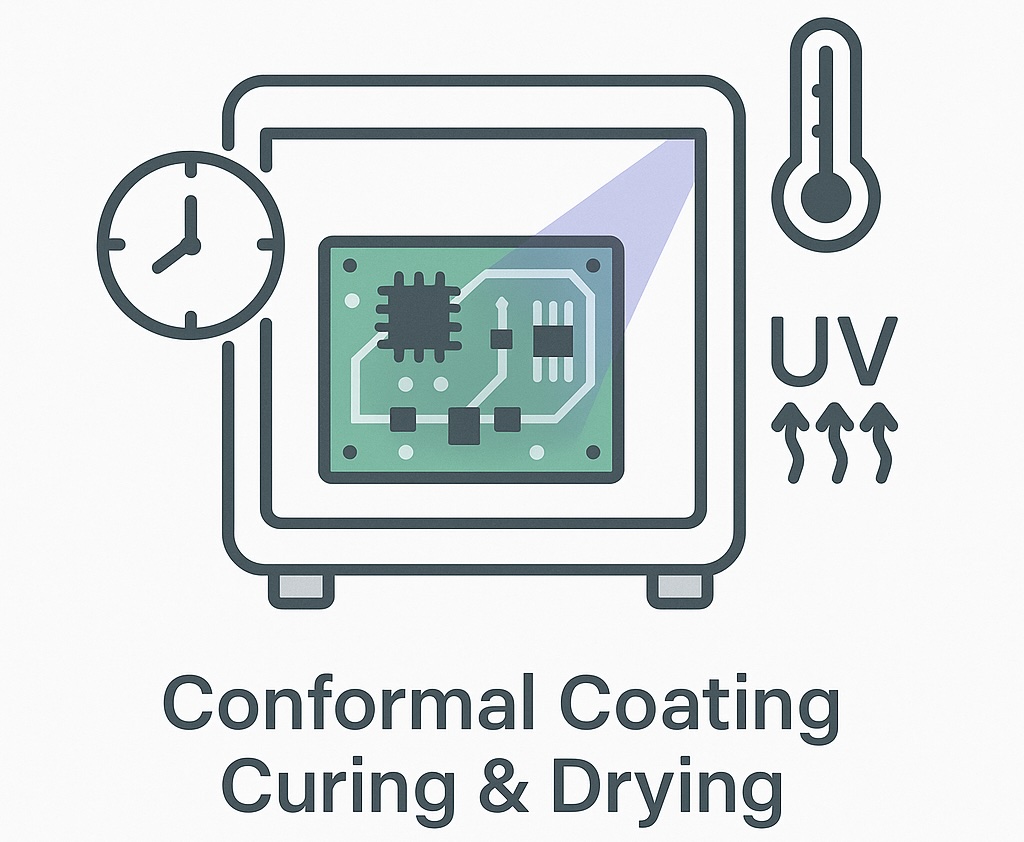
Understanding conformal coating curing & drying is essential for ensuring protective films reach full mechanical, electrical, and chemical performance.
This guide explains the main cure mechanisms—air, oven, UV, moisture, and dual-cure—and how to select the right process for quality and throughput.
Why Curing & Drying Matter
- Mechanical strength: Full cure provides adhesion, hardness, and abrasion resistance.
- Electrical reliability: Ensures insulation resistance, dielectric strength, and prevents leakage.
- Chemical resistance: Proper cure resists solvents, fuels, and cleaning agents.
- Process stability: Defined cure profiles reduce variation and rework.
Curing & Drying Methods
| Method | How It Works | Strengths | Limitations |
|---|---|---|---|
| Air Dry / Evaporation | Solvent evaporates at room temperature | Low cost, no equipment, simple | Slow (hours to days), solvent emissions, variable results |
| Oven Cure (Thermal) | Heat accelerates solvent evaporation or cross-linking | Faster, more consistent, controllable profile | Needs ovens, energy cost, possible thermal stress on components |
| UV Cure | UV light triggers polymerisation in photoinitiated coatings | Instant cure (seconds), high throughput, low WIP | Shadowing issues, line-of-sight only, equipment cost |
| Moisture Cure | Ambient humidity triggers cross-linking (common in silicones/urethanes) | No ovens needed, good depth cure | Slow (hours), dependent on RH/temp |
| Dual-Cure (UV + Moisture/Heat) | UV sets surface, secondary cure completes under shadowed areas | Complete cure, high throughput, robust | Complex chemistries, validation required |
Process Control & Best Practice
- Define cure profile: time, temperature, humidity, UV energy dose (validated window).
- Validate equipment: oven mapping, UV intensity monitoring, airflow control.
- Track WIP: record batch cure times, lot numbers, operator signatures.
- Verify cure: solvent rub tests, tack-free checks, hardness, dielectric/SIR checks as applicable.
- Minimise variation: standardise cure fixtures, board spacing, and oven loading.
Standards & Guidance
- IPC-A-610 (workmanship/acceptability)
- OEM/customer specifications for cure time, hardness, solvent resistance, IR/SIR testing
Troubleshooting Cure Issues
- Sticky surface: incomplete cure; increase oven dwell or UV dose; confirm humidity for moisture-cure.
- Blisters/bubbles: solvent trapped / too rapid evaporation; reduce temp ramp; apply thinner coats; add flash-off.
- Discolouration: over-temperature; confirm oven calibration and local hot-spots.
- Cracking: excess thickness or over-cure; check viscosity, film build, and cure window.
SCH Curing & Drying Solutions
We provide curing and drying equipment including:
- Drying cabinets for air and thermal cure
- Operator training and process consultancy on curing best practice
Need help setting cure profiles? SCH can validate cure methods, supply ovens/UV systems, and provide training on conformal coating curing & drying for reliable results.
Why Choose SCH Services?
Partnering with SCH Services means more than just outsourcing — you gain a complete, integrated platform for
Conformal Coating, Parylene & ProShieldESD Solutions, alongside equipment, materials, and training, all backed by decades of hands-on expertise.
- ✈️ 25+ Years of Expertise – Specialists in coating technologies trusted by aerospace, medical, defence, automotive, and electronics industries worldwide.
- 🛠️ End-to-End Support – Guidance on coating selection, Parylene grades, masking strategies, application methods, inspection, and ProShieldESD integration.
- 📈 Scalable Solutions – From small prototype batches to full-scale, high-volume production, SCH delivers flexible capacity that grows with your needs.
- 🌍 Global Reach – Responsive technical support and supply coverage across Europe, North America, and Asia.
- ✅ Proven Reliability – A strong reputation built on quality, consistency, and customer satisfaction across services, equipment, and materials.
📞 Call: +44 (0)1226 249019
✉ Email: sales@schservices.com
💬 Contact Us ›