
Adhesion is one of the most critical factors in achieving reliable coating performance. Even the most advanced coating—such as Parylene—can fail if it doesn’t bond strongly to the underlying surface. That’s where Parylene adhesion promoters (often called primers) come in.
At SCH Services Ltd, we supply and use Parylene adhesion promoters as part of our day-to-day coating work. Selecting the right promoter (and applying it correctly) helps deliver strong, repeatable adhesion and long-term reliability.
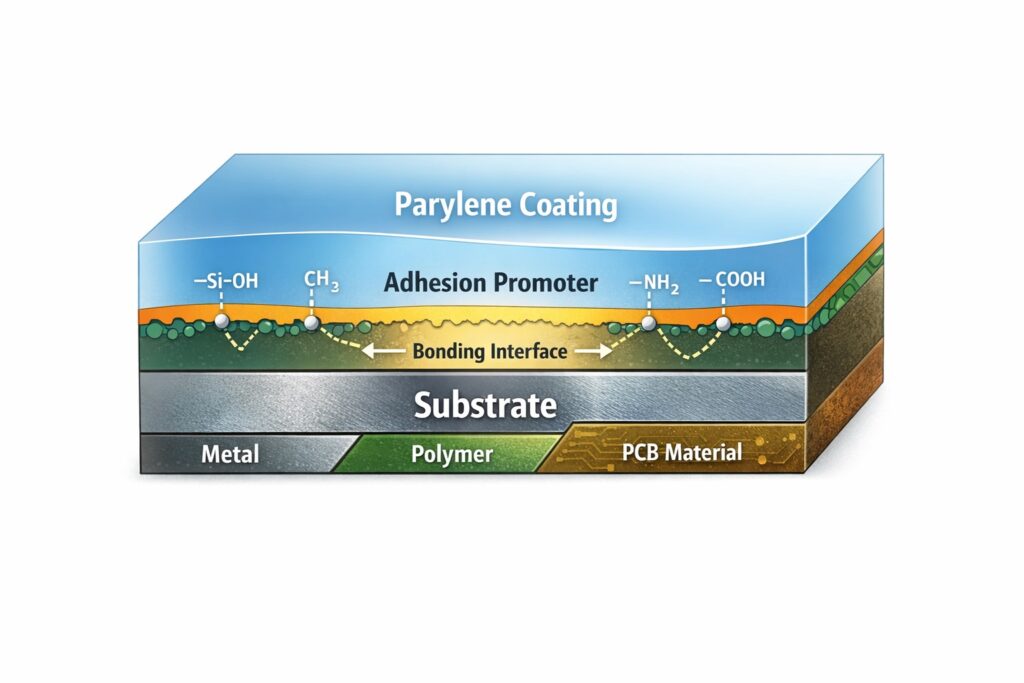
Why Parylene Adhesion Promoters Are Needed
Parylene is deposited as a vapour and forms an ultra-uniform film, but adhesion is highly dependent on surface chemistry and cleanliness. Certain substrates—such as smooth metals, ceramics, glass, and many plastics—can be naturally difficult for Parylene to bond to without additional surface preparation.
Without appropriate preparation and, where required, an adhesion promoter, coatings may:
- Lift, peel, or delaminate over time
- Fail adhesion testing (for example, cross-hatch testing such as ISO 2409 where applicable)
- Compromise moisture, corrosion, or chemical protection
How Parylene Adhesion Promoters Work
Parylene adhesion promoters typically work by creating a chemical “bridge” between the substrate and the Parylene polymer. In practice, they:
- Chemically bond to the substrate surface (after correct cleaning/activation)
- Present a compatible functional layer that Parylene can anchor to during deposition
- Reduce the risk of delamination, especially under thermal cycling, humidity, or chemical exposure
Different Substrates Need Different Approaches
There is no one-size-fits-all solution for Parylene adhesion. The correct approach depends on the substrate type, the contamination risk, and the service environment.
In Parylene processes, adhesion performance is typically driven by a combination of:
- Cleaning (removal of oils, flux residues, silicones, and particulates)
- Surface activation (often plasma treatment where appropriate)
- Adhesion promoter selection matched to the substrate and reliability requirement
Common substrate categories where Parylene adhesion planning matters most include:
- Metals (surface oxides, smooth finishes, and corrosion considerations)
- Plastics (especially low surface energy polymers)
- Ceramics & glass (non-porous surfaces)
- PCB materials (solder masks, exposed copper, and mixed-material assemblies)
A quick note on liquid conformal coatings
For acrylic, urethane, and silicone conformal coatings, adhesion is often managed through process control and surface preparation, and in some cases the use of a primer where the substrate demands it. However, the term “adhesion promoter” is most commonly used in industry when discussing Parylene deposition.
SCH Services Ltd: Practical Parylene Adhesion Support
If you’re seeing adhesion concerns—or you’re qualifying Parylene for a new substrate—SCH can support with promoter selection guidance, surface preparation advice, and production-proven processes based on real coating experience.
Learn more: Discover our full range of Parylene coating solutions, or explore the Coating Defects Hub if you’re investigating adhesion or reliability issues.
If you’d like technical guidance on Parylene adhesion, surface preparation, or promoter selection, contact our team via the contact page.
