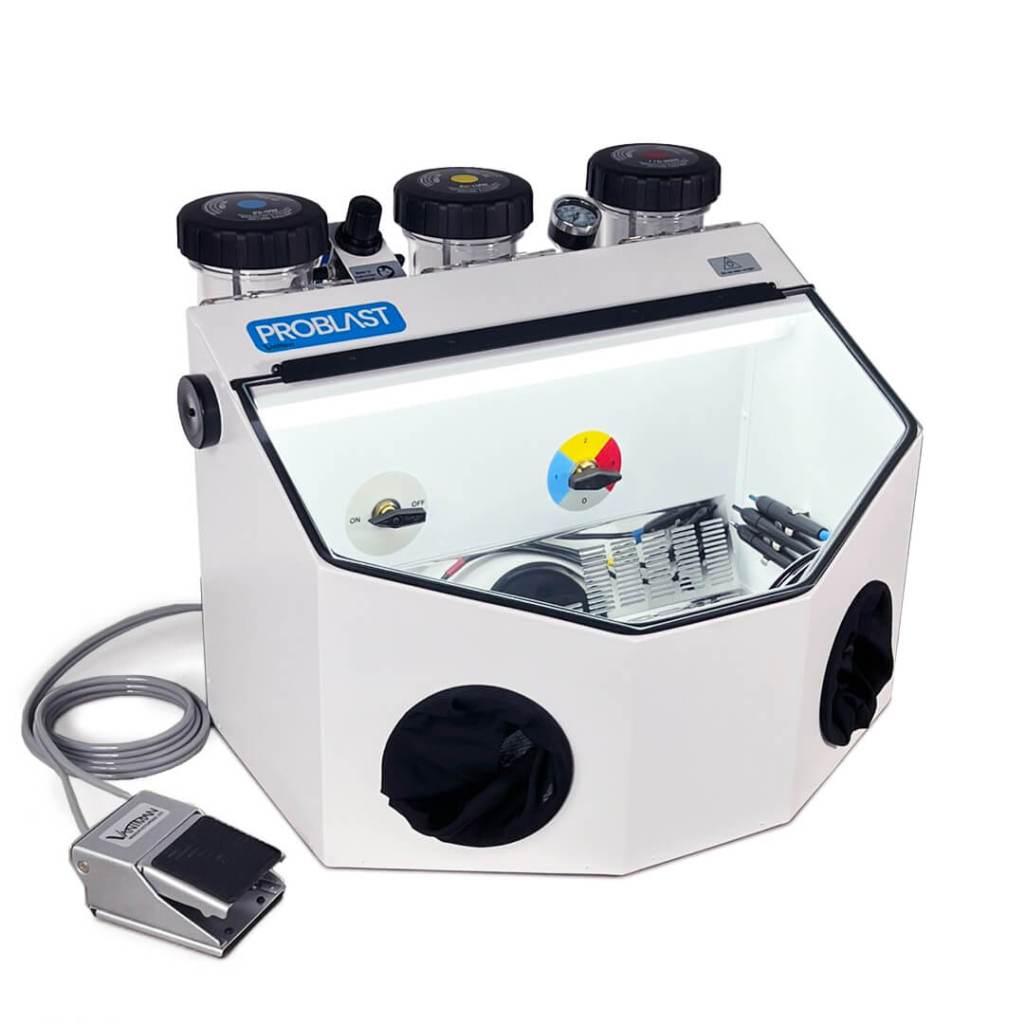
SCH Technologies is proud to announce that we are now the official UK and European distributor for the Vaniman Problast Micro Abrasive Blaster. This partnership strengthens our commitment to providing world-class solutions for electronics protection, rework, and surface preparation.
What is the Vaniman Problast?
The Vaniman Problast is a high-precision micro abrasive blaster designed to safely and accurately remove coatings, contaminants, and residues from delicate substrates. Renowned for quality and reliability, it is widely used in:
- Electronics manufacturing & rework
- Aerospace & defence
- Medical device production
- Automotive electronics
- Research and development labs
At SCH, our focus is on electronics and PCB protection, making the Problast a natural fit for conformal coating and Parylene removal applications.
Why the Problast 3 is essential for electronics & Parylene work
The latest model, the Vaniman Problast 3, includes built-in ESD protection. This is critical for electronics rework because it helps prevent electrostatic discharge from damaging sensitive PCB components during coating removal.
Combined with controlled, precision blasting, the Problast 3 enables:
- Selective coating removal without damaging substrates
- Safer operation on sensitive electronics through ESD control
- Compatibility with a wide range of blasting media
- A robust, compact design suitable for production lines and repair facilities
We also use the Problast within our own conformal coating and Parylene rework activity, proving its effectiveness in real production environments.
Part of SCH’s turnkey philosophy
The Problast is more than a piece of equipment—it supports our turnkey approach. At SCH, we don’t simply supply machines; we provide a complete ecosystem of conformal coating and Parylene solutions, including:
- Services – subcontract coating, rework, and consultancy
- Materials – conformal coatings, Parylene dimers, masking materials
- Equipment – application systems, ovens, inspection booths, and blasting tools
- Training & support – practical guidance to embed processes in your facility
Adding the Vaniman Problast 3 strengthens our ability to deliver end-to-end support—helping customers protect, apply, remove, and rework coatings with confidence.
Benefits of working with SCH as your distributor
By sourcing the Problast directly through SCH, customers gain:
- Immediate UK & EU supply – reduced lead times and simplified logistics
- Technical expertise – guidance from coating specialists who use the equipment in practice
- Spare parts & consumables – support packages to keep systems running
- Training & consultancy – optional add-ons to integrate blasting into your processes
Supporting your entire process
The Vaniman Problast expands our equipment portfolio alongside dipping systems, spray booths, curing ovens, inspection solutions, and Parylene support. Together, these technologies help manufacturers protect, rework, and optimise PCB assemblies to demanding international expectations.
Conclusion
As the official UK & European distributor for the Vaniman Problast 3, SCH Technologies provides more than equipment supply—we help customers implement a repeatable, reliable approach to coating removal and rework in sensitive electronics environments.
To learn more or request a demonstration, contact SCH today.