Parylene is not always a one-shot coating process in development
Parylene is often seen as a permanent final coating, but in development work that is not always the full story. In the right circumstances, it can be removed, the device can be modified or re-evaluated, and the product can then be recoated as part of an engineering loop.
This matters because coating is not always the end of the process. In many real projects, it becomes part of testing, tuning, failure analysis and design optimisation.
Quick take. Parylene can be removed and reapplied during development, rework and validation work. That creates a practical workflow of coat, test, strip, modify and recoat, which is often valuable when electrical behaviour, masking, design details or system performance still need to be refined.
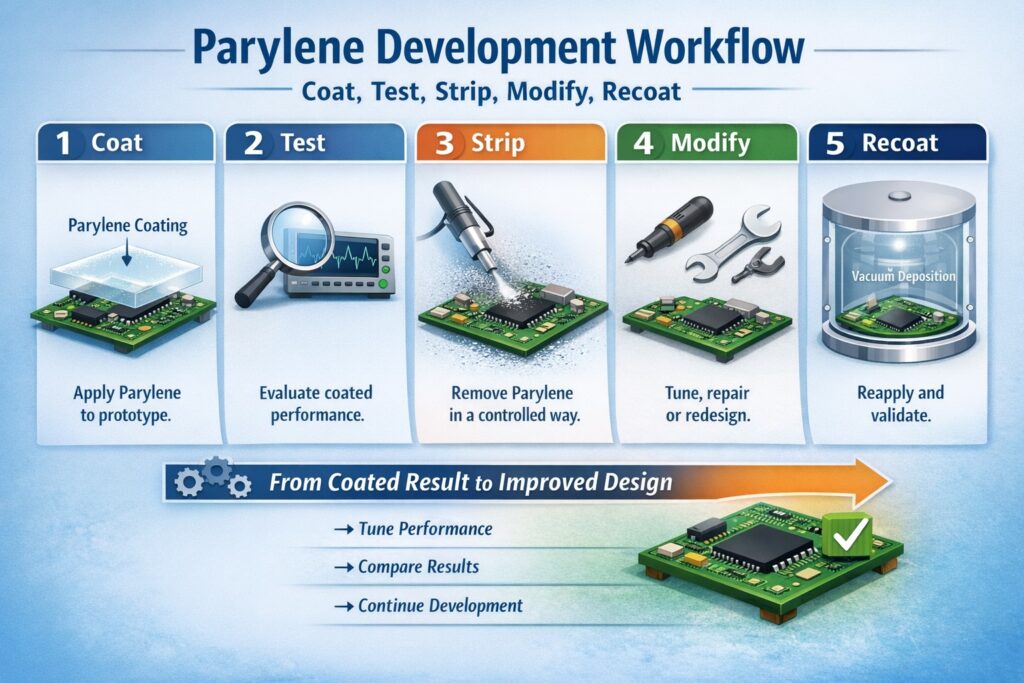
Parylene development often follows a practical workflow of coat, test, strip, modify and recoat, enabling engineers to optimise performance rather than treat coating as a one-shot process.
Why this matters
A common assumption is that once Parylene has been applied, the part is finished and there is no realistic way back. That assumption can be a problem in development programmes, because many products do not behave exactly as expected on the first coated iteration.
Sensor systems, high-reliability electronics, unusual geometries and electrically sensitive devices can all show behaviour that only becomes visible after coating. In those cases, a development team may need to review the design, make a change, re-test the part and then reapply the coating.
That is where rework capability becomes commercially and technically important. It turns coating from a one-direction process into a development tool.
The practical workflow
In development, the real workflow is often not simply coat and ship. It may be:
- apply Parylene to a development build
- test the coated device in real or simulated conditions
- identify a performance shift, masking issue or design change
- remove the coating in a controlled way
- modify, repair or re-evaluate the product
- recoat and validate again
That loop can be extremely useful in product development because it allows coated performance to be studied rather than guessed.
Why removal and reapplication are valuable
The value is not just that Parylene can be stripped. The value is what that enables.
- development teams can tune electrical or mechanical performance after seeing real coated behaviour
- engineering teams can compare coated and recoated results more intelligently
- failure analysis work can separate coating-related effects from design-related effects
- prototype programmes do not always have to start from zero after each change
This is particularly relevant where the coating itself influences the operating system, rather than simply protecting it.
A real example of where this matters
In electrically sensitive devices such as capacitive sensors, coating can change the dielectric environment and shift system behaviour. That means development may need more than a single coat-and-test cycle.
Where the coated part shows an unexpected response, a strip and recoat route can support investigation and optimisation rather than forcing teams to treat the first result as final. For related background, see Why Parylene Coating Changes Capacitive Sensor Performance.
That is one reason why removal capability is not just a service feature. It is part of a wider engineering workflow.
Removal is real, but it is not trivial
It is important to be realistic here. Parylene removal is possible, but it is not automatically simple, low-risk or suitable in exactly the same way for every assembly. The method depends on the coating, the substrate, the geometry, the access, the areas to be preserved and the purpose of the rework.
For some projects, localised removal makes sense. For others, a full strip may be required. In some cases, the rework route is best used for development learning rather than routine production reprocessing.
That is why good removal work is engineering-led. It is not just about taking coating off. It is about taking coating off in a controlled way that still leaves the product useful for the next step.
Where this applies beyond development
Although this workflow is most commonly used in development, it is also relevant in repair and rework situations. Localised coating removal is often used to enable component replacement, fault investigation or targeted modification.
In these cases, the goal is usually to restore function rather than optimise performance, and the removal approach is typically more controlled and limited in scope.
Full strip and recoat can be considered, but this is often more complex and must be assessed carefully against time, cost and risk. For many assemblies, particularly complex electronics, a targeted rework approach is more practical.
Why this changes the development conversation
When teams understand that coated parts can be stripped, reviewed and recoated, the discussion shifts. Coating stops being a final irreversible event and becomes something that can support iterative engineering.
That can reduce hesitation around trial builds, help teams learn faster from early results and support a more confident development pathway where coating performance is being actively understood rather than assumed.
For wider technical background on removal methods, trade-offs and engineering considerations, see Ultimate Conformal Coating Removal Guide (UK & Europe) and Identify Unknown Conformal Coatings (IPC-7711).
What This Means in Practice
If your coated device does not behave exactly as expected, the next step is not always to abandon the concept or assume the coating has failed. In many cases, the better route is to treat the coated result as a development input, then decide whether strip, modify and recoat work can move the project forward.
This is where rework capability becomes strategically useful. It supports prototyping, tuning, validation and learning, especially when the coating itself changes system behaviour.
For engineering teams, that makes Parylene more than a protective finish. It makes it part of the development process.
Need support with Parylene development, removal or rework?
SCH supports engineering teams with Parylene coating trials, removal assessment, strip and recoat workflows, and development-stage problem solving where protection and system performance need to be considered together.
This can include development support, controlled rework evaluation, and practical guidance on how to move from an unexpected coated result to a better-defined next iteration.
Parylene Coating Services | Removal & Rework Systems | Engineering Consultancy