Choosing the Right Parylene Dimer
Selecting between Parylene N, C, D and AF-4 based on performance, environment and process requirements
Choosing the right Parylene dimer is not about selecting the “best” material in absolute terms. It is about matching the dimer chemistry to the electrical, thermal, chemical and geometric demands of the real application.
Parylene N, C, D and fluorinated grades such as AF-4 each offer a different balance of dielectric performance, barrier behaviour, temperature capability and process practicality. For a side-by-side view of those differences, see our Parylene Dimer Comparison guide. The right choice depends on what matters most in service, and what your coating process can consistently deliver.
This guide is intended as a practical decision tool. It explains the main selection factors, shows where each dimer is commonly used, and highlights the trade-offs that matter before you move into qualification, testing and production release.
For a full technical comparison, see our Parylene Dimer Comparison guide. If your coating requirements are unclear at drawing stage, it is often due to weak specification control. See why this happens in our guide to Parylene specification failures.
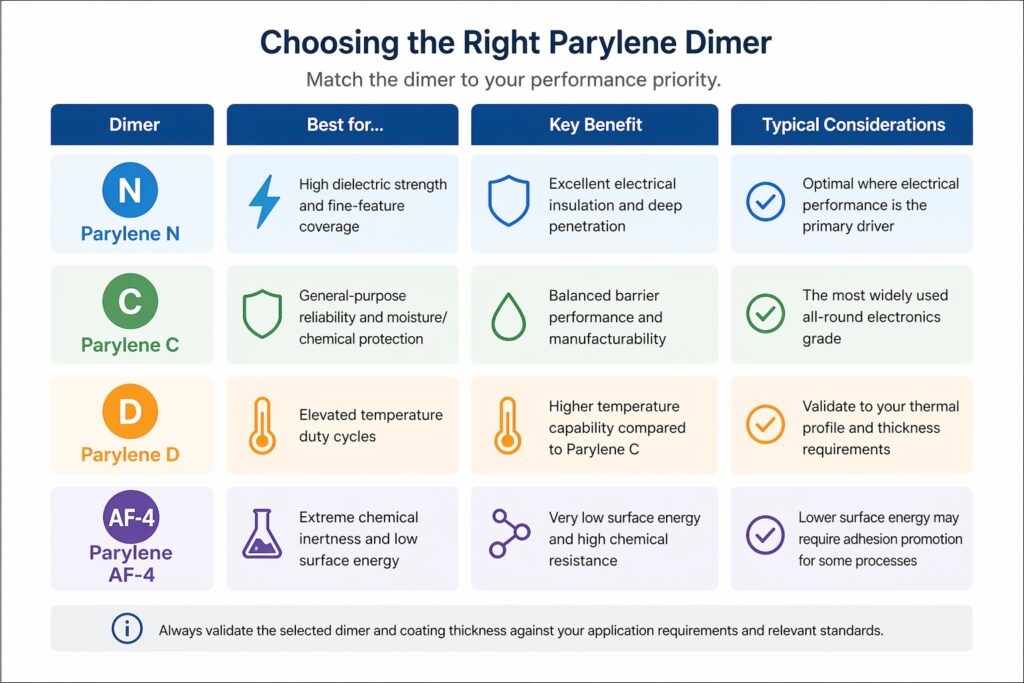
Simple comparison of Parylene dimer types showing typical selection based on dielectric performance, moisture barrier properties and temperature requirements.
Quick Selection Guide
If you need a first-pass shortlist, start here. This is not a substitute for validation, but it is a practical way to narrow the field quickly.
- Parylene N – usually considered where deep penetration, fine-feature coverage and high dielectric strength are priorities.
- Parylene C – usually the baseline choice where moisture barrier, chemical resistance and broad manufacturability matter most.
- Parylene D – generally selected where higher temperature capability is needed beyond what Parylene C normally provides.
- Parylene F / AF-4 – typically chosen where very low dielectric constant, fluorinated chemistry, low surface energy or more demanding environments justify a specialist grade.
Important: avoid writing a drawing or process specification that simply says “Parylene F” unless the exact fluorinated grade is defined. In practice, the grade should be called out clearly, for example AF-4, together with the required thickness and any adhesion-promotion requirement.
Key Selection Factors
Before choosing a dimer, work through the real duty conditions rather than the brochure-level properties. These are the factors that normally drive the decision.
Operating temperature and thermal cycling
If the coated part sees sustained elevated temperature, repeated thermal shock, or significant thermal cycling, the standard baseline choice may no longer be enough. In that situation, Parylene D or a defined fluorinated grade such as AF-4 should usually be considered and then validated against the actual temperature profile and acceptance criteria.
Electrical insulation versus dielectric constant
Where the priority is electrical insulation margin, fine-feature coverage and strong dielectric performance, Parylene N is often a logical candidate. Where the priority shifts toward specialised electrical behaviour, such as very low dielectric constant for certain high-frequency applications, a fluorinated grade may be more appropriate.
Moisture and chemical exposure
For many electronics applications, the starting point is still Parylene C because it offers a practical balance of moisture barrier performance, chemical resistance and manufacturability. See our guide to how dimer purity affects coating quality for how material quality influences long-term reliability.
Geometry, gaps and feature access
Tight gaps, deep cavities and complex assemblies can affect effective thickness distribution and real-world coverage. If the assembly has fine structures or difficult access, Parylene N may offer advantages that become more important than headline barrier data.
Downstream assembly and surface behaviour
Fluorinated grades can offer lower surface energy and stronger chemical inertness, but that can create practical implications for adhesion promotion, printing, bonding and secondary assembly steps. If the coated part must later be bonded, marked, overmoulded or otherwise processed, that should be included in the selection logic from the start.
Qualification route and document control
Material choice should also reflect your qualification route. If the programme has customer approval steps, internal PPAP-style controls, or formal environmental screening requirements, then the dimer choice should be evaluated together with the required documentation, traceability and test coverage.
Application-Driven Choices
Each dimer tends to fit naturally into a different group of application priorities. These are not absolute rules, but they are useful starting points.
Parylene N
Parylene N is often selected where dielectric strength, uniform ultra-thin coverage, optical clarity and penetration into complex geometry are high priorities. It is commonly associated with sensors, MEMS, fine-feature electronics and some precision assemblies.
Parylene C
Parylene C is usually the most practical baseline for general electronic protection. It is widely used where the application needs dependable moisture resistance, chemical barrier performance and robust overall manufacturability across industrial, automotive, aerospace and medical electronics.
Parylene D
Parylene D is normally considered where the thermal profile pushes beyond the comfort zone of C, but the application does not yet justify moving to a fluorinated specialist grade. It is often relevant for higher-temperature electronics, power-related assemblies and development work requiring additional thermal margin.
Fluorinated grades such as AF-4
Fluorinated Parylene grades are usually selected where the application needs a more specialist property set, such as very low dielectric constant, low surface energy, stronger chemical inertness or higher environmental headroom. These materials should be specified precisely by grade rather than grouped loosely under “Parylene F”.
Performance Trade-Offs
No single Parylene type is ideal for every situation. The practical decision comes from understanding the trade-offs rather than chasing the most extreme property on paper.
N versus C
Parylene N may be attractive where penetration and dielectric performance dominate the decision. Parylene C usually becomes stronger where moisture and chemical barrier performance are the primary drivers.
C versus D
Parylene D generally enters the conversation when the design needs more thermal capability than C normally offers. If the operating temperature does not genuinely require that step up, C often remains the more straightforward baseline choice.
C versus fluorinated grades
Fluorinated grades can outperform C in some demanding environments, but they also introduce additional process and downstream assembly considerations. That means the move to AF-4 or another fluorinated variant should usually be justified by a real technical requirement, not by assumption.
Specification clarity matters
Ambiguous terminology causes avoidable risk. If the drawing, quote, customer note or internal process sheet says only “Parylene F”, there is room for misunderstanding. The chemistry, thickness and any adhesion-promotion expectation should all be defined clearly. For grade-specific material and compliance information, review the Parylene F / AF-4 dimer page.
Practical rule of thumb: treat Parylene C as the baseline starting point, then move to N, D or AF-4 only where the application clearly needs a different balance of penetration, temperature capability or electrical behaviour.
Summary Table
The table below is intended as a fast engineering shortcut. It helps match a dominant requirement to a likely starting grade, but it should still be backed by process validation and qualification testing.
| Primary Requirement | Likely Starting Grade | Why |
|---|---|---|
| Fine-feature coverage and strong dielectric performance | Parylene N | Often chosen for penetration, uniform coverage and electrical insulation in complex geometry |
| General-purpose electronics protection | Parylene C | Balanced moisture barrier, chemical resistance and practical manufacturability |
| Higher temperature operating profile | Parylene D | Usually considered where extra thermal headroom is needed beyond C |
| Very low dielectric constant or fluorinated performance | AF-4 / exact fluorinated grade | Used where specialised electrical or environmental performance justifies a defined fluorinated chemistry |
If your application is borderline between two grades, that is usually a sign that process conditions, thickness, adhesion promotion and qualification plan now matter as much as the dimer chemistry itself. In those cases, it often helps to review the individual dimer pages for N, C, D and AF-4 before finalising the route.
Once you have selected a suitable dimer, the next step is to define it clearly. See our guide to specifying Parylene coating on a drawing.
From Selection to Specification
Choosing the dimer is only the first step. A usable production specification should also define the exact grade, thickness range, adhesion-promotion route where relevant, and any qualification or compliance checkpoints needed for release.
That is particularly important for fluorinated grades, where shorthand naming can create confusion, and for higher-reliability applications where coating performance must be demonstrated through inspection, test coupons, environmental screening or customer-specific approval routes. For a broader overview of available materials, see our Parylene dimers page.
Related Articles and Product Pages
For deeper technical detail, use the articles below alongside the individual dimer pages.
- What is Parylene Dimer?
- Parylene Dimer Comparison (N, C, D & AF-4)
- How Dimer Purity Affects Coating Quality
- Parylene N Dimer
- Parylene C Dimer
- Parylene D Dimer
- Parylene F / AF-4 Dimer
If you are working from an existing product drawing or customer specification, compare its wording carefully against the selected grade before release.
Why Choose SCH Services?
Partner with SCH Services for a complete, integrated platform: Conformal Coating, Parylene & ProShieldESD Solutions plus equipment, materials, and training. Our team brings decades of hands-on expertise.
- ✈️ 25+ Years of Expertise – Trusted across aerospace, medical, defence, automotive, and electronics.
- 🛠️ End-to-End Support – From dimer selection to masking, inspection and process optimisation.
- 📈 Scalable Capacity – From prototypes to high-volume production.
- 🌍 Global Reach – Responsive support across Europe, North America, and Asia.
- ✅ Proven Reliability – Consistent quality and strong customer satisfaction.
📞 Call: +44 (0)1226 249019
✉ Email: sales@schservices.com
💬 Contact Us ›