How Parylene Dimer Purity Affects Coating Quality
Linking ppm-level impurities to film performance, yield and reliability
← Back to the Parylene Dimers Hub
Parylene dimer purity is a primary driver of coating quality. Trace non-volatile residues (NVR), moisture, particulates and side products can contribute to pinholes, haze, rate instability and electrical-performance drift—ultimately reducing dielectric margin and long-term reliability. This guide explains how purity translates into visible and latent defects, what to include on your acceptance criteria & Certificate of Analysis (COA), and how handling and storage protect quality.
Further reading: Wikipedia – Parylene
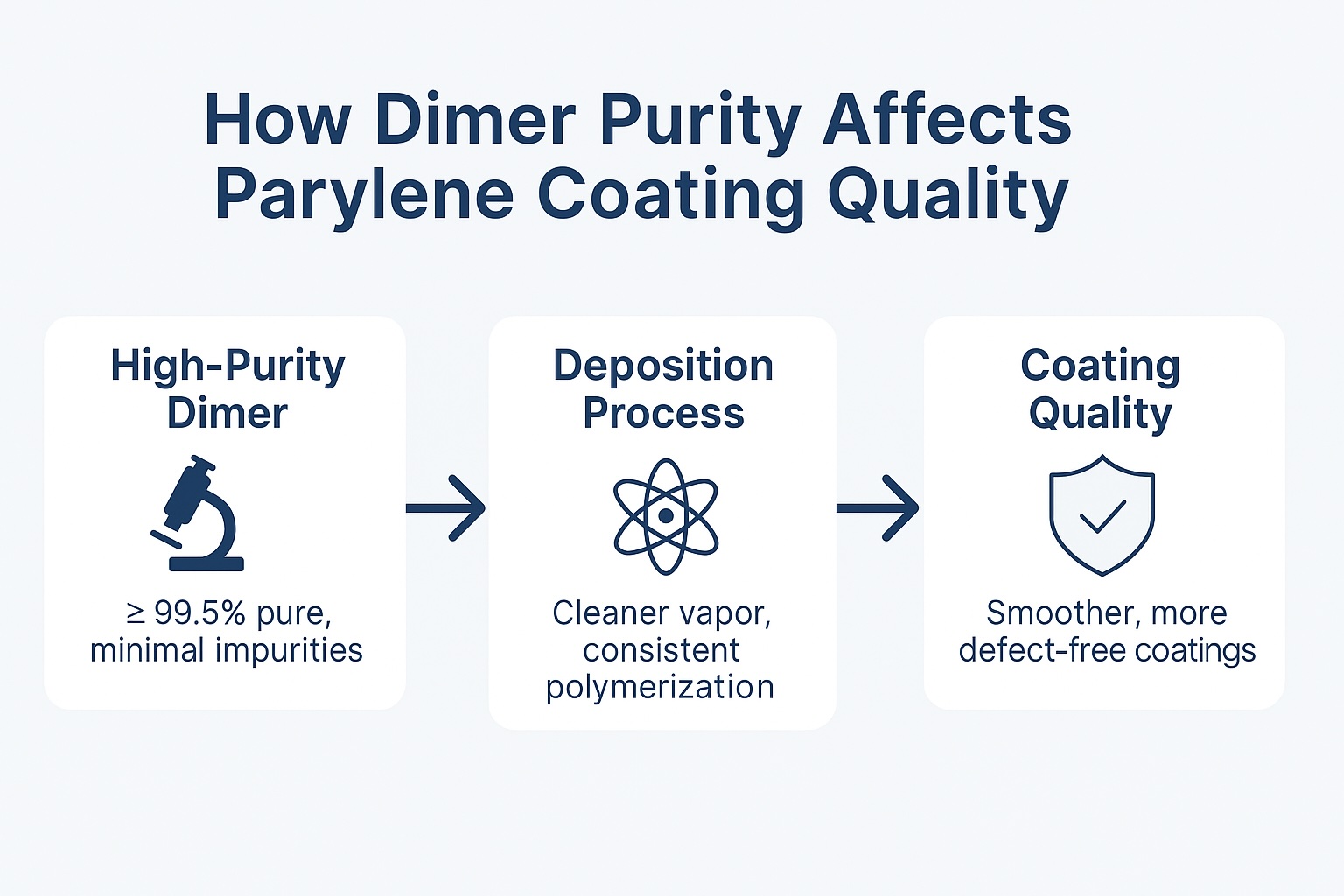
Overview
Even with identical deposition hardware, Parylene dimer purity can shift base pressure, rate stability and film morphology. Four impurity classes matter most:
- NVR/ash – non-sublimable residues that foul crucibles and increase haze/roughness risk.
- Particulates – seed nodules and pinholes; often introduced during transfer/loading.
- Moisture – contributes to outgassing and vacuum instability; can correlate with haze/pinholes if not controlled.
- Side products/solvent traces – can shift electrical properties and raise leakage risk.
Note: Purity numbers and “ppm” claims are only meaningful when the test method, detection limit and reporting basis are defined (e.g., GC vs HPLC, Karl Fischer method, TGA endpoint). Always lock these on the COA.
Purity Metrics & COA Essentials
Your supplier’s Certificate of Analysis should include the following—align these with your internal spec and ensure the method is stated so values are comparable lot-to-lot:
| Metric | What It Shows | Guidance (set by risk class) |
|---|---|---|
| Purity (GC/HPLC) | Main dimer content vs side products | Define an internal minimum by product risk; specify method & detection limits on the COA |
| NVR/Ash (TGA) | Non-sublimable residue at process-relevant endpoint | Set a residue limit and endpoint temperature/time; tighten where appearance/dielectric margin is critical |
| Moisture (Karl Fischer) | Water content driving outgassing/vacuum instability risk | Specify “release / warn / quarantine” bands in ppm with the KF method stated |
| Particle Cleanliness | Contamination control during pack/transfer | Supplier statement + incoming spot checks (e.g., membrane patch) for critical builds |
| Identity (DSC/Melt) | Confirms grade; flags contamination or mix-ups | Establish reference range per grade; investigate drift immediately |
| Traceability | Batch ID, pack date, packaging type | Mandatory on all lots |
Tip: Keep COA fields consistent across grades (N/C/D and fluorinated grades such as AF-4/HT equivalents), because volatility and residue behaviour can differ by chemistry and supplier process.
Set your own release, warn and reject bands and align them with product risk classification (e.g., aerospace, medical, safety-critical).
Impurity → Process → Defect
The following summary links impurity classes to process symptoms and the defects you may see at inspection when Parylene dimer purity is poor:
| Impurity | Process Effect | Typical Defects | Risk |
|---|---|---|---|
| NVR/Ash | Crucible fouling, rate drift | Haze, roughness, orange peel | High |
| Particulates | Contaminated monomer flow | Nodules, inclusions, pinholes | High |
| Moisture | Outgassing, vacuum instability | Haze, pinholes, adhesion variability | Medium-High |
| Side products/solvent | Electrical property drift | Higher leakage, lower breakdown | Medium |
Tip: Place witness coupons in shadowed regions to reveal particulate and morphology tendencies that normal boards may hide.
Acceptance Criteria & Tests
Define clear release thresholds for Parylene dimer purity and verify at incoming inspection. Practical approach:
- Write an internal spec: lock the COA fields, test methods, detection limits and reporting basis.
- Set release/warn/quarantine bands: adjust by product risk and customer requirements.
- Validate functionally: tie COA results to witness-film inspection and electrical tests where appropriate.
| Verification Test | Purpose | Notes |
|---|---|---|
| TGA (Residue) | Confirms non-volatile content | Useful indicator for haze/roughness risk (ensure endpoint is defined) |
| GC-MS/HPLC | Profiles side products | Tracks lot-to-lot variation (method must be consistent) |
| KF Moisture | Detects water uptake | Correlates with outgassing/vacuum stability issues |
| DSC/Melt | Identity confirmation | Flags contamination or mix-ups |
| Witness Film + Electrical Checks | Functional validation | Use application-appropriate methods (e.g., leakage / breakdown / SIR where relevant) |
Handling & Storage
Consistent handling protects purity between COA and deposition:
- Dry & clean transfer: transfer in a clean area; use dedicated tools per grade to prevent cross-contamination.
- Moisture control: keep sealed with desiccant where appropriate; minimise ambient exposure during loads.
- Crucible housekeeping: remove legacy residue; avoid “baking in” contamination between lots.
- Process trending: track base pressure and rate; investigate drift immediately.
- FIFO & re-test: rotate stock; consider re-checking moisture on aged/opened lots.
Explore More on Parylene Dimers
Next steps: Parylene Dimers Hub · What is Parylene Dimer? · Parylene Dimer Comparison · Choosing the Right Dimer
Useful Links
Why Choose SCH Services?
Partner with SCH Services for a complete, integrated platform: Conformal Coating, Parylene & ProShieldESD Solutions plus equipment, materials, and training. Our team brings decades of hands-on expertise.
- ✈️ 25+ Years of Expertise – Trusted across aerospace, medical, defence, automotive, and electronics.
- 🛠️ End-to-End Support – From purity specs and incoming QA to deposition parameters and inspection.
- 📈 Scalable Capacity – From prototypes to high-volume production.
- 🌍 Global Reach – Responsive support across Europe, North America, and Asia.
- ✅ Proven Reliability – Consistent quality and strong customer satisfaction.
📞 Call: +44 (0)1226 249019 ✉ Email: sales@schservices.com 💬 Contact Us ›