
PCB Conformal Coating Removal & Rework Services (UK & Europe)
Controlled removal of acrylic, urethane, silicone, epoxy & Parylene — services, trials, equipment & training
SCH provides controlled conformal coating removal and PCB rework support for manufacturers who need to expose test points, repair solder joints, replace components, or validate a rework method without damaging the underlying assembly.
We support UK and European production and engineering teams with a practical, process-led approach: method selection, feasibility trials, repeatable parameters, and operator training — backed by real use in our own coating and rework operations.
Need help quickly? Tell us your coating type (if known), board value/criticality, and the area to be reworked. We’ll recommend a safe route and next step.
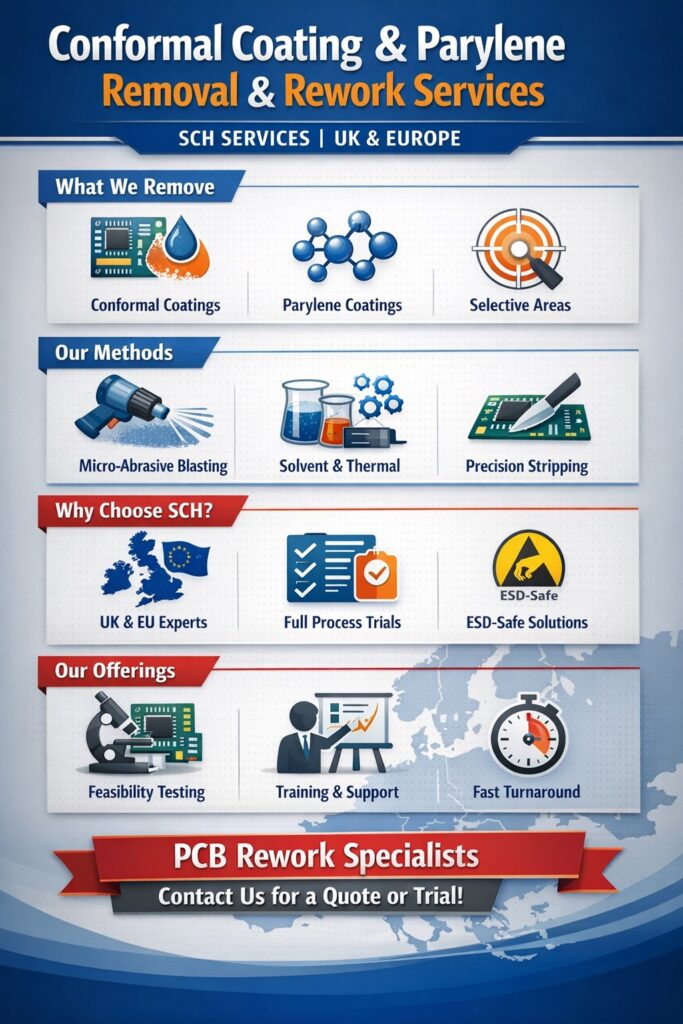
Conformal coating and Parylene removal workflow — services, methods, trials and training for controlled PCB rework across the UK & Europe.
Request a Technical Review / Quote
Fast triage for removal & rework projects — from a single repair to production-scale rework support.
- Removal feasibility review (risk + method selection)
- Process trials (sample boards / coupons)
- Production rework support (repeatable, controlled outcomes)
- Equipment & media guidance (including micro-abrasive options)
- Operator training (IPC-aligned, site-specific)
→ Contact SCH (Technical Review / Quote)
Email: sales@schservices.com | Call: +44 (0)1226 249019
What We Remove
We support removal and rework on conformal coated and Parylene coated PCBs, focusing on controlled, selective removal wherever possible.
- Acrylic conformal coatings
- Urethane (polyurethane) conformal coatings
- Silicone conformal coatings
- Epoxy conformal coatings (case-by-case due to hardness and substrate risk)
- Parylene coatings (selective rework / exposure of defined areas)
If your coating is unknown, we can support identification and method selection before any aggressive removal is attempted.
For Parylene-specific repair questions, see our Insight on whether Parylene can be removed and successfully reapplied.
Common Reasons for Removal & Rework
- Expose test points or pads for probing / fault-finding
- Access solder joints for repair or component replacement
- Remove coating around connectors, keep-outs, grounding points or fasteners
- Strip coating for failure analysis or inspection
- Correct masking errors and localised defects without full strip
- Support production rework loops with repeatable parameters
Removal Methods We Support
The best conformal coating removal methods depend on coating chemistry, thickness, board value, component density, and the area that must be exposed. SCH supports a method-led approach designed to reduce risk and improve repeatability.
- Selective mechanical removal (targeted access to defined areas)
- Micro-abrasive removal (controlled, repeatable, solvent-free removal for defined zones)
- Chemical softening / stripping routes (where appropriate and safe for the assembly)
- Hybrid methods (e.g., soften + controlled removal for difficult coatings)
Process-first rule: For high-value or high-reliability assemblies, we typically start with the least aggressive method that can achieve the required access.
Feasibility Trials & Process Validation
If you’re unsure how tough a coating is — or you need evidence before committing to a rework route — we can run controlled feasibility trials on representative samples.
- Confirm whether removal is achievable without substrate damage
- Recommend repeatable parameters (method-dependent)
- Define acceptable edge quality and post-clean requirements
- Support documentation for internal quality / customer approval
Controlled Micro-Abrasive Removal (Vaniman)
Where solvent-free, selective removal is required, micro-abrasive blasting can provide precise access for rework while supporting repeatability and process control. SCH supplies and supports Vaniman micro-abrasive systems and can guide you through our conformal coating removal services including method suitability, media choice and safe operating windows.
- Selective removal to expose pads, joints, vias and defined zones
- Repeatable control through method parameters and operator training
- Reduced chemical handling versus solvent-heavy approaches (application dependent)
Related equipment: Vaniman Problast Micro Abrasive Systems
Training & Operator Qualification
Removal and rework outcomes are heavily operator-dependent. SCH delivers hands-on training covering method selection, process control, inspection, rework discipline and safe equipment operation — including micro-abrasive systems where applicable.
- Site-specific training aligned to your assemblies, coatings and acceptance criteria
- Focused modules: masking, removal control, inspection, recoat and verification
- Supports repeatability and reduces rework variability
Quality, Risk & Repeatability
Removal can introduce hidden risks: substrate damage, lifted pads, solder mask erosion, component damage, contamination and poor recoat adhesion. Our approach is designed to reduce these risks through controlled method selection, defined parameters and verification.
- Selective removal where possible (avoid full strip unless required)
- Defined acceptance targets (edge quality, exposed area definition, cleanliness)
- Post-removal cleaning and inspection guidance (method-dependent)
- Recoat readiness support where re-application is needed
Technical Guides (Removal & Rework Hub)
If you’re building or validating an internal process, our Knowledge Hub provides practical guidance, workflows and engineering notes for UK/EU production environments.
Tell Us What You’re Trying to Achieve
To recommend a safe, efficient route, include the following in your enquiry (even if you’re unsure):
- Coating type (if known) and thickness / toughness clues
- Area requiring access (pads, joints, connector zones, keep-outs)
- Board value / criticality and any customer acceptance constraints
- Whether you need selective removal or full strip
- Whether you need recoat after rework
