
Why filler-based static control systems often drift, contaminate or become unreliable in real production environments
For decades, industries have relied on carbon-filled paints, metal-loaded coatings and moulded ESD plastics to manage electrostatic discharge. These legacy systems can appear effective at first, but many depend on conductive fillers such as carbon black, graphite or metal powders to create a discharge path.
In real use, that filler-based approach can create inconsistent behaviour, wear-related drift and contamination risk. This is why the ProShieldESD filler-free ESD coating platform provides a different route to long-term static control.
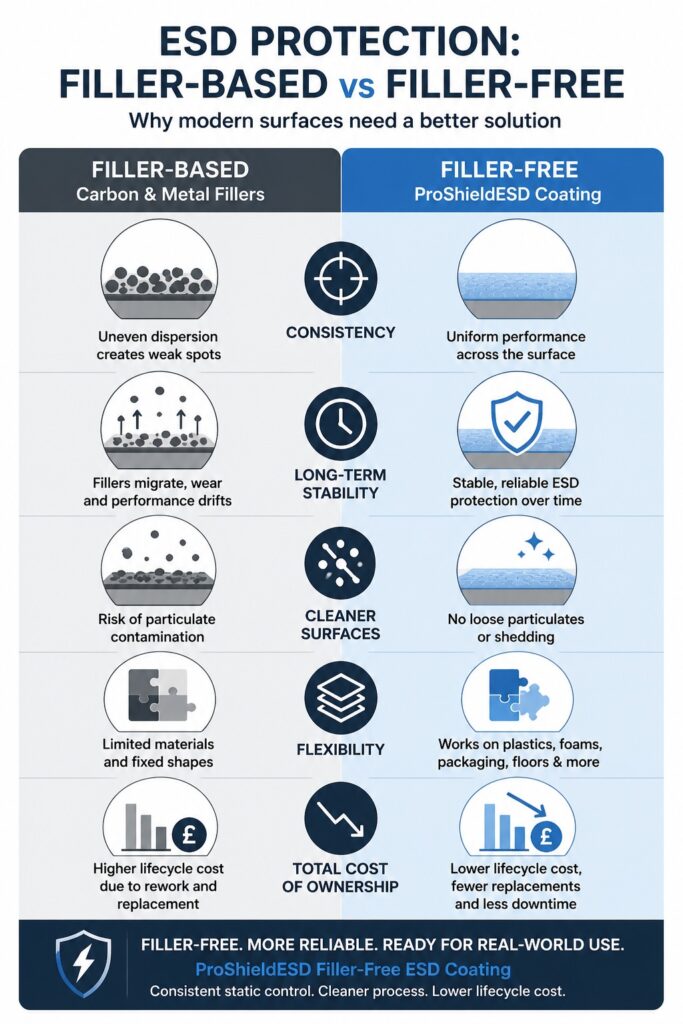
Filler-based ESD coatings vs filler-free coating behaviour in real use conditions
Modern electronics, medical, aerospace and industrial applications need static control surfaces that remain stable over time, across humidity changes, cleaning cycles, abrasion and daily handling. Traditional filler-based coatings and moulded carbon-loaded components can struggle to deliver uniform and repeatable performance at scale.
The Problem With Carbon and Metal Fillers
1) Inconsistent Conductivity
Fillers rarely disperse perfectly through a coating, and moulded anti-static plastics can show variation through the material or across the surface. This can result in patchy resistivity, localised weak areas and unpredictable static behaviour.
2) Performance Drift Over Time
In coatings, filler particles can wear, migrate, clump or become exposed unevenly at the surface. In moulded parts, surface behaviour can change as the material abrades, becomes contaminated or is repeatedly handled. What initially passed inspection may not behave the same way after prolonged use.
3) Contamination Risk
Carbon and metal-filled systems can introduce particulate concerns, especially where surfaces are handled, rubbed, cleaned or abraded. In sensitive electronics, clean manufacturing, medical and precision assembly environments, loose conductive contamination can become a quality and reliability risk.
4) Limited Substrate Flexibility
Filler-based paints often behave differently on plastics, foams, packaging materials, fixtures, floors and equipment surfaces. Moulded ESD plastics are also limited by material choice, tooling, geometry and availability. This can force companies to buy special parts instead of upgrading the surfaces they already use.
5) Higher Lifecycle Cost
Low initial cost can be misleading. Once replacement parts, rework, repeat inspection, downtime, cleaning problems and revalidation are included, legacy filler-based static control systems can become expensive to maintain.
Not all static control failures occur after a product enters service. In many projects, the first challenge is not electrical performance but ensuring the coating can properly bond to the substrate. Understanding surface materials and validating adhesion often determines whether a dissipative coating will succeed long before resistivity testing begins. Why ESD Coatings Fail Before Their Electrical Performance Does.
The Filler-Free Alternative
ProShieldESD filler-free ESD coating is designed to provide stable static dissipative or conductive behaviour without relying on carbon, graphite or metal filler particles.
Instead of using particulate fillers to create a discharge path, ProShieldESD uses a filler-free conductive polymer approach. This allows existing surfaces to be upgraded while reducing the risks associated with particle shedding, uneven filler distribution and wear-related drift.
- Uniform surface behaviour — helps reduce weak spots caused by filler clustering or uneven dispersion.
- Long-term static control — supports stable performance through normal operational use.
- Cleaner surface technology — avoids loose carbon or metal particulate systems in sensitive areas.
- Precision electrostatic surface control — useful in specialist applications such as electrostatic speaker diaphragm coatings where stable and uniform dissipative behaviour is critical to system performance.
- Broad application flexibility — suitable for plastics, fixtures, equipment, packaging, work areas and floors.
- Lower lifecycle risk — reduces reliance on replacement moulded parts or repeated reapplication cycles.
Where This Matters Most
Filler-free static control becomes especially useful where the surface must continue performing after cleaning, handling, movement, abrasion or environmental change.
- Plastic components and housings where moulded ESD alternatives are expensive or restrictive.
- Packaging and logistics systems where surface behaviour must remain consistent through handling and reuse.
- Industrial equipment and fixtures where existing assets can be upgraded rather than replaced.
- Work surfaces and facilities where visible, inspectable and repairable static control is valuable.
The Future of Static Control
As industries demand higher reliability, cleaner processes and more flexible implementation, filler-based paints and moulded ESD products increasingly show their limitations. A filler-free coating platform offers a more controlled way to specify static control across existing parts, surfaces and environments.
For many applications, the question is no longer simply whether a material is labelled anti-static or conductive. The more important question is whether the surface will continue to behave correctly during real use.
Choosing the Right Static Control Route
Not every ESD problem requires the same solution. Some applications need conductive behaviour, others need static dissipative control, and some need a practical way to upgrade existing materials without replacing them.
For a structured comparison of the available routes, see How to Choose the Right Static Control Approach, or explore the full ProShieldESD coating platform.
Note: Static control performance should always be validated against the relevant application, substrate, environment and applicable ESD standards. Final coating selection should be confirmed by testing under representative operating conditions.
