Why traditional ESD approaches fail in real environments and how coating-based systems change the model
Electrostatic discharge (ESD) protection is essential across electronics manufacturing, aerospace, automotive and medical environments. However, many traditional solutions are designed to meet specifications in isolation rather than maintain stable performance during real use.
Common approaches such as carbon-filled moulded products and filler-based ESD paints can appear effective initially, but often introduce variability, wear-related degradation and limitations when scaled across full systems.
This creates a gap between compliance and real-world reliability — particularly where surfaces, environments and usage conditions vary over time.
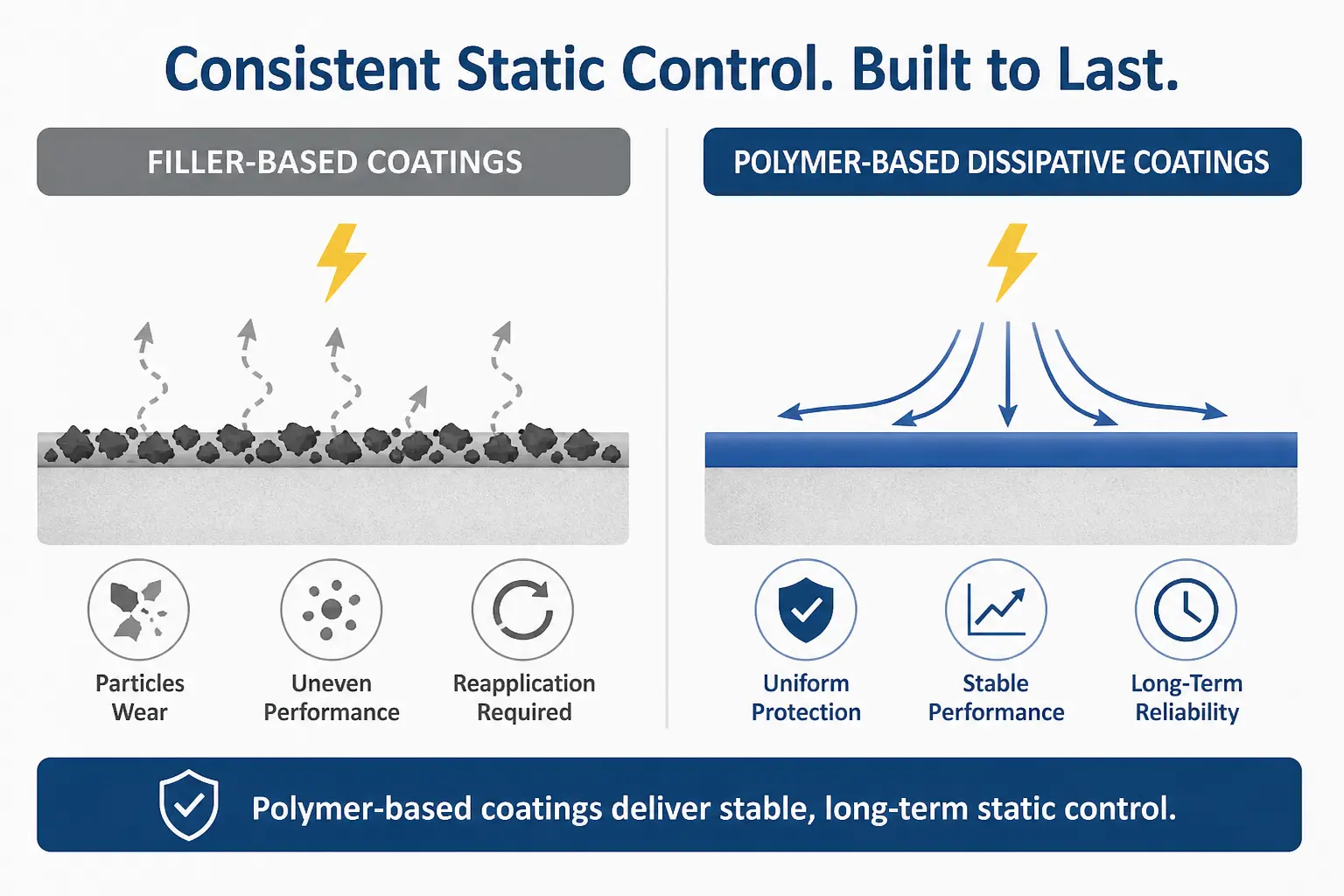
Filler-based ESD coatings rely on particle contact and can degrade over time, while polymer-based coatings provide stable, uniform static control
The Limitations of Traditional ESD Solutions
1) Moulded carbon-filled plastics
Carbon-filled boxes and moulded components provide fixed geometry solutions with embedded conductivity. While effective in controlled use cases, they are inherently inflexible and difficult to adapt across varied applications.
Surface performance can change with wear, contamination or handling, and scaling this approach across complex systems often results in inconsistent control.
2) Filler-based ESD coatings
Most ESD paints rely on carbon or metal fillers to create conductive pathways. These systems are mechanically dependent — meaning performance is influenced by particle distribution, surface wear and environmental exposure.
Over time, fillers can migrate, wear or become unevenly distributed, leading to patchy conductivity, contamination risk and the need for reapplication.
3) Lack of system-wide compatibility
Traditional approaches struggle to provide consistent performance across plastics, foams, packaging, equipment and structural surfaces. This makes it difficult to standardise ESD control across an entire facility.
Most ESD failures are not immediate — they emerge over time as materials wear, environments change and surface behaviour drifts outside controlled ranges.
A Different Approach: Polymer-Based Dissipative Coatings
ProShieldESD uses a polymer-based dissipative system rather than relying on conductive fillers. Instead of creating conduction through dispersed particles, the coating forms a controlled, uniform surface layer designed to maintain stable electrical behaviour.
This shifts ESD protection from a product-based approach to a surface engineering approach — allowing static control to be applied directly where it is needed, rather than constrained by predefined shapes or materials.
Key characteristics
- Uniform behaviour – consistent surface performance without dependence on filler distribution.
- Reduced drift – designed to maintain stability under wear and environmental exposure.
- Substrate flexibility – applicable across plastics, foams, packaging, equipment and floors.
- Clean surface profile – avoids particle shedding associated with filler-based systems.
What This Means in Practice
Moving from discrete ESD products to coating-based surface control enables a more consistent and scalable approach to static management.
- Reduced need for replacement of moulded ESD items.
- Lower maintenance compared to repaint cycles.
- Improved consistency across mixed materials and surfaces.
- Greater control over how and where static behaviour is managed.
This is particularly relevant in environments where multiple materials, handling processes and environmental conditions interact.
Continue Exploring
Understanding ESD control requires looking beyond materials to behaviour and system design. The following resources expand on key concepts and solution pathways:
Why Choose SCH Services?
- Process-led approach to static control, not just product supply
- Capability across coatings, substrates and application methods
- Support from concept through to implementation and validation
- Integration with wider coating and surface engineering expertise
This content is provided as general technical guidance. Final material selection and process validation should be confirmed through application-specific testing and relevant industry standards.