ESD Coating
Controlled Static-Dissipative and Conductive Surface Performance Without Full Material Redesign
ESD coating is used to control electrostatic charge on surfaces that would otherwise behave as insulators. Instead of redesigning a part in specialist conductive materials, an ESD coating can be applied to the surface to create controlled electrostatic performance while retaining the original substrate, geometry and mechanical function.
In many practical applications the goal is not maximum conductivity but controlled static dissipation. For example, coatings are frequently applied to plastic components, industrial equipment and systems operating in hazardous environments where insulating surfaces can allow static charge to accumulate.
ProShieldESD provides a filler-free conductive polymer route to ESD control. In many applications the practical target is a stable static-dissipative surface rather than a highly conductive finish, typically in the range of 106–109 Ω/sq.
Learn more about the ProShieldESD coating platform, the underlying filler-free ESD coating technology and our engineering comparison page on conductive coatings vs conductive plastics.
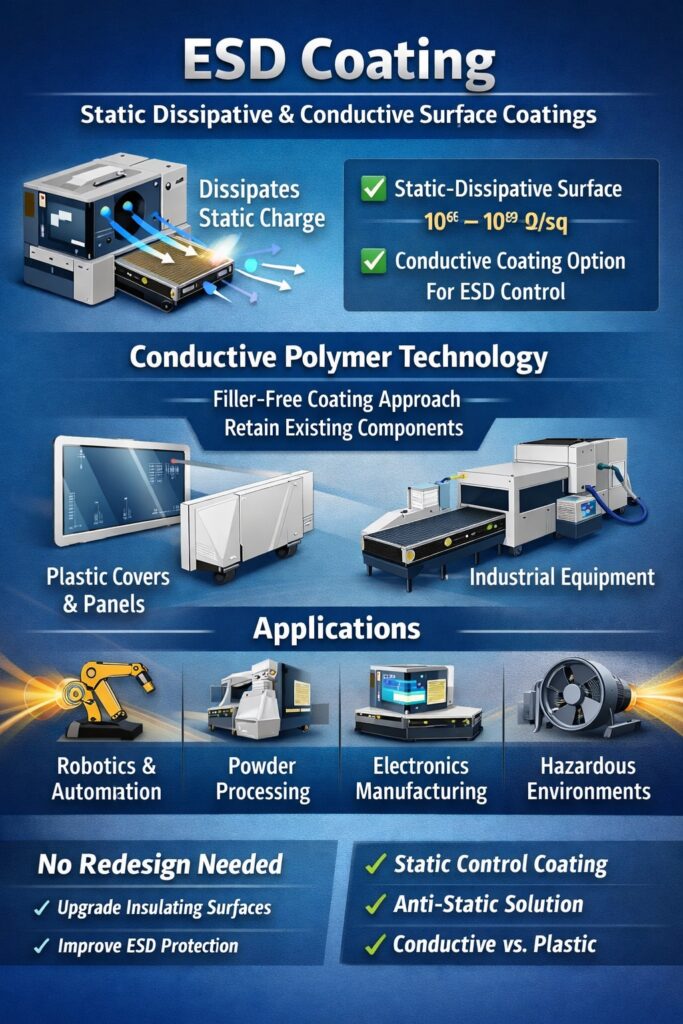
Infographic explaining how ESD coatings use conductive polymer technology to convert insulating surfaces into controlled static-dissipative or conductive surfaces for electrostatic discharge protection.
What Is an ESD Coating?
ESD coating is a functional surface treatment designed to control electrostatic behaviour. It is applied where static charge build-up, uncontrolled discharge, dust attraction or contamination risk must be managed on insulating or poorly dissipative surfaces. Instead of changing the full bulk material, the coating changes the surface response. This can be especially valuable where the existing part already meets the mechanical, dimensional or process requirements and only the electrostatic performance needs to improve.
Static-Dissipative vs Conductive ESD Coatings
Not all ESD coatings are intended to be highly conductive. In many applications the preferred outcome is a static-dissipative surface that allows charge to dissipate in a controlled way rather than discharge too rapidly.
- Static-dissipative surfaces are commonly targeted in the range of 106–109 Ω/sq.
- Highly conductive surfaces may be required in some specific applications, but are not always the preferred route for controlled ESD management.
- The correct target depends on the application, grounding strategy, environment and qualification requirements.
For many engineering use cases, the goal is stable static dissipation rather than maximum conductivity.
Why Use ESD Coating Instead of Conductive Plastics?
Conductive plastics and other specialist materials may solve some electrostatic problems, but they often introduce new design constraints.
- Specialist materials may cost more than standard engineering plastics.
- Material changes may trigger redesign, tooling or validation work.
- Bulk conductive materials are not always needed if only the surface behaviour matters.
- Existing equipment and installed assets cannot usually be upgraded by changing the base material.
ESD coating offers a surface-engineering route that may be more practical when the real need is controlled electrostatic performance on an existing design. For a detailed comparison, see conductive coatings vs conductive plastics.
How ESD Coating Works
ESD coating creates a controlled pathway for electrostatic charge to dissipate across the surface of a component. ProShieldESD uses conductive polymer technology rather than relying on conventional filler-loaded paints. This means electrostatic performance is engineered into the coating system itself rather than depending only on suspended conductive particles. The result can be a more stable and homogeneous surface response suited to long-term ESD control across a range of substrates.
Where ESD Coatings Are Used
ESD coatings can be used across a wide range of materials, components and environments where static charge control is important.
- Plastic housings, enclosures and covers
- Industrial equipment guarding, panels and machine surfaces
- Packaging, trays, foams and handling structures
- Fixtures, jigs, tooling and production aids
- Sensitive environments where static build-up must be carefully managed
Explore specific routes here:
Typical Surface Resistivity Range
For many ESD coating applications, the most useful surface resistivity range is 106–109 Ω/sq. This supports controlled static dissipation while avoiding the rapid discharge behaviour associated with highly conductive surfaces. The correct target should always be selected according to the application, environment and qualification needs.
Engineering Considerations
As with any functional coating system, performance depends on proper engineering assessment.
- Substrate compatibility and adhesion
- Target resistivity and grounding strategy
- Mechanical wear, cleaning and chemical exposure
- Application method and coating thickness
- Environmental and qualification requirements
In hazardous or regulated environments, coating performance should be considered as part of the broader equipment and system assessment rather than as a standalone certification claim.
Need an ESD Coating Solution?
If you need to control static charge on plastics, equipment surfaces, packaging or other insulating materials, we can help assess whether an ESD coating is the right route.
In many cases, a coating-based surface upgrade can deliver the required electrostatic performance without the cost and disruption of a full material redesign.
Keep the design where possible. Upgrade the surface where needed.
Useful Links
- ProShieldESD Overview
- Introduction to ProShieldESD
- Anti-Static Coating for Plastic
- Conductive Coatings vs Conductive Plastics
- Static Control for Industrial Equipment
- Static Control in Hazardous Environments
- Chemistries & Available Formats
- Outsourced Coating Services
- FAQs – Learn More About ProShieldESD
Why ProShieldESD Is Well Suited to ESD Coating Applications
- ✅ Filler-free conductive polymer technology – Supports stable electrostatic performance without relying on conventional filler-loaded paints.
- ✅ Static-dissipative and conductive tunability – Allows the surface response to be matched to the application need.
- ✅ Surface-upgrade route – Improves electrostatic behaviour without requiring full part redesign.
- ✅ Broad substrate potential – Suitable across plastics, composites, metals, foams and more.
- ✅ Engineering-led assessment – Select the correct route based on function, environment and qualification requirements.
ESD coating is not simply about adding conductivity. It is about creating the right electrostatic surface behaviour for the application, often through stable static-dissipative performance rather than highly conductive finishes.