
Mon - Thur 7.30-15.30   Fri 7.30-14.00

What Is Parylene Coating and Why Is It Different From Other Conformal Coatings?


In electronics and advanced manufacturing, protecting sensitive components from moisture, chemicals, and environmental stress is critical. Conformal coatings play a key role in improving reliability and reducing field failures β€” but not all coatings perform the same. Parylene stands out as a highly effective solution when coverage, consistency, and long-term performance matter most.

What Is Parylene?

Parylene is a family of thin, transparent polymer coatings applied using a chemical vapour deposition (CVD) process. Unlike liquid conformal coatings that are sprayed, brushed, or dipped, Parylene is deposited as a vapour in a vacuum chamber. This allows it to coat external and internal surfaces with a uniform, pinhole-free film.

Common Parylene types include:

  • Parylene N – Excellent dielectric properties and strong performance in high-frequency applications.
  • Parylene C – Widely used for outstanding moisture and chemical resistance.
  • Parylene F (AF-4) – Enhanced high-temperature stability and chemical resistance.

How Parylene Differs From Liquid Conformal Coatings

  1. Application method – Vapour deposition in a vacuum chamber delivers even coverage without pooling, meniscus effects, or edge build-up.
  2. Coverage – Parylene can penetrate tight gaps, coat under components, and reach complex geometries that liquid coatings often cannot.
  3. Film properties – Typically ultra-thin (commonly 1–50 Β΅m), transparent, flexible, and suitable for demanding environments.
  4. Performance – Strong resistance to moisture and many chemicals, with stable electrical and dielectric characteristics.
  5. Cleanliness – As a dry, solvent-free deposition process, Parylene avoids solvent residues and is well suited to sensitive applications including medical and aerospace electronics.

Liquid vs Parylene Coating
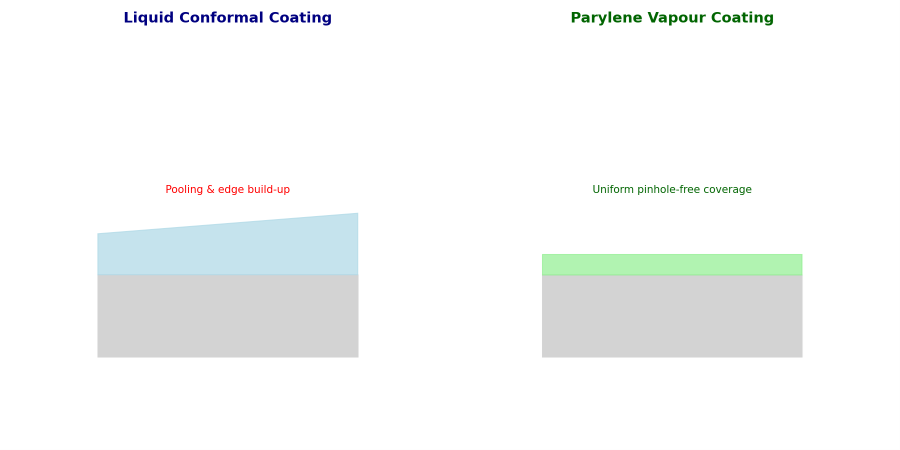
Comparison between liquid conformal coating and Parylene vapour deposition on electronic assemblies

Comparison between traditional liquid conformal coating and Parylene vapour deposition.

Where Is Parylene Used?

  • Medical devices – Catheters, sensors, pacemakers, and implantable or body-contact components.
  • Aerospace and defence – High-reliability electronics, sensors, and mission-critical assemblies.
  • Automotive – EV electronics, sensors, and ADAS-related components.
  • Consumer electronics – Wearables, IoT products, and microelectronics.

Why Choose SCH for Parylene?

At SCH Services Ltd, we combine decades of coating expertise with a complete Parylene offering:

  • Subcontract coating services – ISO-controlled Parylene coating capability for prototypes through to production.
  • Turnkey Parylene systems – Equipment, dimers, training, and long-term technical support for in-house deployment.
  • Reliable materials supply – Official European distribution partnership supporting consistent dimer availability and quality.

Whether you need immediate coating capacity or a full in-house solution, SCH provides the knowledge, equipment, and materials to support success.

If you would like to discuss Parylene coating for your assemblies or compare options against liquid coatings, get in touch with SCH. To explore SCH’s wider Parylene capabilities, including services, equipment, dimers, and support, visit our Parylene solutions page.
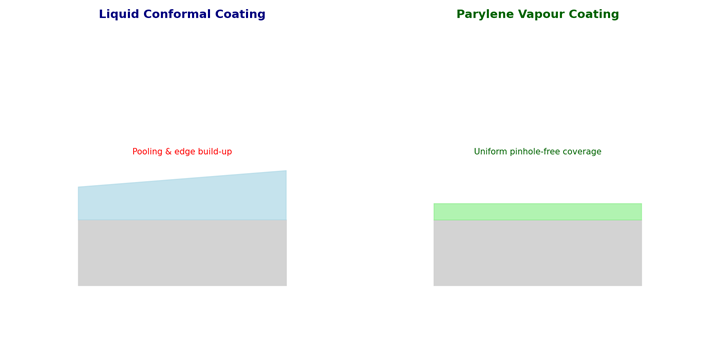

Comparison between liquid conformal coating and Parylene vapour deposition on electronic assemblies

What Is Parylene Coating and Why Is It Different From Other Conformal Coatings?


In electronics and advanced manufacturing, protecting sensitive components from moisture, chemicals, and environmental stress is critical. Conformal coatings play a vital role in ensuring long-term reliability, but not all coatings perform in the same way. Among available technologies, Parylene stands out as a unique and highly effective solution.

What Is Parylene?

Parylene is a family of thin, transparent polymer coatings applied using a chemical vapour deposition (CVD) process. Unlike liquid conformal coatings that are sprayed, brushed, or dipped, Parylene is deposited as a vapour inside a vacuum chamber. This enables it to coat all exposed surfaces β€” internal and external β€” with a uniform, pinhole-free film.

The most common Parylene variants include:

  • Parylene N – Excellent dielectric properties, often used in high-frequency applications.
  • Parylene C – The most widely used type, offering strong moisture and chemical resistance.
  • Parylene F (AF-4) – Enhanced high-temperature and chemical resistance.

How Parylene Differs From Other Conformal Coatings

  1. Application method – Vapour deposition in a vacuum environment ensures even coverage without pooling, meniscus effects, or edge build-up.
  2. Coverage – Parylene penetrates tight gaps, coats under components, and reaches complex geometries that liquid coatings cannot.
  3. Film properties – Ultra-thin (typically 1–50 Β΅m), transparent, flexible, and biocompatible.
  4. Performance – Superior resistance to moisture, chemicals, and many extreme environments.
  5. Cleanliness – A dry, solvent-free process that leaves no residues, making it ideal for medical, aerospace, and high-reliability electronics.

Where Is Parylene Used?

  • Medical devices – Catheters, stents, pacemakers, sensors, and implantable electronics.
  • Aerospace and defence – Flight electronics, sensors, and mission-critical systems.
  • Automotive – EV electronics, sensors, and ADAS components.
  • Consumer electronics – Wearables, IoT devices, and microelectronics.

Why Choose SCH for Parylene?

At SCH Services Ltd, we combine over 30 years of coating expertise with a complete Parylene offering that supports both outsourced coating and in-house capability.

  • Subcontract coating services – ISO-controlled, production-ready Parylene coating.
  • Turnkey Parylene systems – Complete equipment, dimers, training, and long-term technical support.
  • Reliable materials supply – Official European distribution supporting quality and continuity.

Whether you need immediate coating capacity or a fully validated in-house process, SCH provides the knowledge, equipment, and materials to ensure long-term success.

If you would like to discuss whether Parylene is the right solution for your application, get in touch with SCH. Β To explore SCH’s complete Parylene capability, including services, equipment, dimers, and technical support, visit our Parylene solutions page.

0
  • Your current order total is £0.00 β€” you must have an order with a minimum of £75.00 to place your order.
0
Your Cart
Your cart is empty
  • Your current order total is £0.00 β€” you must have an order with a minimum of £75.00 to place your order.
Calculate Shipping
  • Your current order total is £0.00 β€” you must have an order with a minimum of £75.00 to place your order.

Conformal Coating UK

Technical banner showing PCB and process icons representing conformal coating, masking, inspection and training on the SCH technical knowledge hub.
Conformal Coating UK
Privacy Overview

This website uses cookies so that we can provide you with the best user experience possible. Cookie information is stored in your browser and performs functions such as recognising you when you return to our website and helping our team to understand which sections of the website you find most interesting and useful.