Conformal Coating Removal: Local and Full Stripping
When to use localised coating removal versus full PCB stripping
← Back to the Removal & Rework Hub
Conformal coating removal is a critical step in PCB repair and rework. Removal may be required locally—for exposing pads, connectors, or components—or across the entire assembly when full stripping is needed. Choosing the correct scope and method ensures coatings are removed effectively without damaging sensitive electronics.
If you’re still deciding which removal route is safest, start with Conformal Coating Removal Methods (Wet & Micro-abrasion).
If coating type is unknown, use Identify Unknown Conformal Coatings (IPC-7711 Method) before you start.
Related Guide: Micro-Abrasive Media Selection
If you are using micro-abrasion for local removal, abrasive choice is one of the biggest drivers of boundary control and substrate risk.
Local vs Full Conformal Coating Removal
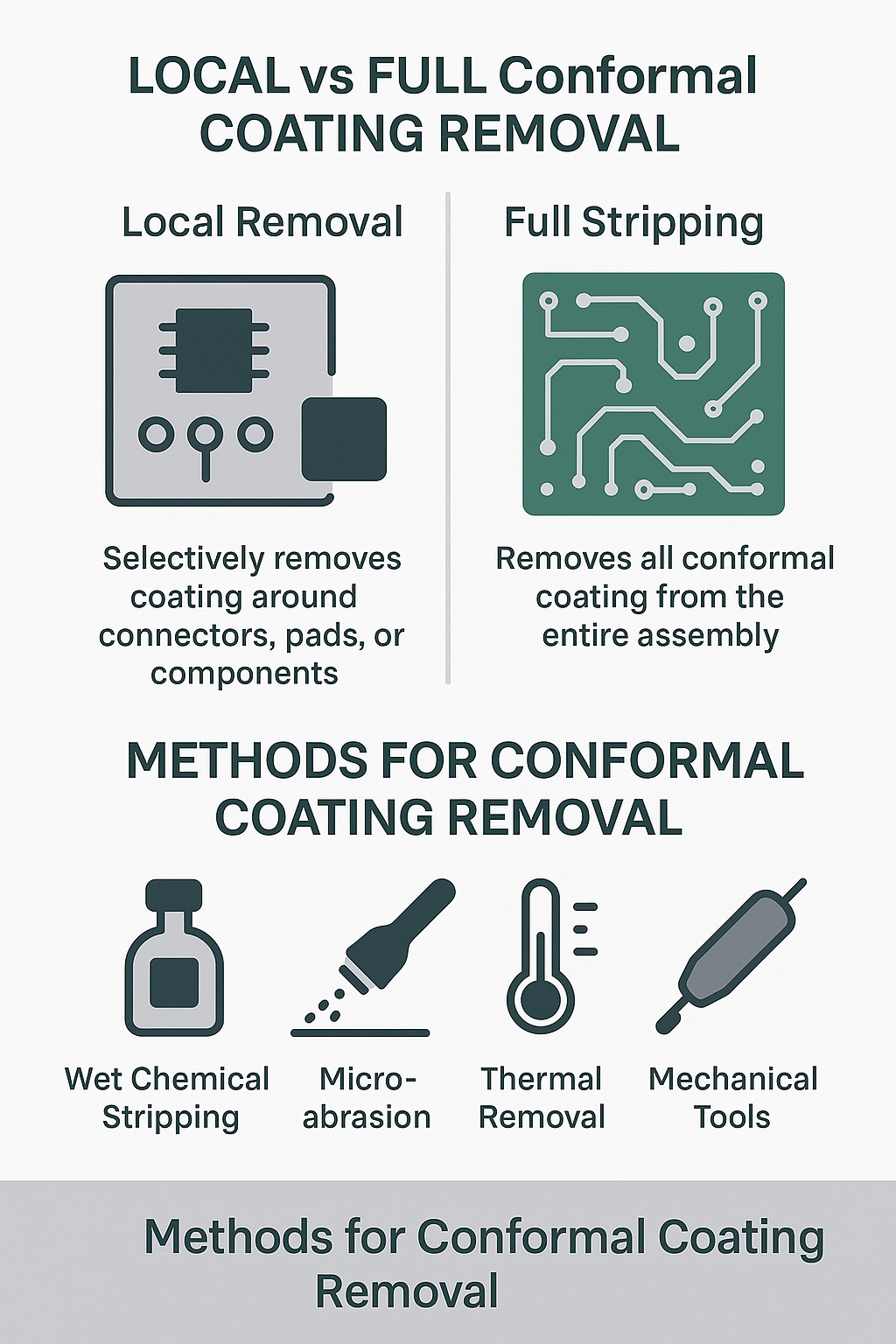
- Local removal: Selectively removes coating around a connector, pad, or component to enable rework, soldering, probing or diagnostics. Precision is key to protect surrounding areas and keep-out boundaries.
- Full stripping: Removes all conformal coating from the assembly. Typically required when repairs are widespread, contamination is systemic, or the assembly must be re-coated with a new material system.
For a UK/EU decision framework covering identification → method choice → risk controls → verification, see:
Ultimate Conformal Coating Removal Guide (UK & Europe).
Methods for Conformal Coating Removal
- Wet chemical stripping: Solvents or chemical agents dissolve or swell the coating. Best for acrylics, urethanes, and silicones. Not effective against Parylene or fluoropolymers.
See our wet stripping systems. - Micro-abrasion: A controlled abrasive stream selectively removes coating, ideal for local rework and for coatings resistant to solvents such as Parylene.
See our micro-abrasion systems and read Inside the Micro-Abrasive Blasting Process for process control (nozzle, standoff, angle, pressure and technique). - Thermal removal: Involves controlled heating to soften or volatilise certain coatings. Typically limited due to risk of component damage.
- Mechanical tools: Scalpels, scrapers, or rotary tools used in manual repair. Useful for small, localised areas but operator-dependent.
Localised Conformal Coating Removal Using Polyester Swabs
For controlled, localised conformal coating removal and precision rework, operators often use solvent-dampened polyester cleaning swabs rather than bulk wiping materials. Polyester swabs provide controlled solvent delivery, low linting, and minimal fibre shedding, making them suitable for cleaning small areas, component leads, and solder joints without spreading contamination.
In manual rework processes, swabs allow the coating to be softened and lifted gradually, reducing the risk of damage to underlying solder masks, component markings, or adjacent keep-out areas. This approach is particularly effective where selective removal is required prior to inspection, touch-up, or repair.
Key Considerations for Safe Removal
- Match the removal method to coating type (e.g., acrylic vs Parylene). If uncertain, use Identify Unknown Conformal Coatings (IPC-7711 Method).
- Ensure operators follow IPC-7711/7721 rework standards.
- Maintain ESD-safe conditions during the entire removal process.
- Inspect after removal for residue, pad integrity, solder mask damage, and readiness for recoat.
- When micro-abrasion is used, control media selection, particle size and changeover discipline to prevent unintended erosion and contamination (see the Micro-Abrasive Media Selection Guide).
If the board is Parylene coated and solvents are not viable, use:
Parylene Removal: Precision Micro-abrasion.
Summary
Conformal coating removal may be performed locally or across the entire PCB, depending on repair needs and recoat intent. Local removal is usually faster and lower risk when you only need targeted access. Full stripping is justified when repairs are widespread, the coating chemistry must change, or you need a clean baseline for inspection and rework.
For next-step guidance, see the Conformal Coating Rework Workflow.
Why Choose SCH Services?
Partnering with SCH Services means more than just outsourcing — you gain a complete, integrated platform for
Conformal Coating, Parylene & ProShieldESD Solutions, alongside equipment, materials, and training, all backed by decades of hands-on expertise.
- ✈️ 25+ Years of Expertise – Specialists in coating technologies trusted worldwide.
- 🛠️ End-to-End Support – Guidance on coating selection, Parylene grades, masking, inspection, and ProShieldESD integration.
- 📈 Scalable Solutions – From prototype batches to high-volume production, SCH grows with your needs.
- 🌍 Global Reach – Responsive support across Europe, North America, and Asia.
- ✅ Proven Reliability – Built on quality, consistency, and customer satisfaction.
📞 Call: +44 (0)1226 249019 | ✉ Email: sales@schservices.com | 💬 Contact Us ›