
Conformal Coating Viscosity Control
Why viscosity matters in process control
Effective conformal coating viscosity control is essential for consistent coverage, defect prevention, and long-term PCB reliability. If viscosity is too low, coatings can run or thin out; too high, and you risk bubbles, voids, poor flow and texture defects. Managing viscosity is a cornerstone of stable, repeatable coating processes.
Viscosity must be treated as a controlled parameter—defined by a target window, measured consistently, recorded for traceability, and linked to thickness and inspection results for closed-loop control.
Article Quicklinks
| Topic | Jump |
|---|---|
| What viscosity affects (coverage, thickness, defects) | 🔗 |
| How to measure (cups, temperature, technique) | 🔗 |
| Control plan (windows, SPC, make-up rules) | 🔗 |
| Troubleshooting (symptom → likely viscosity causes) | 🔗 |
| Downloads & SCH support | 🔗 |
Why Viscosity Matters in Conformal Coating
Viscosity influences how a coating wets, flows, levels and builds thickness. It also changes how the coating atomises (spray), drains (dip), and behaves at edges and component bodies.
- Too low: runs, pooling, thin coverage on edges/high points, wicking under parts, longer tack/contamination risk.
- Too high: poor levelling, texture/orange peel, air entrapment, bridging, voids, inconsistent thickness and edge definition.
- Drifting viscosity: random defects that correlate to solvent loss, temperature changes, open tank time, or poor make-up control.
Viscosity must be controlled alongside temperature, solids content, humidity/airflow and cure profile—because these variables interact.
Measuring Conformal Coating Viscosity
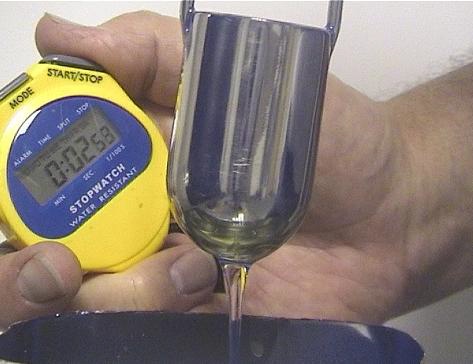
Production-friendly measurement is usually a flow cup (e.g., Zahn/Ford) plus a stopwatch. Consistency depends on doing the test the same way every time.
- Use the correct cup type and size for the coating and target range.
- Control temperature, or record it every time, as viscosity is temperature-sensitive.
- Use a consistent sampling method (same depth, same container, same stir/settle time).
- Define the end-point clearly (first break / continuous stream end) and train operators.
Tip: If you need higher accuracy (e.g., 2K systems or critical specs), add periodic cross-checks using a rotational viscometer and/or solids checks, then correlate back to the cup readings used on the line.
Why measurement matters
- Ensures consistent coating flow and application
- Supports repeatable film thickness and quality
- Reduces risk of bubbles, runs or orange peel
- Forms part of IPC-aligned process control
Best Practices for Viscosity Control
Good control means more than taking a reading—it ties specification limits, trained operators, and verification plans together. Build viscosity into work instructions and link checks to thickness verification for a closed-loop process.
- Define viscosity windows per coating + application method (spray/dip/selective/brush).
- Set a measurement cadence (start of shift, every X hours, after top-ups, after long idle, after filter changes).
- Standardise make-up rules (approved thinner only; max % addition; add in steps; mix time; re-test before release).
- Record for traceability (operator, batch/lot, time, temp, cup/time result, any additions) and trend via SPC.
- Correlate to thickness using coupons/witness boards and inspection outcomes (UV coverage + dry film thickness).
Minimum record set (recommended)
- Date/time, coating ID, batch/lot, cup type, seconds, temperature
- Tank/container ID, filter status, any thinner/top-up amount
- Related process settings (spray pressures / dip withdrawal speed) if changed
- Linked thickness/inspection result (pass/fail + notes)
Troubleshooting: When Viscosity Is (Probably) the Root Cause
- Runs / pooling / thick edges: viscosity too low, over-wet passes, excess thinner, high temperature, poor drain orientation.
- Orange peel / rough texture: viscosity too high, excessive solvent flash (airflow/distance), poor levelling window. (Related: Orange Peel)
- Bubbles / pinholes: viscosity too high or aerated material, aggressive mixing, solvent imbalance, trapped volatiles. (Related: Pinholes, Bubbles & Foam)
- Inconsistent thickness shift-to-shift: temperature not controlled, sampling method inconsistent, top-ups not standardised, evaporation in open tanks.
- Masking leakage suddenly increases: viscosity drift (often lower) + wet passes + capillary routes; confirm viscosity and re-check demask/touch-up rules.
If viscosity is stable but defects persist, broaden the investigation to cleanliness, surface energy/contamination, airflow/booth conditions, and cure profile.
Downloads, Support, Training & Equipment
SCH helps teams implement robust viscosity management—from operator training and process audits to supply of flow cups and accessories. Our specialists optimise coating parameters so you reduce rework, improve yield, and meet customer/industry standards.
- Training on viscosity measurement, material handling and make-up control
- Process setup and optimisation consultancy
- Supply of measurement tools and consumables
Why Choose SCH Services?
Stable viscosity control is one of the fastest ways to reduce coating variation and improve yield. SCH Services helps customers build practical control methods, operator routines and linked process checks so viscosity becomes a managed parameter rather than a hidden source of drift.
- 🧪 Process-Control Expertise – Practical support with viscosity windows, measurement methods and make-up rules for stable coating performance.
- 🛠️ Training & Line Support – Guidance on operator technique, material handling and day-to-day process consistency.
- 📈 Reduced Drift & Rework – Recommendations aimed at improving repeatability, defect prevention and traceable control.
- 🔍 Linked Quality Thinking – Help correlating viscosity checks with thickness, inspection and wider process outcomes.
- 🌍 Integrated Technical Capability – Consultancy, training, equipment support and troubleshooting from one specialist partner.
📞 Call: +44 (0)1226 249019
✉ Email: sales@schservices.com
💬 Contact Us ›
