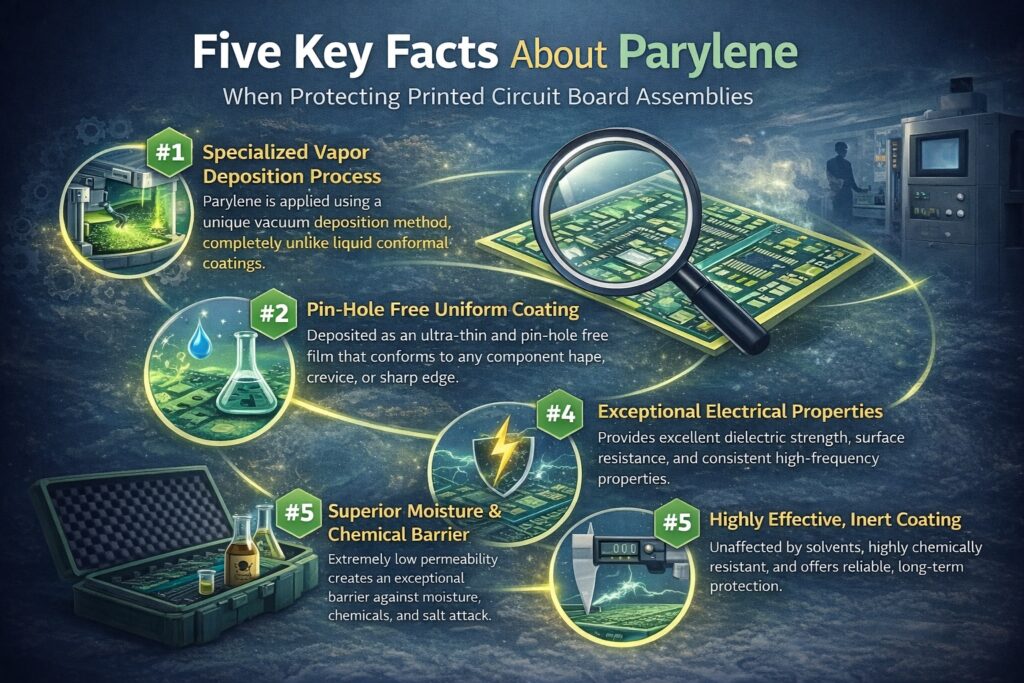
Here are five key facts about Parylene that are critical in understanding this process:
- The Parylene conformal coating process is a very specialised vapour deposition application method using specialist vacuum chamber systems. This differs significantly to all of the other liquid conformal coatings available on the market that are applied by spraying, brushing and dipping.
- Parylene coating is completely conformal and uniform to the surface of the Printed Circuit Board (PCB) or product. It is also pinhole free. Therefore, components with sharp edges, points, flat surfaces, crevices or exposed internal surfaces are coated uniformly without voids.
- Parylene coating provides an excellent moisture and gas barrier due its very low permeability. This means that electronics circuit boards coated in Parylene generally are more “waterproof” than the same electronics coated in a liquid conformal coating.
- Parylene is unaffected by solvents (it has very high chemical resistance) and is very effective against salt attack.
- Parylene has excellent electrical properties. This includes having low dielectric constant and loss with good high-frequency properties, good dielectric strength, and high bulk and surface resistance.
Find more in-depth details about Parylene materials, deposition principles, masking methods, thickness measurement and core application concepts at our Parylene Basics Hub now.
Or, if you’re interested in moving towards a Parylene process click through to our Parylene Solutions, Parylene equipment and Parylene subcontract services pages.
Want to find out more about Parylene?
Contact us now to discuss your needs and let us explain how we can help you.