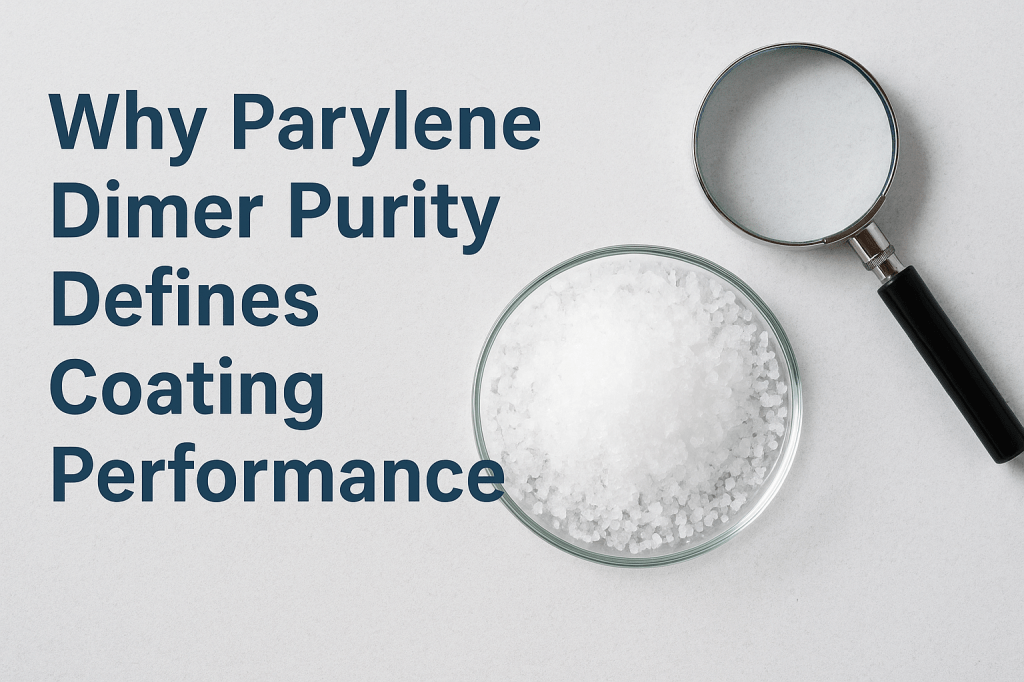
Clean chemistry, flawless coatings
Behind every reliable Parylene coating lies the dimer — a crystalline, purified precursor that drives the entire deposition process. Parylene dimer purity is the single most critical factor in achieving flawless polymerisation, electrical performance and long-term reliability.
When sublimed and cleaved under vacuum, the dimer becomes a reactive monomer that polymerises onto every exposed surface, forming a perfectly conformal, pinhole-free film.
But that level of precision depends on one factor above all others: purity.
How impurities affect coating quality
Even trace contamination in a Parylene dimer can have major consequences. Impurities such as moisture, oxygen, halogens, metal residues or unreacted intermediates can:
- Reduce dielectric strength by interrupting polymer chain growth
- Cause discolouration or haziness in the deposited film
- Lead to pinholes, voids, and residues during sublimation and pyrolysis
- Trigger uneven coating thickness or adhesion issues
Because the Parylene process amplifies any chemical irregularity during polymerisation, even parts-per-million contaminants can result in visible or electrical defects.
Why SCH focuses on ultra-pure feedstock
SCH Services Ltd sources and supplies high-purity Parylene dimers for advanced electronics, aerospace, and medical applications. Each batch undergoes controlled crystallisation, vacuum drying and contamination screening to ensure complete chemical consistency.
Our commitment to purity extends beyond production — it’s independently verified.
Independent SGS verification
Independent SGS testing throughout 2025 confirmed that all SCH Parylene materials — including Parylene N, C, D and fluorinated F (AF-4) — contain no detectable Substances of Very High Concern (SVHCs), polycyclic aromatic hydrocarbons (PAHs), or PFOS/PFOA compounds to ppm-level detection limits.
Fluorinated grades also meet full RoHS 2.0 (2015/863) compliance.
This independent verification demonstrates ultra-high-purity feedstock (>99.9 % equivalent), ensuring stable polymerisation, high dielectric performance, and pinhole-free coatings across the entire SCH Parylene range.
Performance benefits of high-purity Parylene
- Improved dielectric strength and insulation resistance
- Cleaner surface finish with no whitening or carbonised residue
- Consistent film uniformity across complex geometries
- Reduced risk of adhesion failures and outgassing
- Enhanced long-term reliability under thermal or chemical stress
Certified materials for demanding industries
Whether you’re coating aerospace PCBs, medical implants, or automotive sensors, the purity of the dimer defines the quality of the final coating.
SCH’s independently tested materials ensure regulatory compliance, consistent film quality and traceable supply.
Frequently Asked Questions: Parylene Dimer Purity
Why does Parylene dimer purity matter?
Parylene dimer purity directly affects polymerisation, dielectric strength, film uniformity and long-term reliability. Even trace contaminants can disrupt chain growth, leading to pinholes, discolouration, adhesion loss or electrical instability.
What impurities cause problems in Parylene coatings?
Common problematic impurities include moisture, oxygen, halogens, metal residues and unreacted intermediates. These can cause voids during sublimation, hazy films, uneven thickness and reduced insulation resistance.
Can low-purity Parylene dimer still meet thickness targets?
Yes — but thickness alone does not guarantee performance. Low-purity dimers may reach nominal thickness while still producing coatings with reduced dielectric strength, pinholes or long-term reliability failures.
How does dimer purity affect dielectric performance?
High-purity Parylene dimers allow uninterrupted polymer chain formation, resulting in higher dielectric strength, stable insulation resistance and improved performance in high-voltage or high-humidity environments.
Are SCH Parylene dimers independently tested?
Yes. SCH Parylene materials have been independently tested by SGS and confirmed to contain no detectable SVHCs, PAHs or PFOS/PFOA to ppm-level detection limits. Fluorinated grades also meet full RoHS 2.0 compliance.
Does higher dimer purity reduce coating defects?
Yes. High-purity feedstock significantly reduces the risk of pinholes, hazing, carbonised residues, adhesion failures and outgassing — especially on complex geometries and sensitive electronics.
Learn more
Explore our full range of Parylene dimers or dive deeper into the chemistry behind coating performance in the Parylene Dimers Hub and find out how dimer purity affects coating quality.
All SCH Parylene materials have been independently tested by SGS to confirm no detectable SVHCs, PAHs or PFOS/PFOA, ensuring the highest levels of purity and performance.