Inside the Micro-Abrasive Blasting Process
How precision control defines coating removal quality
← Back to the Removal & Rework Hub
Micro-abrasive blasting (also called micro-blasting) is a foundation method for selective conformal coating removal. It provides one of the most precise and controllable ways to remove coatings such as Parylene, acrylic, urethane, and silicone.
Unlike mechanical scraping or chemical stripping, the micro-abrasive blasting process drives a fine stream of dry abrasive particles using compressed air to remove microns of material while protecting the PCB and components.
If you’re deciding whether to remove coating locally vs strip a full assembly, see Conformal Coating Removal: Local and Full Stripping.
For the broader decision framework (identify → choose method → control risk → verify), see Ultimate Conformal Coating Removal Guide (UK & Europe).

Understanding the Micro-Abrasive Blasting Process
Micro-abrasion directs fine media particles through a miniature nozzle at controlled pressure. When the stream strikes the coating, microscopic impacts lift or shear the film. Because the jet is tightly focused—often under a millimetre wide—operators can target exact zones such as test pads, connector edges, or rework sites without disturbing adjacent components.
If you are stripping Parylene specifically, see Parylene Removal: Precision Micro-abrasion.
Advantages of the Micro-Abrasive Blasting Process
Compared with mechanical, thermal, or chemical techniques, precision micro-blasting offers a strong mix of precision, safety, and consistency:
- Precision: Can remove coating in defined zones with minimal disturbance to surrounding areas when correctly set up.
- Control: Tune air pressure, media flow, and angle for repeatable outcomes.
- ESD safety: Use conductive nozzles and grounded cabinets to protect sensitive electronics.
- Clean process: Avoid solvents and fumes; dry removal reduces handling hazards.
- Repeatability: Once parameters are set, operators can follow a consistent recipe.
Key Process Variables in Micro-Abrasive Blasting
Successful outcomes depend on four levers within the micro-abrasive blasting process:
abrasive media, air pressure, nozzle geometry, and technique. Match each to the coating’s hardness and thickness, and to the assembly’s fragility.
Abrasive Media Selection for Precision Coating Removal
The abrasive sets removal aggressiveness. Softer media protect delicate boards; harder media increase throughput on thick films. For populated PCBs where surface integrity matters, VanAcrylic is positioned as a gentle, controllable polymer media.
VanAcrylic equipment check: If you already use VanAcrylic in a Vaniman ProBlast, see Do I Have the Latest VanAcrylic Configuration? for the current tank, violet tip and media-delivery setup.
For a full selection workflow (including particle size and changeover discipline), use Micro-Abrasive Media Selection Guide.
| Abrasive Type | Characteristics | Typical Use |
|---|---|---|
| VanAcrylic | Engineered polymer media; gentle, uniform cutting; supports good visibility and control on delicate assemblies. | Selective removal on populated PCBs, including thin Parylene and acrylic coatings where surface integrity matters. |
| Plastic Media | Broad working range; controllable cut; multiple sizes for different removal rates. | Thicker or multi-layer coatings; general-purpose conformal coating rework. |
| Walnut Shell | Sharper, fibrous particle with moderate hardness. | Tougher polymer or silicone systems that need more cutting power. |
| Sodium Bicarbonate | Angular morphology; relatively soft but can be effective on resilient films depending on setup. | Targeted rework where a “softer” abrasive is desired but removal rate is still required. |
Air Pressure and Media Flow in the Micro-Blasting Process
Work typically between 40–80 psi (2.7–5.5 bar), depending on the coating and board risk. Lower pressures protect components but slow removal; higher pressures increase removal rate but can increase the risk of solder mask erosion. Use clean, dry air and stable regulation to keep media flow consistent.
If you’re still choosing between wet stripping and micro-abrasion, use Conformal Coating Removal Methods (Wet & Micro-abrasion).
Nozzle Geometry and Control for Consistent Results
The nozzle converts air and media into a coherent stream. Size the internal diameter to roughly four times the average particle size to help prevent clogging and maintain uniform flow. For electronics, common sizes sit between 0.018″–0.060″. Use conductive nozzles to support ESD-safe micro-abrasion when working with sensitive assemblies.
Technique: Angle, Distance and Motion
Technique drives finish and precision:
- Angle: Use a shallow 20–30° angle for controlled, targeted areas and boundary work.
- Distance: Hold ~6–12 mm (1/4–1/2″) stand-off to keep cutting power consistent.
- Motion: Sweep evenly to reduce localised erosion risk.
For large areas, first peel the film from a shallow angle, then reverse the angle to separate the lifted edge cleanly. This two-step technique can improve throughput without sacrificing control.
Related Guide: Media Selection
Choosing the correct abrasive and particle size is critical for controlled removal without damaging solder mask or copper.
Process Repeatability and Quality Control
Lock in parameters, then verify them. After you establish the best media, pressure, nozzle, standoff and angle, reproduce the recipe across boards and operators. Use test coupons or coated sample boards to confirm removal rate and to verify you preserve solder mask and component surfaces.
For the end-to-end rework sequence after removal, use Conformal Coating Rework Workflow: Clean, Repair, Recoat.
Parylene and Aerospace: Micro-Abrasive Blasting Considerations
Parylene coatings resist chemicals and challenge most removal methods. Precision micro-abrasive blasting provides controlled, dry removal without chemical attack.
In aerospace and defence work, prevent static discharge and trace damage with an ESD-safe cabinet and a grounded operator setup. Because the process targets only where needed—connectors, inspection pads, rework zones—you maintain overall board integrity.
If your job is Parylene-specific, follow the dedicated method page: Parylene Removal: Precision Micro-abrasion.
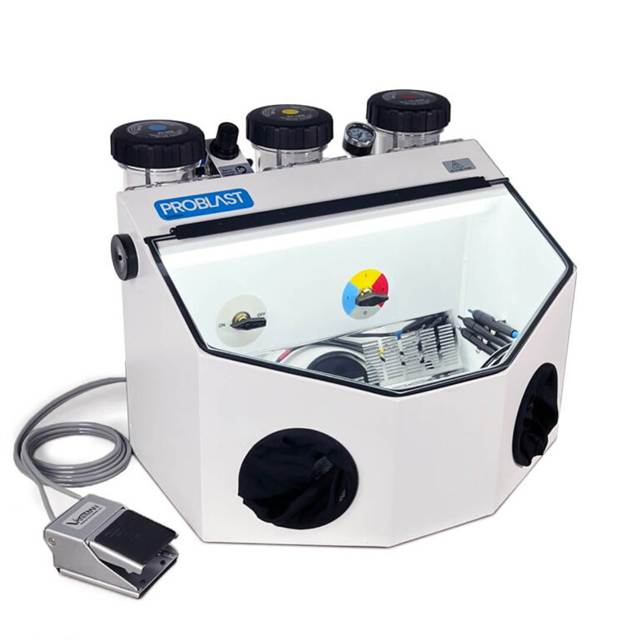
Integrating ProBlast Systems for the Micro-Abrasive Blasting Process
SCH’s ProBlast micro-abrasive systems give you precise control of media flow, air pressure, and nozzle setup so you can deliver consistent results across operators and runs. Pair optional ESD-safe configurations, high-visibility cabinets, and adjustable nozzles with controlled media selection for predictable performance.
For rapid adoption, our team provides process development and operator training via Training & Consultancy.
Official Distributor for the Vaniman ProBlast ESD-3
As an authorised UK/EU distributor for Vaniman, SCH supplies and supports the ProBlast ESD-3 for precision conformal coating removal—including Parylene. The platform combines an ESD-safe cabinet, foot-pedal control, precision nozzles, and dedicated media tanks to support repeatable results for advanced electronics rework.
Review the full specification on the manufacturer’s site: Master ProBlast 3 – 80060 (Vaniman)
See Pricing, Options & Request a Demo
Explore configurations, media options (including VanAcrylic), ESD-safe setups, and training packages. Book a live demo, send sample parts, or request a tailored quote.
Related Technical Guides
If you are building a controlled micro-abrasive removal process or qualifying it for production use, the following guides expand on method selection, coating behaviour and rework decision control:
- Compare wet stripping versus micro-abrasion in Conformal Coating Removal Methods (Wet & Micro-abrasion).
- If coating type is unknown, reduce risk using IPC-7711 Behaviour-Based Coating Identification.
- When scoping rework cost, boundary control and throughput, review Local vs Full Conformal Coating Removal.
- For the full end-to-end decision framework (identify → select → control → validate), use the Ultimate Conformal Coating Removal Guide (UK & Europe).
Why Choose SCH Services?
Partner with SCH Services and gain a complete, integrated platform for Conformal Coating, Parylene & ProShieldESD Solutions—plus equipment, materials, and training backed by decades of hands-on expertise.
- ✈️ 25+ Years of Expertise – Specialists trusted worldwide.
- 🛠️ End-to-End Support – Guidance on coating selection, Parylene grades, masking, inspection, and ProShieldESD integration.
- 📈 Scalable Solutions – From prototypes to high-volume production.
- 🌍 Global Reach – Responsive support across Europe, North America, and Asia.
- ✅ Proven Reliability – Quality, consistency, and customer success.
📞 Call: +44 (0)1226 249019 | ✉ Email: sales@schservices.com | 💬 Contact Us ›