Understanding how grounding, conductive materials, dissipative surfaces and anti-static measures work together
Controlling electrostatic discharge is not achieved by one product, coating or material. It is normally built as a system of layers: grounding, conductive pathways, dissipative working surfaces and anti-static measures that reduce charge generation.
The ESD Control Pyramid is a useful way to visualise this. Grounding forms the base, conductive and dissipative materials provide controlled charge movement, and anti-static measures help reduce charge build-up at the top of the system.
The ProShieldESD coating platform fits into this structure by converting existing surfaces into controlled conductive or static-dissipative materials, depending on the application requirement.
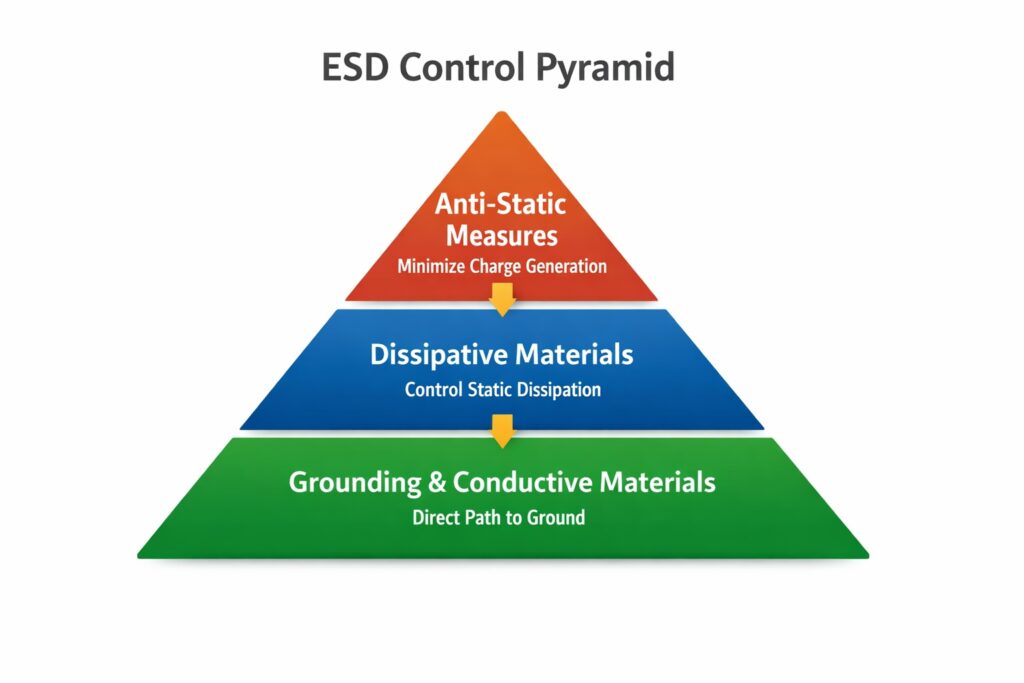
The ESD Control Pyramid illustrates how grounding, conductive and dissipative materials work together to provide controlled static behaviour.
The Base: Grounding and Conductive Materials
At the base of the pyramid is grounding. Conductive materials provide a low-resistance path that allows charge to move towards a defined ground point.
In practical ESD control, the aim is not simply to make everything as conductive as possible. The aim is to create a controlled discharge path that avoids uncontrolled charge accumulation while also avoiding damaging rapid discharge events.
Grounding and verification are normally managed within a wider ESD control programme, often using standards such as IEC 61340 or ANSI/ESD S20.20 as part of the control framework.
How ProShieldESD Helps
ProShieldESD can be engineered into conductive-range coatings where a defined pathway to ground is required. This can be useful for fixtures, housings, equipment surfaces, floors or other components where replacing the base material with a conductive alternative would be expensive or impractical.
The Middle: Static-Dissipative Materials
The middle of the pyramid is where many real ESD control applications sit. Static-dissipative materials are used to control how charge moves, rather than allowing it to remain trapped or discharge too quickly.
This is especially important in electronics manufacturing, precision assembly, aerospace, medical device production, packaging, handling systems and other environments where uncontrolled electrostatic behaviour can create quality, safety or reliability problems.
For many applications, dissipative behaviour is more useful than maximum conductivity. This is why understanding the difference between static-dissipative and conductive surfaces is important before selecting a coating strategy.
How ProShieldESD Helps
ProShieldESD coatings provide controlled dissipative performance across a wide range of substrates. Unlike conventional filler-loaded systems, the platform is based on intrinsically conductive polymer technology, reducing the risks associated with filler distribution, uneven behaviour and performance drift.
The Top: Anti-Static Measures
Anti-static measures sit at the top of the pyramid. Their role is to reduce charge generation, often by minimising friction, separation and triboelectric charging.
Anti-static measures can be useful, but they do not always provide a complete control system on their own. If charge is still generated, the system must still provide a route for controlled dissipation or grounding.
How ProShieldESD Helps
ProShieldESD supports anti-static strategies by giving surfaces a controlled electrical behaviour. If charge appears during handling, airflow, movement or contact, the coated surface can help dissipate or conduct that charge as part of the wider ESD control system.
Why the Pyramid Matters
The pyramid helps prevent a common mistake: assuming that higher conductivity automatically means better static control.
In reality, different parts of an ESD control system need different behaviours. Some areas need a defined path to ground. Some need controlled dissipation. Some need reduced charge generation. The wrong choice can create new risks, especially where sensitive electronics, powders, solvents, plastics or moving equipment are involved.
For a wider decision framework, see how to choose the right static control approach.
The operating environment also matters. Humidity, contamination, wear, cleaning, substrate type and grounding design can all influence ESD performance. This is why electrostatic behaviour depends on the environment, not only the coating material.
Why ProShieldESD Is Different from Traditional ESD Paints and Plastics
Traditional ESD paints and moulded conductive plastics can be useful, but both have limitations.
- Filler-loaded paints can suffer from uneven filler distribution, surface variation, appearance issues and performance drift.
- Moulded ESD plastics can require expensive tooling, minimum order quantities and design changes.
- Topical anti-static treatments may depend on migration, humidity or repeated reapplication.
ProShieldESD provides a different route by upgrading the surface behaviour of existing materials. This can reduce the need for specialist moulded materials and allows ESD control to be added to plastics, foams, housings, fixtures, work surfaces, packaging and industrial equipment.
This approach also supports retrofit projects where the existing part, surface or process is already fixed and cannot easily be redesigned.
Where ProShieldESD Fits in the Pyramid
ProShieldESD can support several layers of the ESD Control Pyramid:
- Conductive-range coatings for defined grounding pathways.
- Static-dissipative coatings for controlled charge movement across working surfaces.
- Surface upgrades for plastics, foams, fixtures, packaging and equipment.
- Retrofit ESD control where replacing the base material is not practical.
- Support for anti-static environments by giving surfaces controlled electrical behaviour.
This makes ProShieldESD a practical engineering option where static control must be added to real products, production equipment or industrial surfaces without redesigning the complete system.
Related ProShieldESD Guidance
Need Help Selecting the Right ESD Coating Strategy?
SCH can help assess where static charge is being generated, how it needs to be controlled, and whether the surface should be conductive, static-dissipative or supported by other ESD control measures.
Use the ProShieldESD coating platform to explore the technology, or contact SCH to discuss a specific surface, material or operating environment.