WS100 Conformal Coating Stripping System
Controlled wet stripping for complete conformal coating removal from PCB assemblies
The WS100 Conformal Coating Stripping System is a dedicated four-stage wet stripping workstation designed for the removal of suitable conformal coatings, paints and lacquers from printed circuit boards and electronic assemblies.
Assemblies are progressively processed through tanks containing stripping fluid at different stages of use. This allows the bulk of the coating to be removed first, followed by progressively cleaner stages to support complete coating removal and final cleaning.
The WS100 provides a purpose-designed workstation incorporating stainless-steel process areas, integrated lighting, a protective operator screen and a 150 mm extraction connection for integration with suitable site extraction / Local Exhaust Ventilation where required by the stripping process.
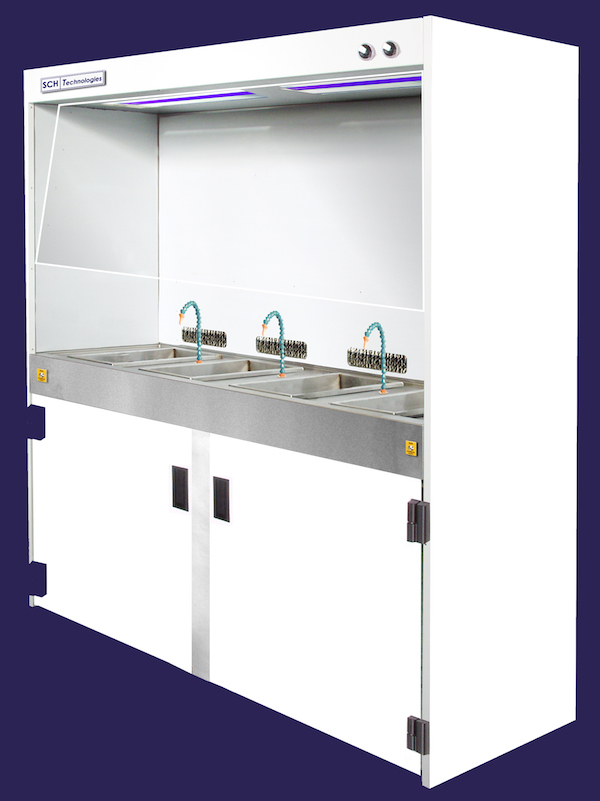
The WS100 provides four wet stripping stages within a dedicated workstation for controlled full-board conformal coating removal.
Why Use a Dedicated Wet Stripping Workstation?
Complete conformal coating removal can be difficult to control when stripping is carried out using individual containers or improvised work areas. The stripping chemistry, level of contamination in the fluid, operator technique and cleaning sequence can all influence the result.
The WS100 provides a defined multi-stage process that helps separate bulk coating removal, progressive cleaning and final finishing, while providing a dedicated workstation that can be integrated with appropriate workplace extraction and handling controls.
Key Benefits & Features
- ✅ Four-Stage Wet Stripping Process – Progressive tanks allow bulk coating removal followed by cleaner stripping stages
- ✅ Dedicated Operator Workstation – Protective screen separates the operator from the open process area during normal operation
- ✅ Solvent-Resistant Process Area – Stainless-steel tanks and internal panels suitable for use with compatible stripping chemistries
- ✅ Integrated Process Lighting – White and UVA illumination supports visual assessment of coating removal
- ✅ Extraction Interface – 150 mm extraction connection for integration with suitable site extraction / LEV
- ✅ Production-Oriented Layout – Integrated tanks, lids and drainage access support routine operation and cleaning
Technical Specifications
- Construction: Powder-coated steel frame with solvent-resistant stainless-steel tanks and internal process panels
- System size: approx. 1985 mm (H) × 660 mm (W) × 310 mm (D)
- Tank size, internal: approx. 230 mm (W) × 445 mm (H) × 330 mm (D)
- Tank capacity: approximately 30 litres per tank
- Extraction connection: 1 × 150 mm
Site Extraction / Local Exhaust Ventilation (LEV)
Suitable site extraction / LEV is required where the WS100 is used with solvent-based stripping materials or other chemistries requiring vapour or contaminant control.
The WS100 provides a 150 mm extraction connection. SCH will provide the relevant equipment dimensions and extraction interface information to assist the customer and their appointed extraction / LEV specialist.
The required airflow and overall extraction system performance should be determined by a competent extraction / LEV specialist based on the stripping chemistry, process, equipment configuration, workplace and applicable health and safety requirements.
For UK installations, applicable HSE guidance, including HSG258 and other guidance relevant to the materials being handled, should be considered. Outside the UK, customers should refer to the applicable national or local legislation, regulations and guidance.
Matching the Stripping Process to the Coating
Wet chemical stripping is highly dependent on the coating being removed, the stripping chemistry selected and the compatibility of the PCB assembly and its components with that chemistry.
Acrylic and some urethane coating systems may be suitable for wet stripping using an appropriate proprietary remover. Other coatings can require different removal techniques or additional process development.
Parylene coatings are generally not suited to conventional wet chemical stripping and normally require alternative removal methods.
Evaluate the Removal Process Before Production
Coating removal should be validated on representative assemblies before a production process is established. Compatibility with components, markings, plastics, adhesives, solder masks and other PCB materials can vary depending on the stripping chemistry and exposure conditions.
SCH can support customers with coating identification, removal trials and process development to help establish an appropriate stripping method before equipment and production parameters are standardised.
FAQs – WS100 Conformal Coating Stripping System
1. What types of coating can the WS100 remove?
2. How does the four-stage stripping process work?
3. Can delicate electronic assemblies be stripped in the WS100?
4. Does the WS100 require extraction / LEV?
5. Why use a dedicated wet stripping system rather than individual containers?
Need to Remove Conformal Coating from Complete Assemblies?
The correct removal process depends on both the coating and the assembly beneath it. SCH can help determine whether wet chemical stripping is appropriate before a production process or equipment configuration is finalised.
Send us details of the coating type, PCB assembly, components, production volume and reason for removal. We can review the application and discuss suitable removal methods, trials and equipment.
Related Equipment & Useful Links
Why Choose SCH Services?
SCH supports both conformal coating application and coating removal, allowing us to approach rework as a process decision rather than simply an equipment sale.
- 🧪 Coating & Chemistry Knowledge – Support with identifying suitable removal approaches for different coating technologies.
- 🔬 Removal Trials – Practical evaluation before a production stripping process is established.
- 🛠️ Multiple Removal Technologies – Wet stripping, selective abrasive removal and rework support depending on the application.
- 🎓 Process Support & Training – Guidance covering coating removal, inspection and subsequent rework operations.
📞 Call: +44 (0)1226 249019 | ✉ Email: sales@schservices.com | 💬 Contact Us ›
Disclaimer: Information on this page is provided as general guidance. Coating removal performance and process suitability depend on the coating, stripping chemistry, PCB construction, components and other assembly materials. Compatibility should be validated before production use. Where solvent-based or other hazardous stripping materials are used, suitable workplace controls and site extraction / LEV must be determined for the specific application. Users remain responsible for material safety information, workplace risk assessment, operating procedures, PPE and compliance with applicable legislation, regulations and local requirements.