Parylene FAQs
Expert Guidance on Parylene Processes
Welcome to our Parylene FAQs guide. Here you’ll find clear answers to the most common Parylene frequently asked questions — what Parylene is, how it works, its benefits and why industries worldwide rely on it for long-term protection.
Use this guide to understand the fundamentals, then explore our Parylene coating solutions for services, equipment, materials and training.
What Is Parylene and Why Is It Used?
Invisible. Reliable. Long-lasting.
Parylene is an ultra-thin, transparent conformal coating that protects electronics, medical devices, aerospace systems and other high-value components. Applied using a chemical vapour deposition (CVD) process, it forms a pinhole-free barrier that protects against moisture, corrosion and chemicals.
Unlike liquid coatings, Parylene forms a truly conformal film that coats every surface evenly without pooling or running.
How Does Parylene Work?
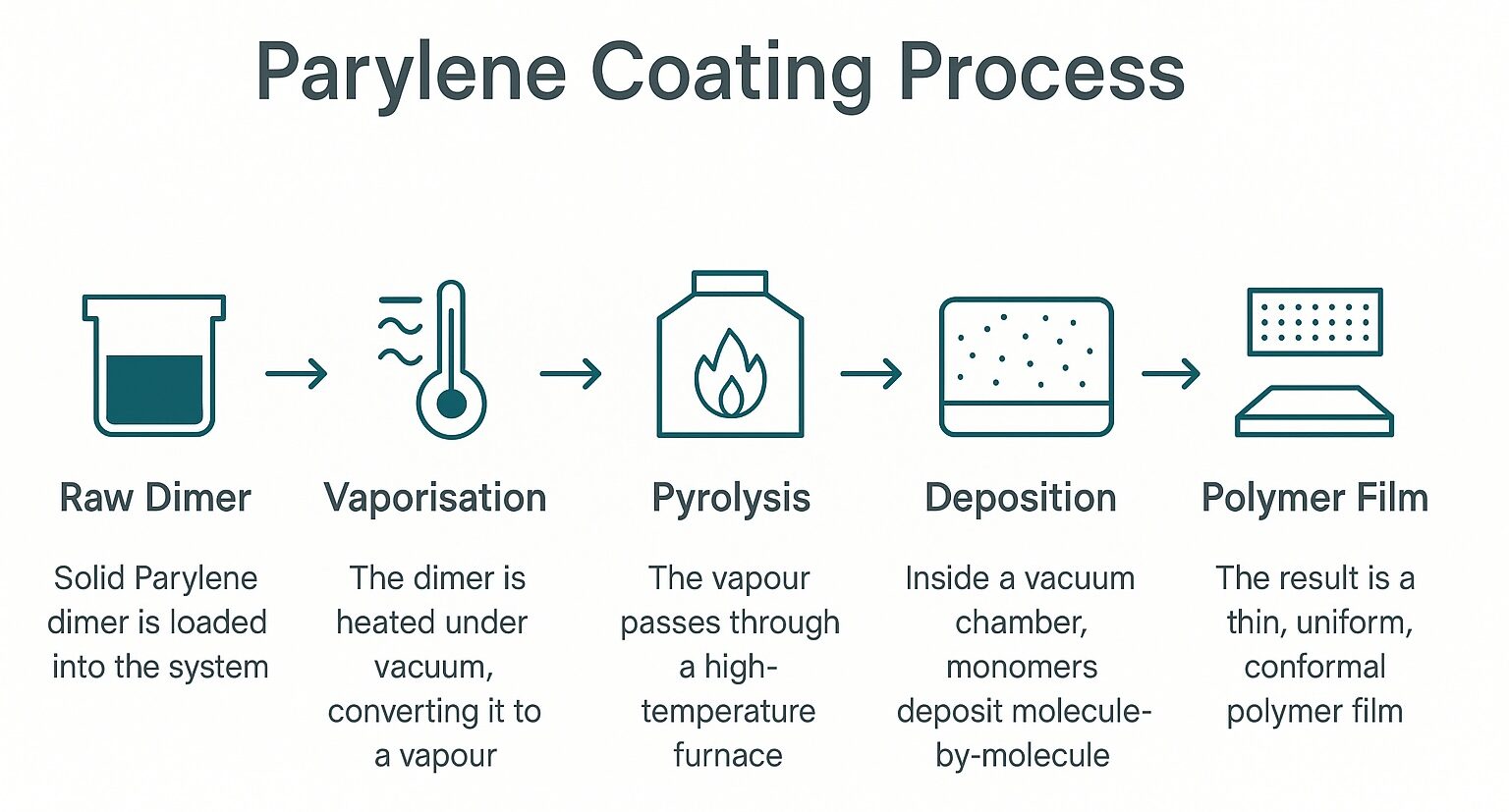
Parylene deposition occurs inside a vacuum chamber where a solid dimer precursor is converted to vapour and polymerises on the surface of the component.
The vapour penetrates everywhere air can reach — including corners, cavities and fine geometries — forming a uniform molecular layer over the entire assembly.
This creates a 360° conformal barrier that protects delicate electronics without altering their shape or weight.
What Are the Key Benefits of Parylene?
Parylene coatings provide reliable long-term protection without significantly altering component design.
🌊 Moisture & corrosion resistance
🧪 Chemical resistance
🔍 Complete conformal coverage
✨ Ultra-thin transparent coating
⚡ Improved electronics reliability
🌡 Thermal stability
🩺 Biocompatibility for medical applications
Where Is Parylene Used?
- Electronics & PCBs – moisture and corrosion protection
- Medical devices – biocompatible protective layers
- Aerospace & defence – reliability in extreme environments
- Automotive electronics – sensors and control systems
- Consumer electronics – wearables and miniaturised devices
How Do Parylene Coatings Compare to Liquid Conformal Coatings?
- Coverage: Parylene delivers true 360° coverage
- Film quality: pinhole-free molecular films
- Thickness: typically microns thick
- Consistency: uniform coating across complex assemblies
What Are the Different Types of Parylene?
- Parylene N – excellent dielectric properties
- Parylene C – strong moisture barrier
- Parylene D – improved thermal performance
- Parylene F / AF-4 – high temperature and chemical resistance
Planning to Use Parylene in Production?
Many companies begin by outsourcing coating services before moving to in-house production. SCH supports the full pathway including subcontract coating, equipment supply, dimers, training and process setup.
Explore the full implementation model: