Conductive Coatings vs Conductive Plastics
Choosing the Right Static Control Strategy for Parts, Surfaces and Equipment
Engineers often face a choice between redesigning parts in conductive plastics or applying conductive coatings to existing materials. Both approaches can support static control, but they differ significantly in cost, flexibility, design impact and long-term implementation strategy.
ProShieldESD offers a coating-based route that can convert standard materials into static-dissipative surfaces using conductive polymer technology, and into conductive surfaces where the application requires it. In many ESD applications the target is controlled static dissipation rather than a highly conductive surface, typically in the range of 106–109 Ω/sq. This can be particularly valuable where existing plastic, composite, foam or coated metal components already meet the mechanical design requirements but lack the required electrostatic performance.
Learn more about the ProShieldESD coating platform, the underlying filler-free ESD coating technology and the broader overview page on ESD coating.
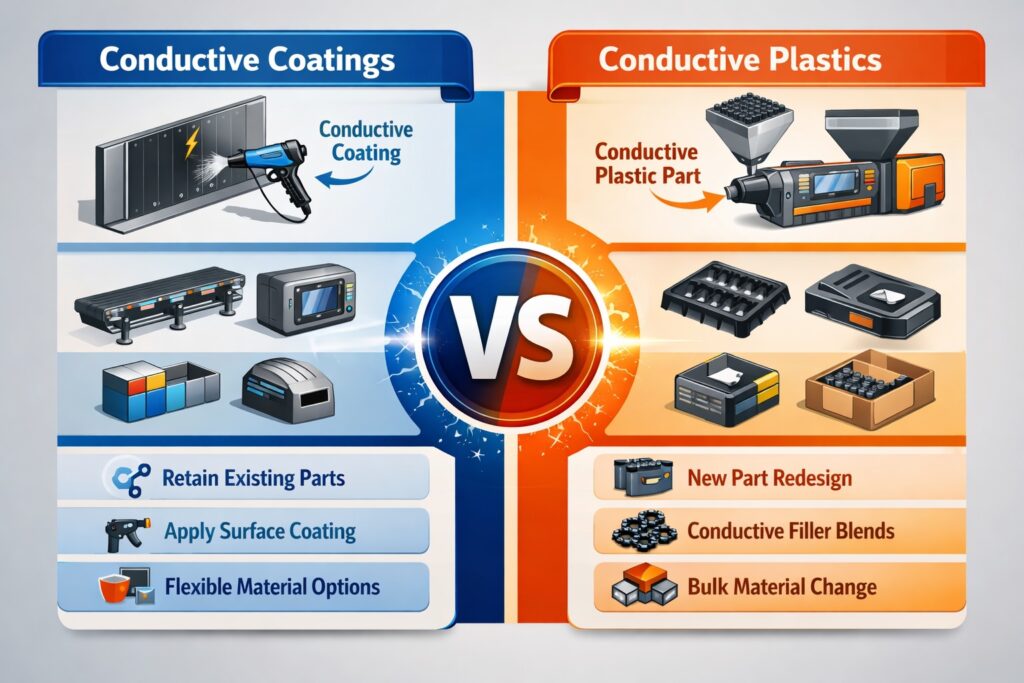
Infographic comparing conductive coatings and conductive plastics for electrostatic discharge control. Conductive coatings upgrade existing materials, while conductive plastics require redesign using filler-loaded polymers.
What Is the Difference?
Conductive plastics achieve electrical performance by incorporating conductive fillers or specialist polymer systems directly into the bulk material. This means the static control function is built into the molded or formed part itself.
Conductive coatings take a different approach. Instead of changing the whole base material, a functional coating is applied to the surface to create a controlled conductive or static-dissipative pathway. In practical ESD design, that often means using conductive polymer chemistry to create a static-dissipative surface rather than targeting a highly conductive finish. The choice between these two strategies depends on whether the priority is material redesign or surface upgrade.
For a broader grounding in the subject, see our overview page on ESD coating.
When Conductive Plastics Are Commonly Used
Conductive plastics are often used where a part is being designed from scratch and the electrostatic requirement is known early in development.
- Molded trays and handling fixtures
- Specialist packaging inserts
- Electronics housings designed for ESD-safe use
- Custom polymer components where tooling already exists
- Applications where the whole bulk material must be conductive
In these cases, conductive plastics may be suitable, but they can also introduce design and commercial constraints.
Why Conductive Plastics Can Be Limiting
Although conductive plastics can solve specific static control problems, they are not always the most practical option for broader engineering use.
- They often cost more than standard engineering polymers.
- Carbon- or metal-filled systems may affect appearance, weight and mechanical properties.
- Each new conductive plastic part may require new tooling or redesign.
- Machining, trimming or wear may alter local conductivity.
- Existing installed equipment cannot easily be upgraded by changing bulk material.
For many applications, these limitations make a surface-engineering approach more attractive than a full material change.
How Conductive Coatings Change the Decision
Conductive coatings allow engineers to retain the original substrate while modifying only the surface behaviour. This means a standard plastic, composite, metal or coated surface can be upgraded for electrostatic performance without redesigning the whole part. This is especially useful where the existing component already satisfies structural, dimensional or processing requirements and only the static control performance needs to change.
ProShieldESD uses a filler-free ESD coating technology based on conductive polymer science, allowing surface conductivity to be introduced without relying on conventional filler-loaded paints. In many cases, the result is a stable static-dissipative surface rather than a highly conductive one, which is often the preferred outcome for controlled ESD management. The broader ProShieldESD coating platform is designed around this surface-upgrade approach.
You can also read the main concept page on ESD coating for a broader explanation of how coating-based electrostatic control works.
Conductive Coatings vs Conductive Plastics Comparison
The engineering trade-off is often easier to understand when the two approaches are compared directly.
| Factor | Conductive Coatings | Conductive Plastics |
|---|---|---|
| Design impact | Upgrades the surface while keeping the existing substrate | Requires use of a different bulk material or part redesign |
| Cost path | Can avoid tooling changes and reduce redesign costs | Often increases material and tooling costs |
| Retrofitting | Suitable for upgrading existing parts and equipment surfaces | Usually not practical for installed equipment |
| Material flexibility | Can be applied to plastics, composites, metals, foams and more | Limited to the selected conductive bulk material |
| Surface behaviour | Targeted surface conductivity, often in the static-dissipative range for ESD control | Conductivity distributed through the bulk material |
| Typical use case | Static control upgrade on existing designs | New part design using specialist materials |
For many practical engineering problems, the decision is less about whether conductivity is possible and more about whether redesign is justified and whether a static-dissipative surface is all that is required.
Where Conductive Coatings Often Make More Sense
A conductive coating approach is often more attractive where the part geometry, tooling or installed asset base already exists and only the static performance needs to change.
- Upgrading plastic components such as housings, covers, ducts and enclosures
- Improving static control on industrial equipment such as guarding, conveyor covers and machine panels
- Reducing electrostatic risks in hazardous environments where insulating surfaces are present
- Retrofitting packaging, fixtures, housings or protective structures
- Maintaining the advantages of standard polymers while adding static control at the surface
These are situations where replacing the bulk material may be disproportionate to the real engineering requirement.
Where Conductive Plastics May Still Be Appropriate
Conductive plastics still have a role in some projects, particularly where the component is new, molded from scratch and intended to be conductive throughout the part thickness.
- High-volume molded parts already justified by tooling economics
- Applications where post-processing or coating is impractical
- Parts that require bulk conductivity rather than surface conductivity
- Designs where material selection is fixed early and cost is less sensitive
The key is to decide whether the performance requirement genuinely demands a conductive bulk material or whether a controlled static-dissipative surface is sufficient.
Engineering Questions to Ask Before Choosing
Before choosing between conductive coatings and conductive plastics, it helps to define the problem clearly.
- Does the whole part need conductivity, or only the surface?
- Is this a new design or an existing installed asset?
- Will changing the bulk material affect mechanical or cosmetic performance?
- Would redesign trigger tooling, qualification or validation costs?
- Is retrofitting a more practical route than re-engineering?
These questions often make the preferred route clear very quickly.
Need Help Choosing the Right Static Control Route?
If you are weighing conductive coatings against conductive plastics, we can review the application and help determine which route best fits your design, process and electrostatic requirements.
In many cases, a coating-based upgrade can deliver the required static control performance without the cost and disruption of a full material redesign, particularly where a stable static-dissipative surface is the real objective.
Keep the design where possible. Change only what the surface needs to do.
Useful Links
Why a Coating-Based Route Is Often More Flexible
- ✅ Retain existing materials – Avoid redesigning parts where the original substrate is already suitable.
- ✅ Reduce redesign pressure – Minimise the need for new tooling, material sourcing and qualification.
- ✅ Upgrade installed assets – Apply static control to parts and equipment that already exist in service.
- ✅ Target the real requirement – Introduce surface conductivity only where it is needed.
- ✅ Support multiple applications – Use one platform across plastic parts, machinery and sensitive environments.
- ✅ Enable engineering choice – Select the best route based on function, cost and practicality rather than defaulting to specialist materials.
Conductive coatings versus conductive plastics is not only a materials question. It is an engineering decision about where conductivity is needed, how much redesign is justified and whether a surface upgrade can solve the problem more efficiently. In many ESD applications, that surface upgrade is best delivered as a stable static-dissipative layer created using conductive polymer technology.