Humidity vs Condensation in Electronics: Why It Matters for Conformal Coating & Parylene
Understanding moisture vapour, liquid water and their different effects on coated electronics
Humidity vs condensation is one of the most misunderstood topics in electronics reliability. Many failures blamed on “high humidity” are actually driven by condensation events — liquid water forming on assemblies during temperature swings, cold starts, power cycling, or enclosure breathing.
This article explains the practical difference between humidity and condensation, why condensation is usually more aggressive for electronics, and what it means for conformal coating and Parylene selection, thickness, masking, inspection and long-term durability.
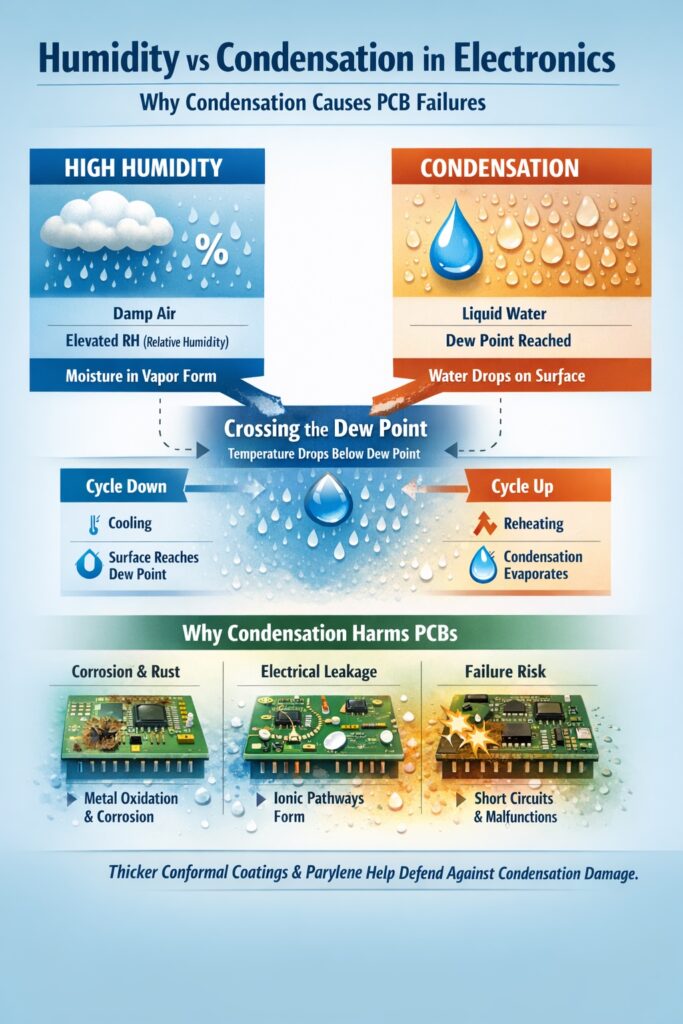
Condensation events, not just high humidity, often drive corrosion and electrochemical migration in electronics.
Related Knowledge Hubs:
The key idea: humidity is vapour — condensation is liquid water
Humidity describes how much water vapour is present in the air. Condensation is when that vapour turns into liquid water on a surface. For electronics, this distinction matters because many failure mechanisms accelerate dramatically in the presence of liquid water films.
Practical takeaway: A product can survive high humidity for years, yet fail quickly if it regularly experiences condensation events.
Why condensation forms: dew point and temperature swings
Condensation occurs when a surface temperature drops below the dew point of the surrounding air. In real products, this is common during:
- Cold starts (equipment brought from a warm area into a cold environment)
- Power cycling (internal heating when on, cooling when off)
- Enclosure breathing (air exchange pulling moist air into a cooling enclosure)
- Outdoor temperature cycling (day/night swings)
- Intermittent operation (industrial controllers, sensors, IoT nodes)
Rule of thumb: Condensation risk is driven more by temperature change and enclosure behaviour than by “average humidity” on a datasheet.
Why condensation is usually more aggressive than humidity
Liquid water on electronics changes the game. It can:
- Create a conductive film across surfaces, especially if contamination is present
- Activate ionic residues, enabling electrochemical migration (ECM)
- Drive corrosion at exposed metals, edges and interfaces
- Penetrate under components and into tight gaps by capillary action
- Concentrate salts and residues during drying, leaving conductive deposits behind
Takeaway: Humidity is often a slow stress. Condensation is often a step-change event that rapidly increases failure probability.
What this means for conformal coating (liquid coatings)
Liquid conformal coatings can provide excellent environmental protection, but condensation highlights a few practical realities:
- Coverage quality matters more than datasheet claims — shadowing, thin spots and meniscus effects remain important
- Edges and interfaces are common weak points, including sharp corners, solder joints and component terminations
- Local defects such as pinholes, bubbles and de-wetting can become condensation entry points
- Rework zones can be vulnerable if not properly sealed and inspected
- Thickness uniformity can be harder on complex 3D topography compared with vapour-deposited films
Good practice: If condensation is likely, prioritise coating process control, inspection discipline and contamination management — not just “a thicker coat”.
What this means for Parylene (slightly deeper technical view)
Parylene is deposited in the vapour phase by CVD and is known for very uniform, conformal coverage — including on complex geometry and tight features. In condensation-prone applications, that uniformity can be a major advantage.
However, condensation reliability is rarely about vapour barrier alone. The real drivers are typically:
- Mechanical robustness during handling, vibration and abrasion over service life
- Edge stability around sharp features and interfaces
- Condensation cycling tolerance during repeated wet/dry events at interfaces
- Contamination activation when ionic residues become conductive under moisture films
Parylene helps because it is highly conformal and can be applied in controlled thickness windows, but it still needs:
- Cleanliness and ionic contamination control
- Correct masking and keep-out design, because vapour-phase masking must seal properly
- Inspection and verification, including witness coupons and coverage checks
Practical takeaway: Parylene can improve condensation resilience, but it does not cancel out contamination risk or poor design-for-coating practice. Cleanliness and surface preparation remain critical, especially where moisture cycling is expected.
Thickness: why condensation pushes you toward more margin
In condensation-prone environments, thickness matters primarily because it increases durability margin — not because thicker films are automatically waterproof.
A thicker film tends to be more forgiving against:
- Micro-damage such as scratches, abrasion and handling
- Edge and corner stress concentration
- Condensation cycling fatigue at interfaces
- Local defects becoming critical over time
If you need practical thickness bands for Parylene selection, see:
Design and enclosure factors often matter more than the coating
If condensation is part of the failure story, it is worth challenging the design assumptions:
- Is the enclosure sealed, vented, or breathing with temperature changes?
- Are there cold spots such as metal standoffs, heat sinks or exposed chassis points?
- Do connectors or cable entries introduce moisture pathways?
- Does the product power cycle frequently?
- Is there a plan for contamination control before coating?
Takeaway: The best results usually come from a combined approach: enclosure behaviour, contamination control, coating strategy and inspection.
Practical engineering checklist (questions to ask early)
- Is condensation possible in real use, including cold starts, cycling or outdoor exposure?
- Is the unit intermittently powered with repeated on/off cycles?
- Is there salt fog, wash-down or chemical exposure risk?
- What is the contamination control plan, including cleaning and verification?
- Are keep-out areas and masking strategy defined and realistic?
- Are there connectors or interfaces that will be handled or serviced?
- What thickness window provides adequate margin without over-specifying?
FAQ: humidity vs condensation in electronics
Is high humidity the same as condensation?
No. High humidity means there is a lot of water vapour in the air. Condensation is liquid water forming on surfaces when they drop below the dew point. Condensation is usually more aggressive for electronics.
Can electronics fail in high humidity without condensation?
Yes, but failures are often slower and depend strongly on contamination, leakage paths and materials. Condensation events typically accelerate corrosion and electrochemical migration much more quickly.
Why does condensation cause PCB failures?
Condensation creates liquid water films that can become conductive if ionic residues are present. This can drive corrosion, leakage currents and electrochemical migration, especially at edges, interfaces and fine-pitch features.
Does conformal coating prevent condensation failures?
Coatings can significantly reduce risk, but success depends on coverage quality, defect control, masking discipline, thickness margin and contamination management. Coatings reduce risk — they do not replace good design and process control.
Is Parylene better than liquid conformal coating for condensation?
Parylene is highly conformal and can be very effective on complex 3D assemblies and tight gaps. However, performance still depends on cleanliness, masking and keep-out control, and appropriate thickness selection.
Why Choose SCH Services?
Moisture failures are rarely caused by one factor alone. SCH Services helps customers assess condensation risk, coating choice, masking constraints, contamination control and inspection strategy so protection is based on real service conditions rather than assumptions.
- 🛠️ Moisture Protection Expertise – Support with conformal coating, Parylene selection and practical protection strategy for humidity and condensation exposure.
- 🔍 Process & Inspection Control – Guidance on cleanliness, masking, coverage verification, witness coupons and defect risk reduction.
- 📈 Realistic Thickness Guidance – Recommendations based on durability margin, geometry, service conditions and application risk.
- 🌍 Integrated Technical Support – Consultancy, coating services, training and process troubleshooting through one specialist team.
- ✅ Built for Reliability – Practical support for high-reliability electronics where moisture exposure, cycling and contamination all matter.
📞 Call: +44 (0)1226 249019 | ✉ Email: sales@schservices.com | 💬 Contact Us ›