Thermal Conformal Coating Removal (Controlled Heat Softening) – UK & Europe
When heat-softening may help, why it’s high-risk, and when to escalate to controlled alternatives
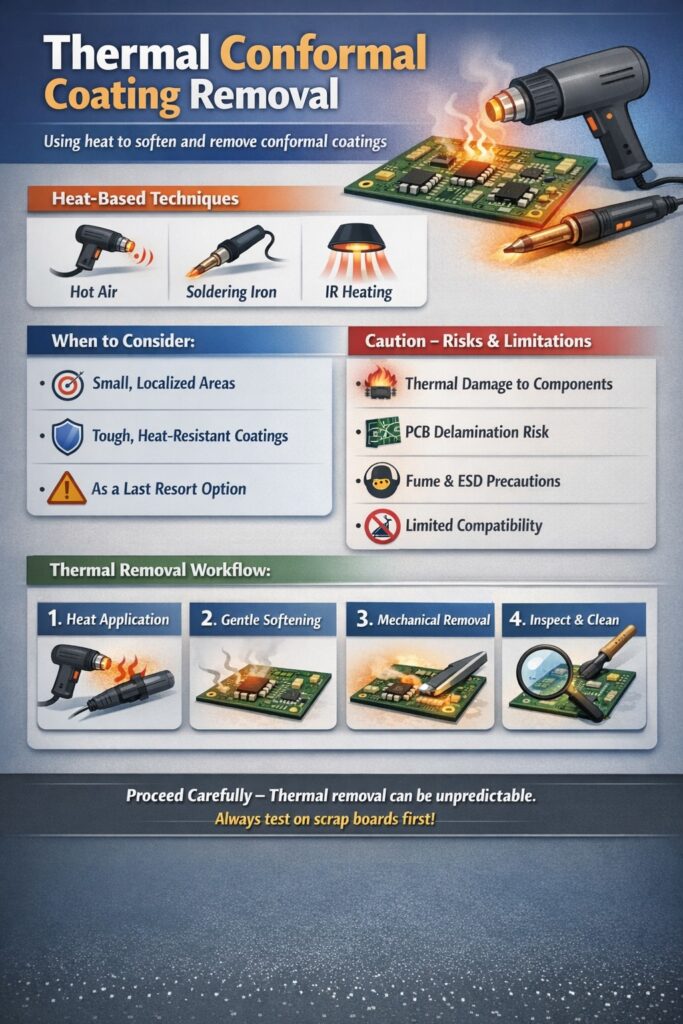
Thermal softening (controlled heat applied locally) is sometimes used in electronics rework to help soften or loosen certain conformal coatings so they can be removed in a defined area. However, it is also one of the easiest ways to introduce collateral damage (plastics deformation, marking loss, solder mask damage,
contamination movement, and latent reliability risk).
This page is intentionally conservative: it explains where thermal behaviour can be useful as a diagnostic cue, what the common failure modes are, and the stop / escalate rules for when you should shift to more controllable routes (e.g., micro-abrasion or validated methods).
If the coating chemistry is unknown, start here first: Identify Unknown Conformal Coatings (IPC-7711 Method).
Quick Navigation
- Where thermal softening fits in a controlled workflow
- When thermal softening may be considered
- Why thermal removal is high-risk on PCB assemblies
- Controls & decision boundaries (keep it local)
- Stop conditions: when to abandon thermal and escalate
- More controllable alternatives (solvent / micro-abrasion)
- FAQs
- Support: trials, services & training
1) Where thermal softening fits in a controlled workflow
In a disciplined rework environment, heat is best treated as a behaviour probe and (in limited cases) a local assist—not a default removal method. The priority is to preserve solder mask integrity, component bodies/markings, and recoat reliability.
- Identify first: confirm (or strongly infer) the coating family before committing to any removal route.
- Local only: define a bounded access window and protect nearby vulnerable items (plastics, labels, fine pitch).
- Validate: if a method will be used repeatedly, it must be trialled, inspected, and documented.
For the end-to-end decision framework (identify → choose method → control risk → validate), use: Ultimate Conformal Coating Removal Guide (UK & Europe).
2) When thermal softening may be considered
Thermal softening may be considered only when you have a clear reason, a local access need, and a defined inspection/stop plan. Typical scenarios include:
- Diagnostic behaviour check: observing whether a coating gums/softens under controlled local heat can help confirm family behaviour alongside other cues.
- Local assist for edge clean-up: in limited cases, controlled softening may reduce brittle cracking or allow gentler mechanical lift in a defined area.
- When solvents are inappropriate: e.g., high collateral risk to plastics/inks/labels or uncertain compatibility—heat might still be rejected, but it is sometimes evaluated.
3) Why thermal removal is high-risk on PCB assemblies
Heat does not only affect the coating. It can affect the entire local ecosystem: plastics, solder mask, adhesives, labels, inks, and contamination movement. Common failure modes include:
- Plastics deformation: connector bodies, housings, seals and cable materials can distort or weaken.
- Marking loss: component markings, board legend, labels and barcodes can fade or smear.
- Solder mask damage: thermal stress combined with mechanical action increases mask lifting/tearing risk.
- Contamination movement: softened residues can migrate, smear and become a recoat adhesion risk.
- Latent reliability risk: local overheating can stress materials in ways that don’t show up immediately.
If repeatable boundary control and minimal collateral damage are priorities, thermal methods are often not the first choice.
4) Controls & decision boundaries (keep it local)
If thermal softening is evaluated, treat it like a controlled process experiment:
- Local-only application: define the smallest viable access window; avoid “heating the area and hoping”.
- Shield vulnerable items: assume plastics/labels/inks are vulnerable unless proven otherwise.
- Minimise dwell: extended dwell is where collateral damage and residue migration typically accelerates.
- Inspect frequently: stop to inspect under magnification; do not “push through” resistance.
- Document outcomes: if it’s repeatable and safe, document boundaries, inspection points, and stop conditions.
5) Stop conditions: when to abandon thermal and escalate
Stop and escalate when any of the following are observed or likely:
- Gumming / smearing: softened coating drags across pads or fine pitch regions.
- Marking/label risk: any sign of legend fade, label lift, or ink movement.
- Plastics proximity: connectors, housings, seals or polymers are near the work zone.
- Unclear boundary: you cannot maintain a clean access window edge suitable for rework/recoat.
- High-value / safety-critical assemblies: if proof of control is not available, do not proceed.
In these cases, move to a method that offers more controllability and repeatability.
6) More controllable alternatives (solvent / micro-abrasion)
Two commonly used controlled alternatives are:
- Solvent-based local removal (where compatible): Solvent-Based Conformal Coating Removal — emphasising local-only control, compatibility risks and residue management.
- Micro-abrasive removal for controlled access windows: Micro-Abrasive Media Selection Guide and Inside the Micro-Abrasive Blasting Process.
If the coating is likely Parylene, a controlled micro-abrasion approach is often the most predictable route for defined access windows: Parylene Removal: Precision Micro-abrasion.
FAQs
Is thermal softening a standard conformal coating removal method?
Can thermal softening damage connectors and plastics?
When should I switch away from heat to micro-abrasion?
What if I don’t know the coating type?
Need help validating a safe removal route?
If you’re dealing with unknown coatings, high-value boards, or you need repeatable rework outcomes, SCH can support method selection, feasibility trials, process documentation and operator training across the UK and Europe.
For a quick triage, send us an enquiry and include: coating type (if known), the area needing access, board criticality, and whether recoat is required after rework.
Related Removal & Rework Resources
Always validate coating identification, method selection, safety controls, inspection criteria, and compliance requirements against your specific assembly materials,
customer requirements, and applicable standards before rework.