Micro-Abrasive Media Selection Guide for Conformal Coating Removal
How to choose abrasive type and particle size for controlled PCB rework (UK & Europe)
← Back to the Removal & Rework Hub
Selecting the correct micro-abrasive media is one of the biggest drivers of outcome quality in micro-blasting. The same cabinet, nozzle and pressure can produce either clean, repeatable coating removal or solder mask damage depending on the abrasive family, particle size, and changeover discipline.
This guide explains how to select media for controlled conformal coating and Parylene removal in UK/EU production environments where ESD control, repeatability and traceability matter.
For the end-to-end workflow (identify → select method → control risk → validate), use the Ultimate Conformal Coating Removal Guide (UK & Europe).
Quick Navigation
- Core media selection principles
- Abrasive families & behaviour
- VanAcrylic & polymer/plastic media
- Particle size (grade) selection
- Media selection table (rule-of-thumb)
- Contamination & changeover control
- Surface finish & recoat readiness
- When trials are mandatory (and escalation rules)
- Related removal & rework guides
- Vaniman systems, media & SCH support
1) Core media selection principles
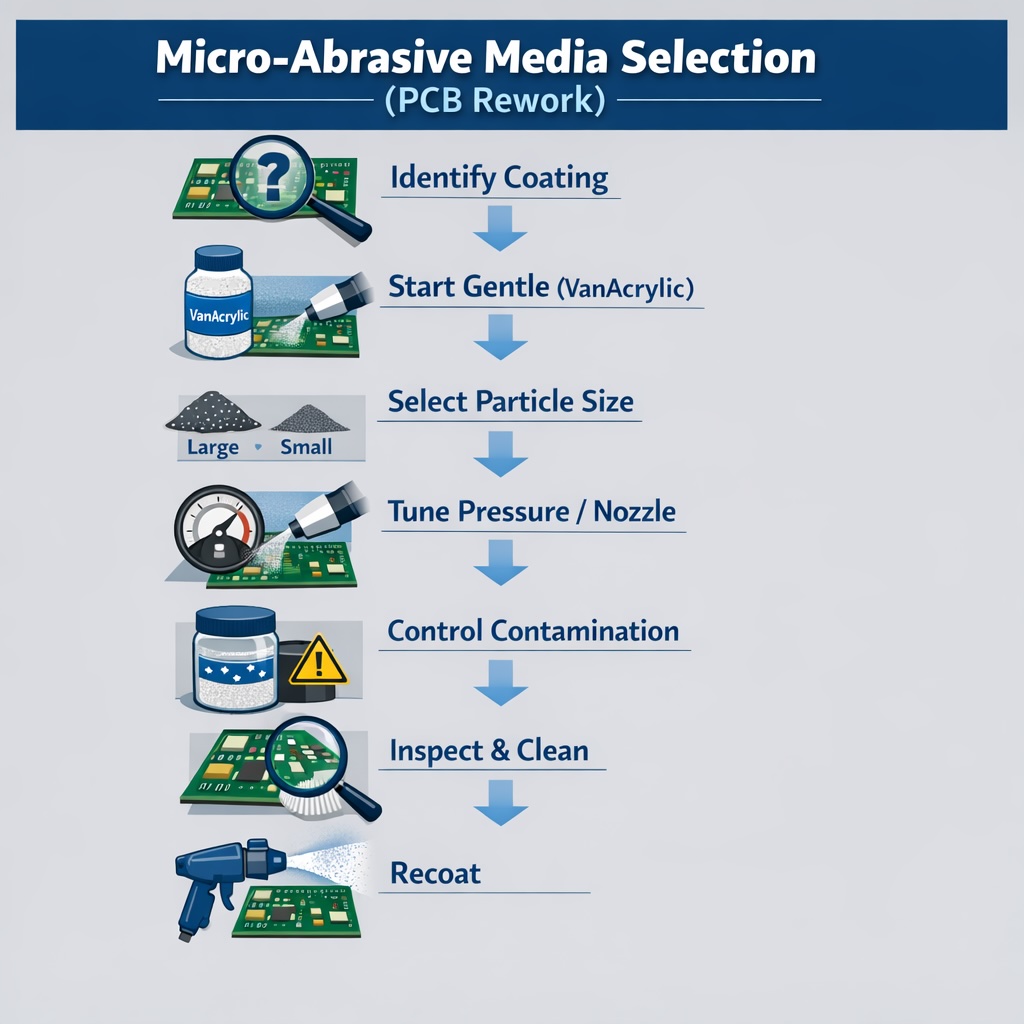
- Start with the least aggressive media capable of removing the coating at an acceptable speed.
- Control removal using technique first: pressure range, nozzle distance, angle and dwell time — before escalating media hardness.
- Balance coating hardness/thickness against substrate sensitivity (solder mask thickness, fine pitch, exposed copper, fragile components).
- Preserve solder mask integrity and copper geometry wherever possible (avoid “chasing speed” with aggressive media).
- Prioritise boundary control: clean access windows with minimal feathering/undercutting.
- Validate in trials on representative builds before production release and lock down a documented recipe.
For deeper parameter control (nozzle, standoff, angle and pressure behaviour), read: Inside the Micro-Abrasive Blasting Process.
2) Abrasive families and removal behaviour
In micro-abrasion, the media is the “cutting tool”. If media is too aggressive, you risk solder mask erosion, copper exposure and component marking loss. If media is too gentle, you can lose throughput and encourage over-dwell (which can still cause damage).
| Media family | Behaviour / notes | Typical use cases |
|---|---|---|
| VanAcrylic (polymer) | Gentle, controllable cut; strong visibility; lower risk on solder mask when correctly tuned. | Selective removal on populated PCBs, boundary work, fine-pitch areas and access windows (including Parylene). |
| Plastic media (general) | Broad working range; stable once tuned; multiple grades available. | General conformal coating removal where you need a balance of speed and control. |
| Walnut shell | More cutting power; can increase risk on fragile solder mask if misapplied. | Tougher films or thicker build-ups where polymer/plastic is too slow (trial-based). |
| Glass bead | Spherical, gentler cleaning action; limited effectiveness on hard coatings. | Surface cleaning / light preparation rather than primary removal (use cautiously on electronics). |
| Sodium bicarbonate | Relatively soft and water-soluble; performance depends heavily on setup and coating behaviour. | Targeted rework where a softer abrasive is desired but removal is still required (trial-based). |
| Alumina / ceramic | Hard, aggressive abrasives; higher removal rate; higher risk to solder mask/copper/features. | Generally reserved for exceptional cases after controlled trials and strict limits. |
If you are deciding whether to use wet removal vs micro-abrasion, start with: Conformal Coating Removal Methods (Wet & Micro-abrasion).
If you are reviewing media choice for sensitive conformal coating removal, see our article introducing VanAcrylic thermoset plastic blasting media.
3) VanAcrylic plastic abrasive media (and why it’s often the safest start)
VanAcrylic is a thermoset acrylic polymer abrasive engineered for controlled micro-abrasive PCB work. It provides cutting action while reducing substrate aggression compared with hard mineral abrasives — often giving better boundary control on populated assemblies.
Already using VanAcrylic? If you need to check whether your ProBlast has the current tank, violet tip and media-delivery arrangement, see Do I Have the Latest VanAcrylic Configuration?
Key characteristics
- Controlled cutting behaviour for localised removal
- Lower risk of solder mask damage (when tuned and verified)
- Good boundary definition for access windows and pads
- Supports repeatability in ESD-controlled rework cells
Recommended starting applications (trial-based)
- Acrylic, urethane and many silicone conformal coatings
- Parylene access windows where substrate sensitivity is high
- Fine-pitch PCBs and densely populated assemblies
- Unknown coatings during initial evaluation (before escalation)
If coating chemistry is uncertain, start here before escalating: Identify Unknown Conformal Coatings (IPC-7711 Method).
4) Particle size (grade) selection
- Smaller particles generally improve control, edge definition and reduce damage risk — ideal for populated PCBs and boundary work.
- Larger particles can increase removal speed but raise substrate risk if pressure, stand-off and dwell are not tightly controlled.
- Nozzle compatibility matters: align particle size to nozzle selection to prevent clogging and unstable flow.
- Optimise size during trials using representative assemblies and lock the grade down in your SOP.
Media is only one part of the recipe — for the full mechanism and parameter interactions, use: Inside the Micro-Abrasive Blasting Process.
5) Media selection table (rule-of-thumb starting points)
This table is a practical starting point only. Always validate on a representative sample board before production use, and document limits for pressure, dwell time and inspection criteria.
| Coating type | Typical starting media | Notes / controls |
|---|---|---|
| Parylene | VanAcrylic or fine plastic media | High control needed; focus on access windows and boundary quality. See: Parylene Removal: Precision Micro-abrasion. |
| Acrylic (AR) | VanAcrylic or plastic media | Wet removal may be viable too — compare methods here: Removal Methods. |
| Urethane (UR) | Plastic media → walnut shell (if needed) | Can be tough/elastic; control dwell and avoid dragging debris across pads; trial before escalation. |
| Silicone (SR) | Plastic media (trial-based) | Behaviour varies; validate on sample first; watch for gumming/smearing behaviour. |
| Epoxy (ER) | Plastic media → walnut shell (if needed) | Hard/bonded; throughput pressure can push operator over-dwell — use documented limits and inspection checks. |
If the coating type is uncertain, start with: Identify Unknown Conformal Coatings (IPC-7711 Method).
6) Contamination & changeover control
Media changeover discipline prevents unstable performance and cross-contamination. Treat media change as a controlled activity:
- Never mix incompatible media in the same hopper/lines.
- Fully purge hoppers, pick-up lines and nozzles before changing media type or grade.
- Store media sealed and dry (moisture causes clumping and unstable flow).
- Label containers clearly (type + grade + date) and segregate by type/size.
- Extraction & visibility: keep cabinet extraction maintained to support consistent technique and edge definition.
If you’re deciding between local removal and full stripping (which affects media choice and risk), see: Conformal Coating Removal: Local and Full Stripping.
7) Surface finish & recoat readiness
Media selection influences surface finish, residue risk and long-term recoat reliability. Define “ready-to-recoat” criteria as part of your process plan.
- Edge quality: clean boundaries without feathering into keep-out zones.
- Substrate integrity: solder mask preserved; copper geometry not eroded; component bodies not damaged or marked.
- Residue control: define post-blast cleaning steps (and verification) before repair and recoating.
- Inspection: use magnification and consistent pass/fail criteria (photos help with traceability).
For the downstream sequence after removal, follow: Conformal Coating Rework Workflow: Clean, Repair, Recoat.
8) When trials are mandatory (and escalation rules)
Run structured trials and document results when:
- The coating is unknown, mixed, aged, or has an unclear rework history.
- The assembly is high value or safety-critical (aerospace/defence/medical).
- You are changing media type, media grade, nozzle geometry, or pressure range.
- You are introducing new board designs, new solder masks, or fine-pitch components into the process.
- You need repeatability for production support (SOP, training, traceability).
Escalation rule: start with the most controllable media/grade and only escalate after you can demonstrate that technique controls (pressure/stand-off/dwell) are not achieving removal within safe limits.
Need Help Validating a Removal or Rework Process?
SCH supports UK and European manufacturers with controlled conformal coating and Parylene removal — including feasibility trials, micro-abrasive methods, operator training and production rework support.
- Method selection and risk assessment
- Trial validation on representative samples
- Equipment and media guidance
- IPC-aligned training and documentation
Related removal & rework guides
- Ultimate Conformal Coating Removal Guide (UK & Europe) – the full decision framework and validation workflow.
- Conformal Coating Removal Methods (Wet & Micro-abrasion) – compare chemical vs micro-abrasive routes.
- Inside the Micro-Abrasive Blasting Process – nozzle, pressure, stand-off and repeatability discipline.
- Parylene Removal: Precision Micro-abrasion – focused strategy for hard, thin Parylene films.
- Conformal Coating Removal: Local and Full Stripping – when to expose access windows vs strip larger areas.
- Conformal Coating Rework Workflow: Clean, Repair, Recoat – correct downstream sequence after removal.
- Identify Unknown Conformal Coatings (IPC-7711 Method) – behaviour-based identification to select the safest route.
Vaniman systems, media & SCH support
SCH supports customers across the UK and Europe with media selection, structured trials on representative boards, operator training, and process documentation. We also supply and support Vaniman ProBlast systems configured for ESD-conscious electronics rework.
View Vaniman ProBlast Systems (UK & EU)ortalk to a rework specialist