Ultimate Guide to Conformal Coating Removal – UK & Europe
How to identify coatings, select removal methods and control micro-abrasive PCB rework using Vaniman systems
This conformal coating removal guide explains how to identify common coating types, choose an appropriate removal method and apply micro-abrasive blasting as a controlled PCB rework process. It is written for UK and European manufacturing environments where ESD control, repeatability and traceability are important.
SCH distributes Vaniman micro-abrasive stripping systems across the UK and Europe and supports customers with equipment selection, demonstrations, trials, operator training, process development and consumables.
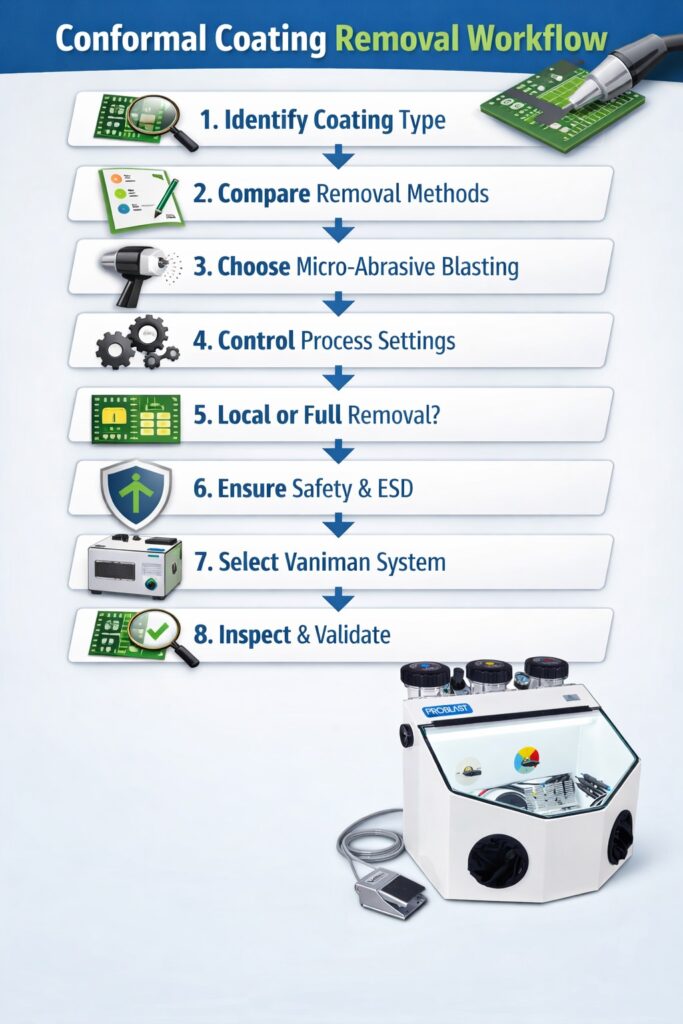
Conformal coating removal workflow used by SCH for controlled PCB rework using Vaniman micro-abrasive blasting systems across UK and European production environments.
How to Use This Guide
This guide follows a practical engineering workflow from identifying the coating, through method selection and process control, to system selection and validation. Follow it step-by-step or jump directly to the stage you need.
- Identify the coating – Understand the chemistry, thickness and condition you are dealing with.
- Review removal methods – Compare available techniques and their risks.
- Why micro-abrasive blasting – Understand where the process can provide controlled removal.
- Process control fundamentals – Control the variables that influence removal and board damage.
- Local vs full removal – Decide how much coating actually needs to be removed.
- Safety, ESD & compliance – Consider the controls required around the process.
- Select a Vaniman system – Match equipment to the application.
- Validation & inspection – Confirm that the assembly is suitable for repair or recoating.
- Demos, trials & training – Engage SCH for practical implementation support.
- Downloads & resources – Access supporting guides and checklists.
1) Identify the Coating Before Removal
Correct identification reduces damage risk and prevents wasted process development. Removal behaviour can vary significantly between acrylics, urethanes, silicones, epoxies and Parylene. The removal method should therefore be selected using coating chemistry, thickness, adhesion and assembly risk.
Practical identification approaches
- Documentation first: review drawing notes, process travellers, OEM coating specifications, cure information and any previous rework history.
- Visual cues: assess gloss, hardness, edge behaviour around keep-out boundaries and typical application patterns.
- UV inspection behaviour: useful where UV tracers are present, but UV response alone does not definitively identify the coating chemistry.
- Small-area testing: a controlled test in a non-critical location can help establish likely removal behaviour.
- Thickness and build: heavy coating build can change the practicality of localised rework versus full stripping.
- Advanced analysis: FTIR or other material-analysis techniques may be appropriate where reliable material identification is critical.
For a structured comparison of the available approaches, see Conformal Coating Removal Methods.
2) Overview of Conformal Coating Removal Methods
There is no single best removal method for every assembly. The correct approach depends on coating type, access, board value, rework density and the acceptable risk of solder-mask damage, copper exposure, pad damage or other latent reliability problems.
Common removal routes
- Solvent or chemical stripping: effective with some coating chemistries but unsuitable or ineffective for others.
- Thermal softening: can assist removal of certain materials but introduces additional thermal considerations for components and laminate.
- Mechanical scraping or grinding: potentially fast but highly dependent on operator control and can damage solder mask or underlying conductors.
- Laser ablation: a specialist process that can provide controlled removal when appropriately developed and validated.
- Micro-abrasive blasting: a controllable removal technique particularly useful where localised access or difficult coating chemistries are involved.
Useful decision principles
- When solvents are ineffective or inappropriate, controlled mechanical techniques may provide a more practical route.
- When selectivity matters, masking combined with micro-abrasive removal can create controlled access to specific areas.
- When repeatability matters, documented process variables and inspection criteria become more important than whether a method succeeds on a single assembly.
For the full comparison, see Conformal Coating Removal Methods.
3) Why Use Micro-Abrasive Blasting for Conformal Coating Removal?
Micro-abrasive blasting removes coating using controlled kinetic energy rather than relying on chemical dissolution or thermal softening. When properly developed, it can provide localised and repeatable coating removal while allowing the engineer to control media, pressure, nozzle geometry, working distance and masking.
Key technical advantages
- Control: media type, particle size, pressure, nozzle geometry and stand-off distance can all be adjusted to suit the task.
- Local selectivity: supports controlled exposure of pads, tracks, component leads and defined rework zones.
- Low thermal input: removal does not normally depend on intentionally heating the assembly.
- Reduced dependence on solvents: useful where chemical compatibility or coating resistance makes solvent removal undesirable or ineffective.
- Scalability: applicable to occasional rework and repeat production work when suitable process controls are established.
Typical applications
- Parylene removal and localised access
- Epoxy and urethane coating removal
- Failure analysis and diagnostic access
- Connector, component and test-point exposure
- Controlled production rework
Micro-abrasive blasting should be treated as a controlled engineering process rather than an aggressive sanding operation. Vaniman ProBlast systems provide adjustable media delivery and operator control for precision coating-removal applications.
Related equipment: If you are evaluating micro-abrasive blasting for conformal coating removal, see Vaniman ProBlast Systems – UK & Europe.
4) Micro-Abrasive Process Control Fundamentals
The difference between controlled coating removal and board damage is strongly influenced by process control. The objective is to remove the required coating while protecting solder mask, copper, component terminations and critical assembly features.
Primary control variables
- Media type & particle size: affects aggressiveness, removal rate and surface condition.
- Pressure: increasing pressure can increase removal energy but can also increase substrate-damage risk.
- Nozzle selection: nozzle diameter and geometry influence energy concentration and operator precision.
- Stand-off distance & angle: affect localised erosion, removal rate and boundary control.
- Masking strategy: protects keep-out areas and helps define controlled removal boundaries.
- ESD controls: grounding and suitable ESD handling should be incorporated when processing electronic assemblies.
- Post-cleaning: residual media and particulate should be removed before repair or recoating.
Using VanAcrylic with a ProBlast? Check Do I Have the Latest VanAcrylic Configuration? if you are unsure whether the correct tank, violet tip or latest media-delivery components are fitted.
Common failure modes and causes
- Over-etching or solder-mask erosion: excessive process energy, prolonged dwell or unsuitable media.
- Copper exposure: excessive dwell time or an aggressive setup concentrated in one location.
- Boundary damage: poor masking technique or inadequate edge definition.
- Contamination: inadequate post-cleaning or poor media-handling discipline.
For more detail, see Inside the Micro-Abrasive Blasting Process.
5) Localised Removal vs Full Stripping
Not every rework operation requires complete coating removal. Localised exposure can often reduce process time and limit unnecessary disturbance of the assembly, provided that the removal and subsequent recoating boundaries can be controlled.
Localised removal is typically considered when
- only one or a small number of components require access
- rework density is low and the boundaries can be clearly defined
- coating thickness and chemistry allow controlled edge formation
- full stripping would introduce unnecessary process risk
Full stripping may be considered when
- multiple rework areas exist across the assembly
- the coating is extensively damaged, contaminated or incorrectly applied
- inspection indicates systemic coating problems
- the required recoating process benefits from resetting the complete coated surface
See Local vs Full Conformal Coating Stripping for the detailed decision pathway.
6) Safety, ESD & UK/EU Considerations
Micro-abrasive removal should be implemented with appropriate controls for dust, PPE, ESD, media handling and waste. The precise controls required depend on the equipment, media, coating being removed and the site’s own risk assessments and procedures.
Controls to consider
- PPE: appropriate eye protection, gloves and respiratory protection where identified by the risk assessment.
- Extraction: control and capture dust and coating debris using suitable extraction arrangements.
- ESD control: provide appropriate grounding and ESD-safe handling for electronic assemblies.
- Housekeeping and media handling: minimise cross-contamination and maintain consistent media condition.
- Documentation: define operating parameters, acceptable removal boundaries and inspection requirements.
In UK environments, relevant substances and process risks should be considered within the site’s established COSHH and health-and-safety assessment processes.
Need Help Validating a Removal or Rework Process?
SCH supports UK and European manufacturers with controlled conformal coating and Parylene removal, including feasibility trials, micro-abrasive process development, equipment selection and operator training.
- Removal-method selection and process-risk review
- Trials using representative assemblies or samples
- Equipment, nozzle and media guidance
- Operator training and process-documentation support
7) Selecting the Right Vaniman System
System selection should be based on required precision, throughput, ESD requirements, typical coating types and the preferred working practices within the facility.
Selection criteria
- Precision requirement: consider fine-pitch areas, local exposure zones and boundary-control requirements.
- Throughput: distinguish occasional engineering rework from regular production use.
- ESD requirements: consider the equipment configuration and grounding arrangements required for electronic assemblies.
- Board size and access: consider working envelope, visibility and ergonomics.
- Consumables: consider media selection, nozzles, tanks, spares and ongoing technical support.
Start with Vaniman ProBlast – UK & Europe.
8) Validation, Inspection & Quality Control After Removal
A removal process is only successful if the assembly is left in a condition suitable for the intended repair, inspection and recoating operation. Define acceptance criteria before production use rather than relying only on whether the coating appears to have been removed.
Typical checks
- Visual inspection: assess solder-mask integrity, copper exposure, component terminations and surrounding surfaces.
- UV inspection: where the original coating contains a suitable UV tracer, this may help identify residual material or define the removal boundary.
- Cleanliness: confirm that media residue, dust and other particulate have been removed.
- Boundary quality: confirm that the removal area is appropriate for the intended repair and subsequent coating operation.
For repeat production, these checks should form part of the documented removal and inspection process.
9) Demos, Trials, Training & Support
SCH supports Vaniman system implementation across the UK and Europe. Where micro-abrasive coating removal is new to the organisation, practical trials can help establish feasibility before equipment and process parameters are committed.
Support options
- System selection: identify an appropriate ProBlast configuration for the work.
- Trials: evaluate representative coated assemblies and difficult areas before production adoption.
- Operator training: cover equipment setup, masking, removal technique and inspection.
- Process development: establish repeatable operating parameters and supporting documentation.
- Consumables and spares: support ongoing use with appropriate media and replacement parts.
Useful starting information: tell SCH the coating type, assembly type, area requiring removal, whether the requirement is localised or full stripping and the expected production volume.
10) Resources & Downloads
These SCH and Vaniman resources provide supporting information for engineers, quality teams and production personnel developing or operating micro-abrasive conformal coating removal processes.
- UK / EU Conformal Coating Removal Quick Guide | Micro-Abrasive Rework – condensed guidance covering coating identification, removal-method selection, micro-abrasive fundamentals, safety and inspection.
- Micro-Abrasive Setup Checklist for PCB Conformal Coating Removal – practical setup guidance covering nozzle selection, pressure, media handling, masking and post-cleaning verification.
- Micro-Abrasive Media Selection Guide for PCB Conformal Coating Removal – guidance on abrasive type, particle sizing, aggressiveness, surface risk and media selection, including VanAcrylic.
Related Removal & Rework Guidance
Considering a Vaniman System for Micro-Abrasive Removal?
SCH supplies and supports Vaniman micro-abrasive stripping systems across the UK and Europe, including equipment configuration, media selection, demonstrations, trials and operator support.
View Vaniman ProBlast Systems ›
Discuss Your Removal Application ›
Why Choose SCH Services?
SCH combines conformal coating process knowledge with practical experience of removal, rework and micro-abrasive equipment. This allows us to consider the complete application rather than treating the blasting equipment as an isolated purchase.
Support can include coating and application review, removal trials, Vaniman system selection, VanAcrylic and alternative media guidance, operator training, process development, consumables and ongoing technical support.