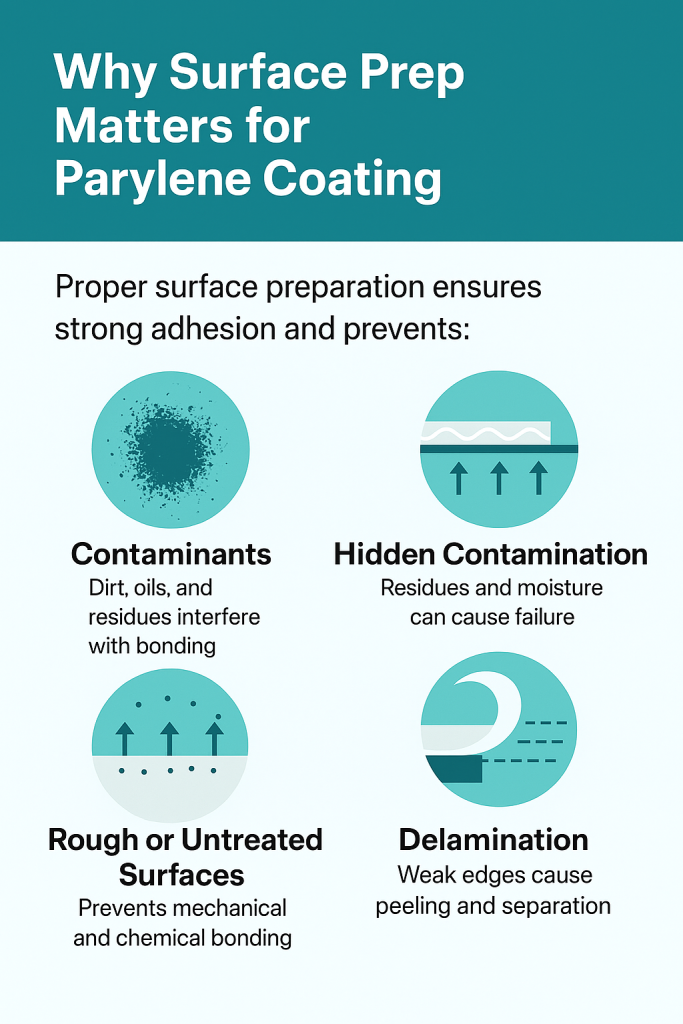
Even the best Parylene coating cannot perform reliably if the surface beneath it is not properly prepared. Adhesion failures, delamination, and reduced barrier performance often trace back to poor Parylene surface preparation. That’s why substrate preparation is one of the most critical steps before Parylene deposition.
Parylene is applied via vapour deposition, forming a thin, uniform layer that reaches every exposed surface. However, if the substrate has contamination, low surface energy, or residues, the Parylene may not bond properly — resulting in peeling, flaking, or reduced adhesion.
Correct preparation helps ensure:
- Strong coating adhesion
- Reliable moisture and chemical protection
- Consistent long-term performance
For a deeper explanation of how vapour deposition works and why surface condition plays such a critical role, see our Parylene deposition process overview.
Cleaning: Removing contaminants
Before applying any adhesion promoter, thorough cleaning thinks about one thing: removing anything that blocks bonding. Residues such as flux, oils, fingerprints, silicone release agents, and dust can prevent Parylene from anchoring properly.
Common cleaning approaches include:
- Solvent cleaning to remove organic residues (oils, greases, certain process residues)
- Ultrasonic cleaning for intricate assemblies and precision components (where suitable)
- Controlled drying to prevent water spots, residue redeposition, or recontamination
Cleaning effectiveness is also a common root cause in adhesion and coverage failures, which we break down further in our Conformal Coating Defects Hub.
Adhesion promoters: Creating reliable bonding sites
Adhesion promoters (often silane-based primers, depending on substrate and process) are used to improve Parylene bonding strength by modifying the surface chemistry. They help create functional bonding sites so the deposited film anchors more reliably.
They are particularly useful on low-surface-energy and difficult substrates such as some plastics, ceramics, and glass, and they can also support consistency across mixed-material assemblies.
By combining effective cleaning with the correct adhesion promoter strategy, manufacturers reduce delamination risk and achieve Parylene coatings that remain stable over the required service life.
SCH Services Ltd: Proven preparation and coating expertise
At SCH Services Ltd, we combine controlled cleaning and adhesion promoter treatments with expert Parylene deposition to deliver coatings that bond reliably across demanding substrates. Because these preparation steps are used in our own coating services, customers benefit from proven, production-ready processes designed for maximum performance.
Learn more: Explore our Parylene Coating Solutions or contact our team to discuss your substrate, environment, and coating thickness requirements.
If you’re assessing whether Parylene is suitable for your application or need support with substrate preparation and validation, our Parylene coating services provide end-to-end process control from preparation through inspection.